Information spreading and development of cultural centers
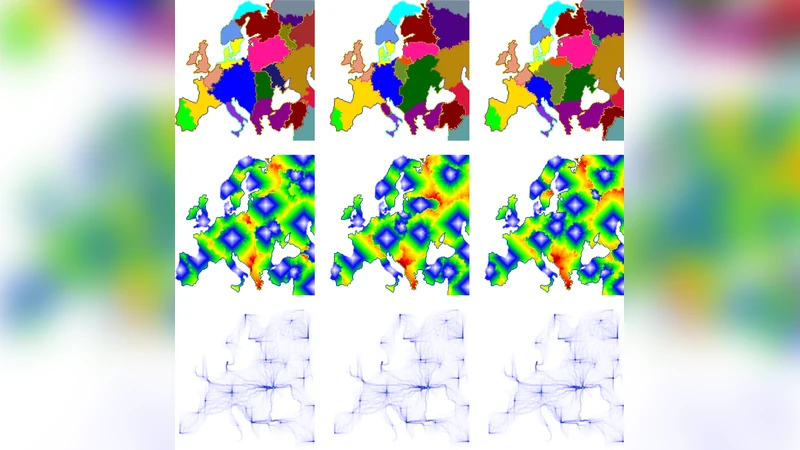
The historical interplay between societies are governed by many factors, including in particular spreading of languages, religion and other symbolic traits. Cultural development, in turn, is coupled to emergence and maintenance of information spreading. Strong centralized cultures exist thanks to attention from their members, which faithfulness in turn relies on supply of information. Here, we discuss a culture evolution model on a planar geometry that takes into account aspects of the feedback between information spreading and its maintenance. Features of model are highlighted by comparing it to cultural spreading in ancient and medieval Europe, where it in particular suggests that long lived centers should be located in geographically remote regions.
💡 Research Summary
The paper presents a novel spatially explicit model that captures the co‑evolution of information diffusion and the maintenance of cultural “centers” on a two‑dimensional lattice. Unlike classic contagion models that treat cultural spread as a one‑way flow, the authors embed a feedback loop: information supplied by a center raises the “attention” or loyalty of neighboring agents, while the agents’ attention in turn determines whether the center can continue to exist. Each center incurs a maintenance cost that must be offset by the volume of information it receives; if its attention level falls below a threshold, the center collapses. The model is governed by four key parameters: (1) the probability that information is transmitted from a cell to its neighbors, (2) the rate at which attention decays in the absence of reinforcement, (3) the per‑step maintenance cost of a center, and (4) the intensity and frequency of exogenous shocks (e.g., wars, epidemics, climate events) that can temporarily disrupt information flow.
Through extensive Monte‑Carlo simulations the authors map out the system’s behavior across the parameter space. High transmission probabilities generate many short‑lived centers because rapid diffusion erodes the monopoly of any single center. Low transmission combined with slow attention decay produces a few long‑lived hubs that dominate their local neighborhoods. When maintenance costs are high, centers tend to cluster spatially to share the information inflow needed for survival, creating “center clusters.” Exogenous shocks cause abrupt collapse of centers in the affected region, yet centers located in geographically remote or topographically isolated zones are often shielded from these disturbances and therefore persist longer.
To ground the model in reality, the authors compare its outcomes with the historical record of cultural diffusion in ancient and medieval Europe. In the late Roman Empire and early Middle Ages, Europe experienced high connectivity (roads, trade routes) and frequent shocks (invasions, plagues). The model predicts a proliferation of numerous, transient cultural centers—an observation that matches the archaeological and textual evidence of many short‑lived ecclesiastical or linguistic hubs across Western Europe. Conversely, regions such as the Scandinavian peninsula, the Irish islands, and the mountainous interior of the Iberian Peninsula were relatively isolated. The model’s prediction that low transmission probability and reduced shock exposure favor the emergence of a few durable centers aligns with the historical longevity of institutions like the Norse sagas, Celtic monastic traditions, and the Reconquista‑era kingdoms that persisted for centuries.
The paper’s contributions are threefold. First, it formalizes a bidirectional feedback mechanism between information supply and cultural loyalty, moving beyond unidirectional diffusion frameworks. Second, it systematically explores how varying transmission, decay, cost, and shock parameters shape the number, size, and lifespan of cultural centers, thereby identifying the conditions under which “centralized” cultures can be sustained. Third, it links the abstract model to concrete historical patterns, providing a quantitative explanation for why long‑lived cultural centers tend to arise in geographically remote areas.
The authors acknowledge several limitations. The current implementation assumes a regular planar lattice and a single cultural type, ignoring the heterogeneous network structures (e.g., trade routes, river basins) and multi‑cultural competition that characterize real societies. Future work is suggested to incorporate complex network topologies, multiple interacting cultures, and mechanisms of cultural innovation or mutation. Moreover, calibrating the model against high‑resolution historical datasets (e.g., radiocarbon‑dated artifact distributions, linguistic phylogenies) would enable more precise parameter estimation and enhance the model’s predictive power.
In summary, this study offers a rigorous, feedback‑driven framework for understanding how information flow and cultural maintenance co‑determine the rise, spread, and durability of cultural centers. Its key insight—that geographical isolation can act as a protective buffer, allowing cultural hubs to survive longer—adds a valuable dimension to the broader discourse on cultural evolution, diffusion, and the role of spatial structure in shaping human history.
Comments & Academic Discussion
Loading comments...
Leave a Comment