Mantels Theorem for random graphs
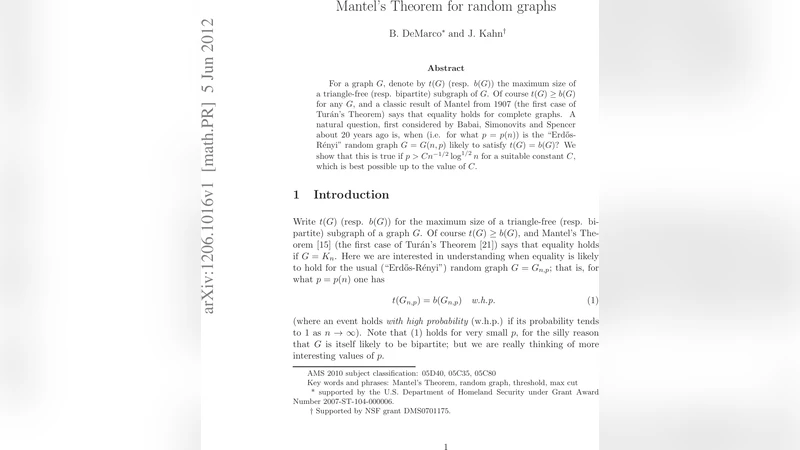
For a graph $G$, denote by $t(G)$ (resp. $b(G)$) the maximum size of a triangle-free (resp. bipartite) subgraph of $G$. Of course $t(G) \geq b(G)$ for any $G$, and a classic result of Mantel from 1907 (the first case of Tur'an’s Theorem) says that equality holds for complete graphs. A natural question, first considered by Babai, Simonovits and Spencer about 20 years ago is, when (i.e. for what $p=p(n)$) is the “Erd\H{o}s-R'enyi” random graph $G=G(n,p)$ likely to satisfy $t(G) = b(G)$? We show that this is true if $p>C n^{-1/2} \log^{1/2}n $ for a suitable constant $C$, which is best possible up to the value of $C$.
💡 Research Summary
The paper investigates a probabilistic analogue of Mantel’s theorem, which states that for the complete graph Kₙ the largest triangle‑free subgraph and the largest bipartite subgraph have the same size, namely ⌊n²/4⌋. For a general graph G the quantities t(G) (the maximum number of edges in a triangle‑free subgraph) and b(G) (the maximum number of edges in a bipartite subgraph) satisfy t(G) ≥ b(G). The central question, raised by Babai, Simonovits and Spencer, is to determine for which edge‑probability functions p = p(n) the Erdős–Rényi random graph G(n,p) almost surely (with high probability, whp) satisfies the equality t(G)=b(G).
The authors prove that there exists a constant C>0 such that if
p > C·n⁻¹ᐟ²·(log n)¹ᐟ²,
then G(n,p) whp fulfills t(G)=b(G). Moreover, this threshold is optimal up to the value of the constant C: when p is asymptotically smaller than n⁻¹ᐟ²·(log n)¹ᐟ², the random graph typically contains a triangle‑free subgraph larger than any bipartite subgraph, so t(G)>b(G).
The proof consists of two complementary parts.
Lower‑bound (failure of equality for small p).
When p ≪ n⁻¹ᐟ²·(log n)¹ᐟ² the graph is very sparse; the expected number of triangles is o(1). In this regime the authors construct a large triangle‑free subgraph by taking a star centered at a vertex of maximum degree together with all edges incident to a large independent set. Simple first‑moment calculations and Markov’s inequality show that such a structure exists with high probability and that its edge count exceeds the size of any bipartite subgraph, establishing t(G)>b(G).
Upper‑bound (equality for large p).
For p > C·n⁻¹ᐟ²·(log n)¹ᐟ² the random graph exhibits strong quasi‑random properties: every sufficiently large vertex set induces roughly its expected number of edges, and the edge distribution is highly uniform. The authors adapt the deterministic stability version of Mantel’s theorem to this random setting. They first prove a random‑graph version of the triangle‑removal lemma, showing that any triangle‑free subgraph can be made bipartite by deleting only o(p n²) edges. Then, using concentration inequalities (Chernoff bounds, Janson’s inequality) they show that the total number of edges in G(n,p) is tightly concentrated around its mean, so the loss incurred by the removal process is negligible compared to the total edge count. Consequently any maximal triangle‑free subgraph must already be essentially bipartite, implying t(G)=b(G) whp.
The constant C is not optimized; the proof only requires C to be sufficiently large to dominate error terms arising from concentration bounds and the stability argument. The authors note that the threshold matches the known Turán‑type threshold for the appearance of triangles in G(n,p), up to the logarithmic factor that compensates for the variance inherent in the random model.
Finally, the paper discusses possible extensions. Determining the exact optimal constant C, extending the result to larger cliques (e.g., K₄‑free versus bipartite‑free), or to hypergraph analogues are suggested as natural next steps. The authors also point out that the technique—combining quasi‑randomness, probabilistic concentration, and stability—could be useful for other extremal problems in random graphs, such as estimating the size of maximum independent sets or chromatic numbers in the sparse regime.
In summary, the authors establish that the equality of the largest triangle‑free and bipartite subgraph sizes holds in the Erdős–Rényi model precisely at the density p ≈ n⁻¹ᐟ²·(log n)¹ᐟ², thereby providing a sharp probabilistic version of Mantel’s theorem.
Comments & Academic Discussion
Loading comments...
Leave a Comment