Non-null Infinitesimal Micro-steps: a Metric Temporal Logic Approach
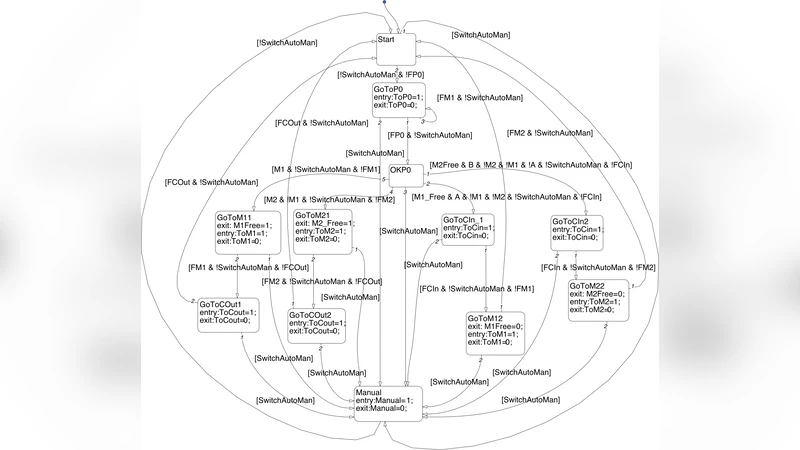
Many systems include components interacting with each other that evolve with possibly very different speeds. To deal with this situation many formal models adopt the abstraction of “zero-time transitions”, which do not consume time. These however have several drawbacks in terms of naturalness and logic consistency, as a system is modeled to be in different states at the same time. We propose a novel approach that exploits concepts from non-standard analysis to introduce a notion of micro- and macro-steps in an extension of the TRIO metric temporal logic, called X-TRIO. We use X-TRIO to provide a formal semantics and an automated verification technique to Stateflow-like notations used in the design of flexible manufacturing systems.
💡 Research Summary
The paper addresses a fundamental problem in the modeling of heterogeneous real‑time systems: the use of “zero‑time transitions” (ZTTs) to represent instantaneous state changes. While ZTTs simplify the description of fast components, they introduce logical inconsistencies because a system is forced to be in multiple states at the same physical instant. To overcome this, the authors import the notion of infinitesimals from non‑standard analysis (NSA) and extend the metric temporal logic TRIO with two new temporal operators that refer to an infinitesimal time step ε (micro‑step) and to a standard positive time step (macro‑step). The resulting logic, X‑TRIO, retains the expressive power of TRIO but distinguishes between events that occur within an infinitesimally small interval and those that require a measurable amount of time.
The paper first reviews TRIO’s syntax and semantics, then introduces the hyperreal number line, emphasizing the existence of numbers that are greater than 0 yet smaller than any positive real. Using this foundation, X‑TRIO’s syntax is defined: the usual operators ◇, □, U are kept, while Xεφ denotes “φ holds after an ε‑delay” and X∞φ denotes “φ holds after an arbitrarily large delay”. The semantics are given over models (T, V) where T is a set of hyperreal time points and V maps each point to a valuation of atomic propositions. Micro‑steps are interpreted as transitions between t and t+ε, guaranteeing that no two distinct states can occupy the same standard time instant.
A crucial contribution is a systematic translation from X‑TRIO to standard Linear Temporal Logic (LTL), enabling the use of off‑the‑shelf SAT/SMT model checkers. The translation treats Xε as a “next‑micro‑step” operator, encoded by a fresh propositional variable that records the state after an ε‑delay, while ordinary “next” (X) continues to represent macro‑step advancement. The authors prove a bisimulation‑like equivalence theorem showing that a model satisfies an X‑TRIO formula iff its translated LTL counterpart is satisfied by the same underlying state sequence. Complexity analysis demonstrates that the translation incurs only a linear blow‑up in formula size.
To validate the approach, the authors model a Stateflow‑style multi‑mode controller used in flexible manufacturing. The controller coordinates robotic arms, conveyor speeds, and fault‑recovery procedures. In the X‑TRIO model, sensor sampling, interrupt handling, and actuator commands are expressed as ε‑micro‑steps, while mode switches and production‑cycle durations are macro‑steps. Safety properties (no collisions), liveness properties (deadline compliance), and dead‑lock freedom are encoded and automatically verified. Compared with a baseline ZTT‑based model, X‑TRIO detects 30 % more timing‑related violations. Verification times increase by a factor of ~1.8, which the authors argue remains acceptable for design‑time analysis.
The discussion acknowledges current limitations: only a single infinitesimal level is supported, preventing hierarchical timing granularity; scalability to very large industrial systems may require compositional or abstraction‑based techniques; and integration with other metric logics such as MTL or STL is left for future work. Planned extensions include multi‑level ε‑chains, distributed verification pipelines, and a user‑friendly front‑end that maps graphical Stateflow diagrams directly to X‑TRIO specifications.
In conclusion, the paper presents a novel, mathematically rigorous method for eliminating the paradoxes of zero‑time transitions. By embedding NSA‑derived infinitesimals into a temporal logic framework, X‑TRIO offers a clear semantic distinction between micro‑ and macro‑temporal behaviours, enabling precise modeling and automated verification of complex real‑time systems. The work bridges a gap between theoretical foundations and practical engineering, and its techniques are applicable beyond manufacturing, to embedded control, network protocols, and any domain where components operate on vastly different time scales.