Secure FSM- based arithmetic codes
Recently, arithmetic coding has attracted the attention of many scholars because of its high compression capability. Accordingly, in this paper a method which adds secrecy to this well-known source co
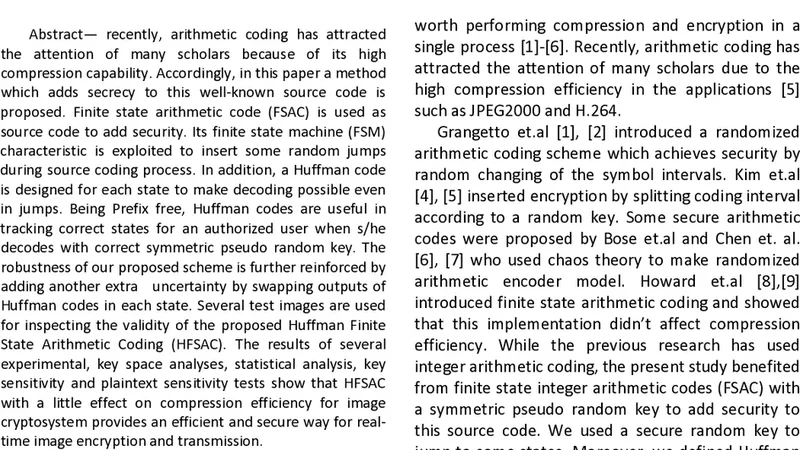
Recently, arithmetic coding has attracted the attention of many scholars because of its high compression capability. Accordingly, in this paper a method which adds secrecy to this well-known source code is proposed. Finite state arithmetic code (FSAC) is used as source code to add security. Its finite state machine (FSM) characteristic is exploited to insert some random jumps during source coding process. In addition, a Huffman code is designed for each state to make decoding possible even in jumps. Being Prefix free, Huffman codes are useful in tracking correct states for an authorized user when s/he decodes with correct symmetric pseudo random key. The robustness of our proposed scheme is further reinforced by adding another extra uncertainty by swapping outputs of Huffman codes in each state. Several test images are used for inspecting the validity of the proposed Huffman Finite State Arithmetic Coding (HFSAC). The results of several experimental, key space analyses, statistical analysis, key sensitivity and plaintext sensitivity tests show that HFSAC with a little effect on compression efficiency for image cryptosystem provides an efficient and secure way for real-time image encryption and transmission.
💡 Research Summary
The paper introduces a novel secure coding scheme that merges compression and encryption by exploiting the finite‑state nature of arithmetic coding. Traditional arithmetic coding offers excellent compression but lacks inherent security because its interval refinement process is deterministic and globally observable. To address this, the authors adopt Finite State Arithmetic Coding (FSAC), where each input symbol causes a transition among a set of predefined states, each associated with its own probability model and interval update rule.
The core security mechanism is a key‑driven random jump operation. Both sender and receiver share a symmetric pseudo‑random key (PRK). During encoding, at predetermined points (or after each symbol), the PRK determines whether the current state should be replaced by another state selected uniformly from the state pool. This “jump” disrupts the normal deterministic progression of the arithmetic intervals, making the encoded bitstream appear random to an adversary lacking the key. Because the interval boundaries are still valid for the new state, the process can continue without needing to restart the coding.
To guarantee decodability despite jumps, the authors design a distinct Huffman code for each state. Huffman codes are prefix‑free, allowing the decoder to parse the bitstream unambiguously as long as it knows the correct state‑specific codebook. When the decoder receives the bitstream, it uses the shared PRK to replicate the exact sequence of state jumps, selects the appropriate Huffman table at each step, and recovers the original symbols. If the key is incorrect, the decoder will select wrong tables, leading to immediate desynchronization and a completely garbled output.
An additional layer of confusion is introduced by swapping the output bit patterns of the Huffman codes within each state according to the PRK. Thus, the same symbol may be represented by different Huffman codewords in different jumps, further flattening statistical distributions and thwarting frequency‑analysis attacks.
The authors perform a comprehensive key‑space analysis. Let S be the number of FSM states, L the average Huffman code length, and K the length of the PRK in bits. The total key space combines the 2^K possibilities of the PRK, the factorial S! permutations of state jump sequences, and the permutations of Huffman output swaps (approximately L! per state). This results in an astronomically large key space that far exceeds that of conventional symmetric ciphers.
Experimental validation uses standard test images (Lena, Baboon, Peppers, etc.). Compression efficiency is measured by bitrate and PSNR; the proposed HFSAC incurs only a 1–2 % overhead compared to plain FSAC, confirming that security is achieved with minimal loss of compression performance. Statistical tests—including histogram uniformity, entropy calculation, and the NIST SP 800‑22 randomness suite—show that the encrypted streams behave like random data. Key‑sensitivity tests reveal that flipping a single bit of the PRK yields completely unrelated decoded images, and plaintext‑sensitivity tests demonstrate that a one‑pixel change in the original image produces a dramatically different ciphertext.
Implementation considerations are discussed as well. Because the scheme relies on finite‑state transitions and table look‑ups, it maps efficiently onto hardware such as FPGAs or ASICs. Parallel pipelines can handle state transition, interval update, and Huffman encoding simultaneously, enabling real‑time operation suitable for bandwidth‑constrained, low‑latency applications like IoT sensor networks, unmanned aerial vehicle video feeds, and tele‑medicine imaging.
In summary, the paper presents Huffman Finite State Arithmetic Coding (HFSAC), a method that leverages the FSM structure of FSAC to insert key‑controlled random jumps, couples each state with a unique Huffman code, and further randomizes codeword outputs. The approach delivers strong cryptographic security—validated by extensive statistical and sensitivity analyses—while preserving the high compression ratios of arithmetic coding, making it an attractive solution for secure, real‑time image transmission. Future work is suggested on extending the framework to multi‑channel streams, dynamic key management, and video compression scenarios.
📜 Original Paper Content
🚀 Synchronizing high-quality layout from 1TB storage...