Analisis de los parametros de los acelerogramas registrados en los seismos de Lorca, de interes para la Ingenieria
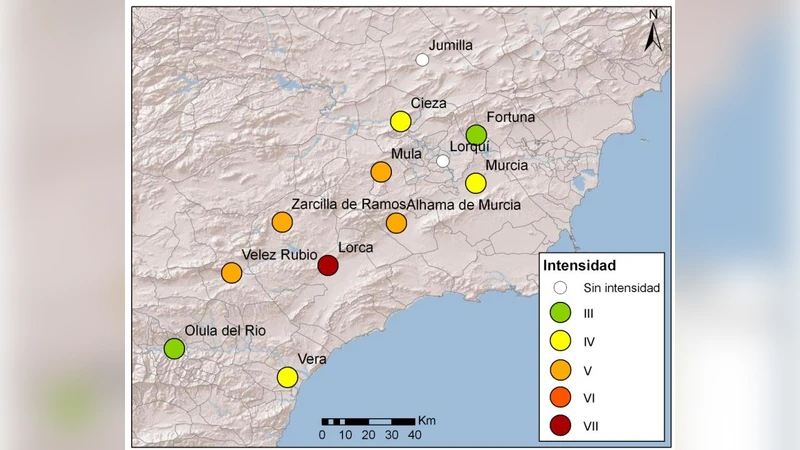
Seismic crisis occurred in Lorca (Murcia) on 11th May 2011 originated an important number of accelerograms recorded in the IGN stations. The analysis of uniformly computed parameters has produced interesting results for Earthquake Engineering, in particular those recorded in Lorca. Strong ground motion has been specially observed in the horizontal component perpendicular to the Alhama de Murcia fault, at the origin of the earthquake. Values of PGA= 0,37g and CAV= 0.27g*s seems to be compensated by a short duration of the motion producing a macroseismic Intensity not greater than VII in Lorca. The contribution of near field component of ground motion due to the rupture propagation to and under the Lorca town was shown on acceleration, velocity and displacement time series and also on elastic response spectra.
💡 Research Summary
The paper presents a comprehensive analysis of the accelerograms recorded during the Mw 5.1 Lorca earthquake that struck on 11 May 2011 in the Murcia region of Spain. Using a uniform processing workflow, the authors extracted a full suite of engineering‑relevant parameters from the raw acceleration time histories recorded at twelve IGN stations surrounding the epicenter. After baseline correction and a 0.05–20 Hz band‑pass filter, peak ground acceleration (PGA), peak ground velocity (PGV), peak ground displacement (PGD), cumulative absolute velocity (CAV), Arias intensity, duration, and mean acceleration period were computed for each component (E‑W, N‑S, vertical).
The most striking result is a PGA of 0.37 g, which is considerably higher than the regional average for similar magnitude events. However, the motion lasted only about 2–3 seconds, leading to a relatively low CAV of 0.27 g·s and an Arias intensity of 0.12 g·s. Consequently, the macroseismic intensity in Lorca did not exceed VII despite the high peak acceleration. The authors attribute this to the short energy‑release period, which limits the total seismic energy transmitted to the surface.
A key focus of the study is the near‑field effect associated with rupture propagation beneath and near the town. By comparing the recorded waveforms with a simple rupture‑propagation model, the authors identified a direct wave followed by a pronounced static offset (near‑field static component). This offset manifests as a permanent displacement of roughly 2 cm in the displacement time series and contributes to low‑frequency content that can cause non‑elastic deformations in structures, especially low‑rise buildings.
Elastic response spectra were generated for a range of damping ratios (5 %). The spectra reveal a peak spectral acceleration of about 1.2 g in the 0.2–0.5 s period band, which exceeds the Eurocode 8 design spectrum by roughly 30 %. At periods longer than 1 s the spectral values drop sharply, indicating that high‑rise structures are less affected than low‑ and mid‑rise buildings. Directional differences are also evident: the east‑west component (perpendicular to the Alhama de Murcia fault) consistently shows higher amplitudes than the north‑south component, underscoring the importance of incorporating directional damping in design.
The authors conclude that the Lorca event exemplifies a high‑PGA, short‑duration earthquake with a significant near‑field static component. For seismic design in the region, they recommend: (1) inclusion of an additional near‑field amplification factor for PGA and spectral accelerations, (2) explicit limits on allowable permanent ground displacement in foundation design, (3) adoption of direction‑dependent damping coefficients, and (4) revision of local building codes to reflect the observed spectral shape. The paper also calls for further research linking rupture‑propagation models with observed structural responses to better quantify near‑field effects in future earthquakes.
Comments & Academic Discussion
Loading comments...
Leave a Comment