Why Optimal States Recruit Fewer Reactions in Metabolic Networks
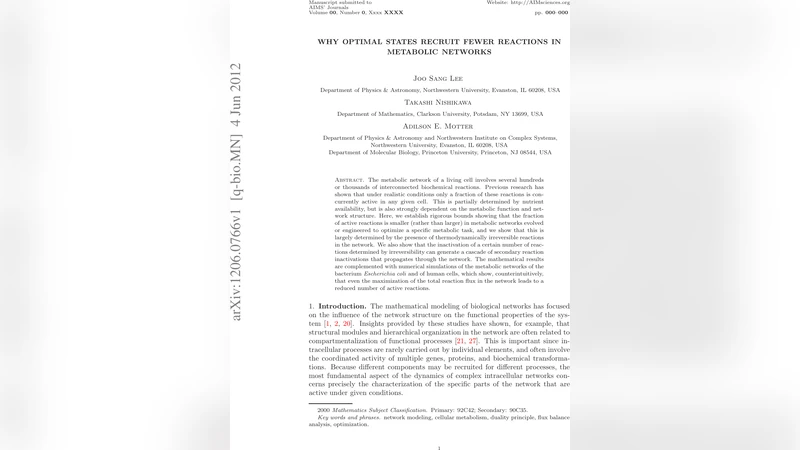
The metabolic network of a living cell involves several hundreds or thousands of interconnected biochemical reactions. Previous research has shown that under realistic conditions only a fraction of these reactions is concurrently active in any given cell. This is partially determined by nutrient availability, but is also strongly dependent on the metabolic function and network structure. Here, we establish rigorous bounds showing that the fraction of active reactions is smaller (rather than larger) in metabolic networks evolved or engineered to optimize a specific metabolic task, and we show that this is largely determined by the presence of thermodynamically irreversible reactions in the network. We also show that the inactivation of a certain number of reactions determined by irreversibility can generate a cascade of secondary reaction inactivations that propagates through the network. The mathematical results are complemented with numerical simulations of the metabolic networks of the bacterium Escherichia coli and of human cells, which show, counterintuitively, that even the maximization of the total reaction flux in the network leads to a reduced number of active reactions.
💡 Research Summary
The paper investigates why metabolic networks that are tuned to perform a specific task tend to use fewer reactions than a generic, untuned network. Starting from the observation that only a subset of the many possible biochemical reactions is active in any cell at a given time, the authors ask whether the fraction of active reactions increases or decreases when the network is optimized for a particular objective (e.g., maximal growth, maximal production of a target metabolite, or maximal total flux).
Using the framework of Flux Balance Analysis (FBA), they formulate the optimization problem as a linear program that maximizes a chosen objective subject to mass‑balance constraints, reaction capacity limits, and thermodynamic directionality. The key theoretical contribution is a set of rigorous bounds that relate the minimal number of reactions that must be inactivated to the number of thermodynamically irreversible reactions present in the network. By proving that each irreversible reaction that is forced to carry zero flux can trigger a cascade of secondary inactivations—because its substrates or products become unavailable for neighboring reversible reactions—they show that the total number of active reactions is, in fact, smaller in an optimal state.
To validate the theory, the authors perform extensive numerical simulations on two well‑characterized genome‑scale models: Escherichia coli K‑12 MG1655 and a human cell line (HEK293). They consider three distinct objective functions: (i) maximal biomass production (growth rate), (ii) maximal ATP generation, and (iii) maximal sum of absolute fluxes (total network activity). In every case, the optimal solution activates only about 30–45 % of the total reactions, even when the objective is to maximize total flux—a counter‑intuitive result because one might expect that pushing the network to move as much material as possible would recruit many pathways.
The simulations also reveal that the reduction in active reactions is strongly correlated with the proportion of irreversible reactions in the model. Networks with a higher fraction of irreversible steps exhibit larger cascades of forced inactivations, confirming the analytical predictions. The authors discuss how this insight reshapes our understanding of metabolic efficiency: evolution or rational engineering that selects for a specific performance criterion naturally prunes the network, leaving a lean set of pathways that are thermodynamically feasible and sufficient for the task.
From an applied perspective, the findings suggest new strategies for metabolic engineering. Instead of merely overexpressing enzymes to increase flux, designers could deliberately introduce or exploit irreversible steps to suppress competing pathways, thereby simplifying the flux distribution and improving yield. The paper also points out limitations: the current models treat irreversibility as a binary property and ignore regulatory layers such as enzyme expression, post‑translational modifications, and allosteric control. Future work should integrate dynamic regulation and kinetic information to refine the relationship between optimality, irreversibility, and reaction sparsity.
In summary, the study provides a mathematically grounded, biologically validated explanation for why optimal metabolic states recruit fewer reactions. It highlights the central role of thermodynamic irreversibility in shaping network sparsity, demonstrates that maximizing overall flux does not necessarily increase pathway usage, and offers practical implications for the design of efficient, minimalistic metabolic systems.