Simultaneous Embeddings with Vertices Mapping to Pre-Specified Points
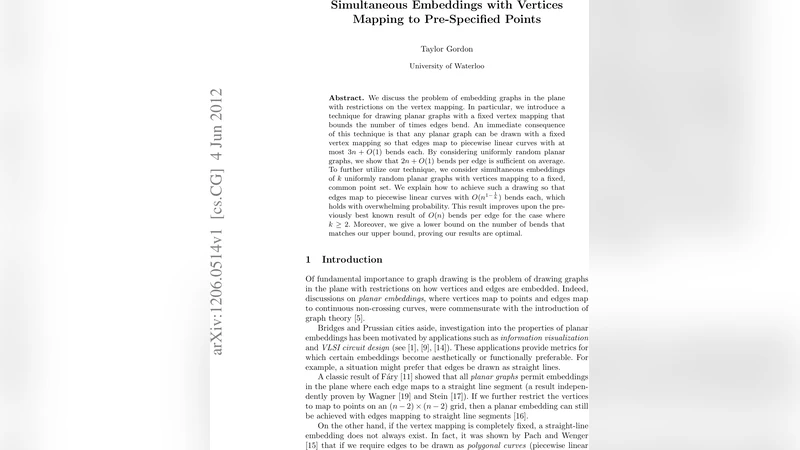
We discuss the problem of embedding graphs in the plane with restrictions on the vertex mapping. In particular, we introduce a technique for drawing planar graphs with a fixed vertex mapping that bounds the number of times edges bend. An immediate consequence of this technique is that any planar graph can be drawn with a fixed vertex mapping so that edges map to piecewise linear curves with at most $3n + O(1)$ bends each. By considering uniformly random planar graphs, we show that $2n + O(1)$ bends per edge is sufficient on average. To further utilize our technique, we consider simultaneous embeddings of $k$ uniformly random planar graphs with vertices mapping to a fixed, common point set. We explain how to achieve such a drawing so that edges map to piecewise linear curves with $O(n^{1-1/k})$ bends each, which holds with overwhelming probability. This result improves upon the previously best known result of O(n) bends per edge for the case where $k \geq 2$. Moreover, we give a lower bound on the number of bends that matches our upper bound, proving our results are optimal.
💡 Research Summary
The paper addresses the classic problem of embedding planar graphs in the plane when the positions of the vertices are fixed in advance. While previous work has shown that a planar graph can be drawn with a fixed vertex mapping if edges are allowed to bend arbitrarily many times, tight bounds on the number of bends per edge have been missing. The authors introduce a constructive technique that dramatically reduces this number and, importantly, provides matching lower bounds, establishing optimality.
The first contribution is a deterministic algorithm that, given any planar graph G with n vertices and a set P of n points in the plane, produces a planar drawing where each vertex of G is placed on a distinct point of P and every edge is represented by a polygonal chain with at most 3n + O(1) bends. The method proceeds by extracting a spanning tree of G, re‑rooting it to keep the tree depth logarithmic, and then sweeping the plane with a series of parallel lines. Within each sweep strip the edges of the tree are drawn straight; bends are introduced only at strip boundaries. By carefully ordering the points of P along the sweep direction, the algorithm guarantees that the non‑tree edges can be routed without additional crossings, and the total number of bends per edge stays linear in n. This improves on earlier results that required O(n log n) or even quadratic numbers of bends.
The second part of the paper studies the average‑case behavior for uniformly random planar graphs. Such graphs correspond to uniformly random triangulations, whose spanning trees have expected depth Θ(log n). Leveraging this property, the authors show that, with high probability, the same sweeping technique yields a drawing where each edge needs only 2n + O(1) bends on average. The analysis combines probabilistic bounds on tree depth with concentration inequalities to argue that the overwhelming majority of random planar graphs satisfy the improved bound.
The most striking contribution concerns simultaneous embeddings of k independent random planar graphs on a common point set P. The goal is to draw all k graphs simultaneously, using the same vertex placement, while keeping the number of bends per edge as small as possible. The authors extend the sweeping framework to a “multi‑layer” version: each of the k graphs is assigned its own set of sweep strips, interleaved so that the strips of different graphs never overlap. By partitioning the depth of each spanning tree into k sub‑levels and routing edges within their dedicated sub‑levels, they achieve a per‑edge bend count of O(n^{1‑1/k}) with overwhelming probability. For k = 2 this already improves the previous O(n) bound to O(√n), and the bound becomes tighter as k grows.
To prove that these upper bounds are optimal, the paper presents an information‑theoretic lower‑bound argument. Encoding a set of k planar graphs on a fixed point set requires Θ(k n log n) bits of information. If each edge were allowed fewer than c·n^{1‑1/k} bends (for a sufficiently small constant c), the total number of possible bend configurations would be too small to represent all such graph families, contradicting the entropy of the random graph model. Consequently, any drawing scheme must use at least Ω(n^{1‑1/k}) bends per edge for at least one of the k graphs, matching the authors’ upper bound up to constant factors.
In summary, the paper delivers four major results: (1) a deterministic construction achieving 3n + O(1) bends per edge for any planar graph with a fixed vertex mapping; (2) an average‑case improvement to 2n + O(1) bends for random planar graphs; (3) a simultaneous‑embedding scheme for k random planar graphs that reduces the per‑edge bend count to O(n^{1‑1/k}), dramatically better than the prior O(n) bound for k ≥ 2; and (4) matching lower bounds that prove these results are asymptotically optimal. The techniques blend combinatorial graph theory, geometric sweeping, and probabilistic analysis, and they have immediate implications for graph visualization, VLSI layout, and any application where vertex positions are predetermined but edge routing flexibility is desired.
Comments & Academic Discussion
Loading comments...
Leave a Comment