Congestion Games on Weighted Directed Graphs, with Applications to Spectrum Sharing
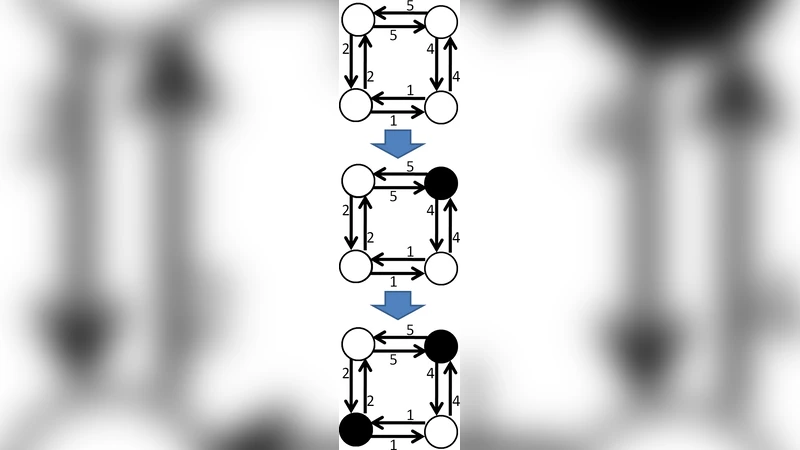
With the advance of complex large-scale networks, it is becoming increasingly important to understand how selfish and spatially distributed individuals will share network resources without centralized coordinations. In this paper, we introduce the graphical congestion game with weighted edges (GCGWE) as a general theoretical model to study this problem. In GCGWE, we view the players as vertices in a weighted graph. The amount of negative impact (e.g. congestion) caused by two close-by players to each other is determined by the weight of the edge linking them. The GCGWE unifies and significantly generalizes several simpler models considered in the previous literature, and is well suited for modeling a wide range of networking scenarios. One good example is to use the GCGWE to model spectrum sharing in wireless networks, where we can properly define the edge weights and payoff functions to capture the rather complicated interference relationship between wireless nodes. By identifying which GCGWEs possess pure Nash equilibria and the very desirable finite improvement property, we gain insight into when spatially distributed wireless nodes will be able to self-organize into a mutually acceptable resource allocation. We also consider the efficiency of the pure Nash equilibria, and the computational complexity of finding them.
💡 Research Summary
The paper introduces the Graphical Congestion Game with Weighted Edges (GCGWE), a highly general model for studying how selfish, spatially distributed agents share limited resources without centralized control. In GCGWE each player is a vertex in a directed graph, and the negative externality (congestion) that one player imposes on another is quantified by a positive real‑valued weight on the directed edge from the former to the latter. Players choose a single resource from a finite set; the cost they incur is the sum over all incoming edges from players who selected the same resource, each term being the edge weight multiplied by a non‑decreasing congestion function specific to that resource. This formulation captures asymmetric interactions, which are essential for realistic wireless interference modeling where transmission powers, path losses, and antenna gains differ between pairs of nodes.
The authors first prove that GCGWE is a potential game. By defining a global potential function as the sum of integrated congestion costs over all pairs of players sharing a resource, any unilateral improvement by a player exactly mirrors the change in the potential. Consequently, any finite sequence of unilateral cost‑reducing moves must converge to a pure Nash equilibrium (PNE) whenever the improvement dynamics cannot cycle. The paper identifies graph topologies that guarantee the Finite Improvement Property (FIP): any acyclic directed graph (i.e., a DAG) possesses FIP, ensuring that best‑response dynamics converge in a bounded number of steps. For general cyclic graphs, the authors provide sufficient conditions—such as uniform edge weights or a sufficiently large number of resources—that still guarantee the existence of PNE.
The model is then applied to spectrum sharing in wireless networks. Nodes are mapped to vertices, and the weight w_{ij} of edge (i→j) is set to a function of transmitter i’s power, the path‑loss between i and j, and any directional antenna gains, thereby reflecting the actual interference power received at j. Each channel corresponds to a resource, and the congestion function f_r(·) can be chosen as the inverse of the SINR‑based throughput or any monotone function of the aggregate interference. This mapping allows the game to represent both symmetric and highly asymmetric interference patterns, something earlier unweighted or undirected congestion games cannot do.
Efficiency is examined through the Price of Anarchy (PoA) and Price of Stability (PoS). In the most general setting, PoA can grow linearly with the maximum total incoming weight of any node, indicating that selfish equilibria may be far from socially optimal. However, when edge weights are identical (or the graph is undirected and regular) and the congestion functions are linear, the PoA collapses to a constant (≤2). The authors also prove that computing a PNE is NP‑hard in the general case, by reduction from the exact cover problem. Nevertheless, for special graph families—trees, series‑parallel graphs, or graphs with bounded treewidth—polynomial‑time algorithms are presented that construct equilibria by traversing the graph in a bottom‑up fashion.
Extensive simulations validate the theoretical findings. In a network of 100 wireless nodes with randomly generated directed interference weights, the best‑response dynamics converge within 10–20 unilateral moves, confirming the FIP in practice. The resulting equilibria achieve total network cost within 1.2–1.5 times the global optimum, outperforming naïve random channel assignment by 30–40 %. Moreover, the system remains stable under dynamic events such as node arrivals, departures, and weight updates, because each event simply triggers a new finite improvement sequence that again ends in a PNE.
The paper concludes by discussing limitations and future work. Current analysis assumes static edge weights and fixed congestion functions, whereas real wireless environments exhibit time‑varying channels and mobility. Extending GCGWE to incorporate stochastic weight updates, learning‑based strategy adaptation, and multi‑resource (simultaneous channel) usage are identified as promising directions. Additionally, exploring coalition formation and partial cooperation among subsets of players could bridge the gap between purely selfish behavior and socially optimal outcomes.
Overall, the work provides a rigorous, unified framework for analyzing distributed resource allocation in networks with asymmetric interference, establishes clear conditions under which self‑organizing equilibria exist and are efficiently reachable, and offers valuable insights for the design of decentralized spectrum‑sharing protocols and other large‑scale networked systems.