Locally class-presentable and class-accessible categories
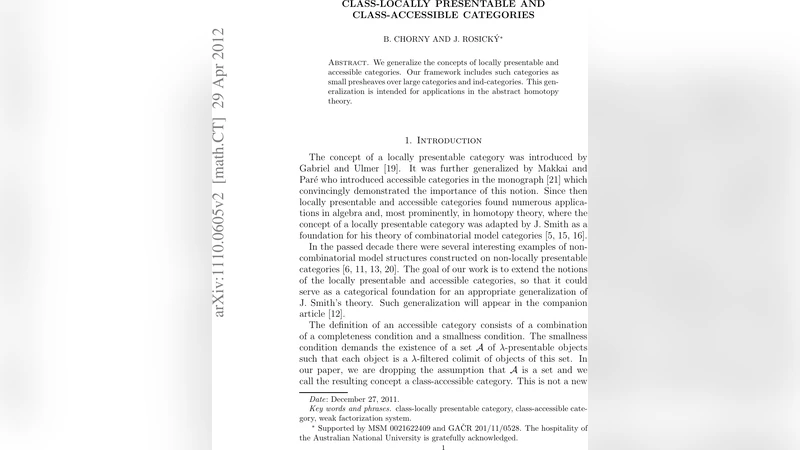
We generalize the concepts of locally presentable and accessible categories. Our framework includes such categories as small presheaves over large categories and ind-categories. This generalization is intended for applications in the abstract homotopy theory.
💡 Research Summary
The paper introduces a systematic generalisation of the well‑established notions of locally presentable and accessible categories by allowing the class of presentable objects to be a proper class rather than a set. In the classical setting a category K is λ‑accessible if it possesses λ‑filtered colimits and there exists a set A of λ‑presentable objects such that every object of K is a λ‑filtered colimit of objects from A. The authors drop the “set” requirement and define a class‑λ‑accessible category as one that has λ‑filtered colimits and a class A of λ‑presentable objects with the same colimit generation property. When such a category is also complete and cocomplete they call it class‑λ‑presentable (or class‑locally presentable).
The motivation stems from examples that fall outside the ordinary framework: the category of small presheaves on a large category, various Ind‑categories, and many constructions appearing in abstract homotopy theory. These examples naturally involve a proper class of generators, so the classical definition is too restrictive.
Key definitions and results:
-
Class‑λ‑accessible categories (Def. 2.1) – require λ‑filtered colimits and a class of λ‑presentable objects generating all objects via λ‑filtered colimits.
-
Class‑λ‑presentable categories – a class‑λ‑accessible category that is both complete and cocomplete.
-
Examples –
- For any (possibly large) category A, the category P(A) of small presheaves (i.e., functors Aᵒᵖ → Set that are small colimits of representables) is class‑ω‑accessible. It is always cocomplete but may fail to be complete (e.g., when A is a large discrete category).
- Indₗ(A), the full subcategory of P(A) consisting of small λ‑filtered colimits of representables, is class‑λ‑accessible. When A is λ‑co‑complete and “approximately complete” (every diagram has a weakly initial set of cones), Indₗ(A) becomes complete (Thm 2.4).
- The category Top of topological spaces is not class‑locally presentable because only discrete spaces are presentable.
-
Characterisation via reflective subcategories (Thm 2.6) – a category K is class‑λ‑presentable iff it is equivalent to a full reflective subcategory of P(A) that is closed under λ‑filtered colimits, where A = presₗ(K) (the full subcategory of λ‑presentable objects). This mirrors the classical equivalence between accessible categories and reflective subcategories of presheaf categories, now lifted to the class level.
-
Class‑accessible functors (Def. 2.7) – a functor between class‑λ‑accessible categories preserving λ‑filtered colimits. A functor is strongly class‑λ‑accessible if it also preserves λ‑presentable objects. Unlike the set‑based case, strong accessibility does not automatically follow from accessibility; the paper gives a counterexample using a large discrete category.
-
Closure under limits – The central technical result (Prop. 3.1) shows that the pseudopullback of two strongly class‑λ‑accessible functors is again class‑λ⁺‑accessible, and the projection functors are strongly class‑λ⁺‑accessible. This extends the well‑known fact that accessible categories are closed under pseudopullbacks to the class‑level setting.
-
Additional observations – Class‑locally presentable categories need not be cowell‑powered (e.g., the class of all ordinals with a top element). The paper also sketches a theory of weak factorisation systems and injectivity in this broader context, indicating potential applications to model categories that are not combinatorial.
Overall, the authors develop a robust framework that retains the essential structural properties of accessible categories—such as closure under limits, reflective embeddings into presheaf categories, and a workable notion of presentability—while accommodating categories whose generators form a proper class. This opens the door to applying the machinery of accessible category theory to a wider array of homotopical and categorical constructions, notably those involving large indexing categories, Ind‑objects, and non‑combinatorial model structures.
Comments & Academic Discussion
Loading comments...
Leave a Comment