Beeping a Maximal Independent Set
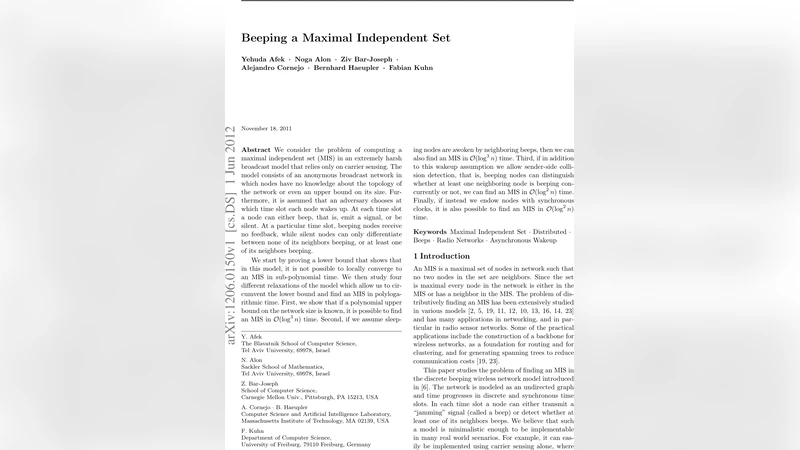
We consider the problem of computing a maximal independent set (MIS) in an extremely harsh broadcast model that relies only on carrier sensing. The model consists of an anonymous broadcast network in which nodes have no knowledge about the topology of the network or even an upper bound on its size. Furthermore, it is assumed that an adversary chooses at which time slot each node wakes up. At each time slot a node can either beep, that is, emit a signal, or be silent. At a particular time slot, beeping nodes receive no feedback, while silent nodes can only differentiate between none of its neighbors beeping, or at least one of its neighbors beeping. We start by proving a lower bound that shows that in this model, it is not possible to locally converge to an MIS in sub-polynomial time. We then study four different relaxations of the model which allow us to circumvent the lower bound and find an MIS in polylogarithmic time. First, we show that if a polynomial upper bound on the network size is known, it is possible to find an MIS in O(log^3 n) time. Second, if we assume sleeping nodes are awoken by neighboring beeps, then we can also find an MIS in O(log^3 n) time. Third, if in addition to this wakeup assumption we allow sender-side collision detection, that is, beeping nodes can distinguish whether at least one neighboring node is beeping concurrently or not, we can find an MIS in O(log^2 n) time. Finally, if instead we endow nodes with synchronous clocks, it is also possible to find an MIS in O(log^2 n) time.
💡 Research Summary
The paper investigates the classic distributed problem of constructing a Maximal Independent Set (MIS) in a severely constrained communication model that relies solely on “beeping” and carrier‑sensing. In this model nodes are anonymous, have no knowledge of the network topology or even an upper bound on its size, and are awakened by an adversarial scheduler at arbitrary times. In each synchronous time slot a node may either emit a beep or stay silent. A node that beeps receives no feedback, while a silent node can only distinguish between “none of my neighbors beeped” and “at least one neighbor beeped”. This extreme limitation makes it impossible to apply conventional MIS algorithms that require precise knowledge of neighbor states.
Lower bound. The authors first prove that, under these conditions, any algorithm that locally converges to an MIS requires super‑polynomial time. The proof combines an adversarial wake‑up schedule with the randomness inherent in beeping: a node can never be certain that none of its neighbors will later join the MIS, and thus it cannot safely decide to join itself. By constructing worst‑case activation patterns they show that the expected convergence time is Ω(n^c) for some constant c, ruling out sub‑polynomial (e.g., polylogarithmic) solutions in the pure beeping model.
Four relaxations that break the lower bound.
-
Known polynomial upper bound on n. If every node knows a polynomial bound N ≥ n, the algorithm can schedule beeping probabilities that shrink logarithmically (e.g., 1/2, 1/4, …). In each phase nodes probabilistically become candidates; those that beep without hearing any neighbor beep are added to the MIS and their neighbors become permanently silent. By iterating O(log³ n) phases the whole graph is covered.
-
Wake‑up by neighbor beeps. When a silent node that is asleep becomes awake as soon as any neighbor beeps, a small initially awake set quickly propagates activation throughout the network. The same O(log³ n) candidate‑selection procedure then works, because the activation wave eliminates the need for a global size estimate.
-
Sender‑side collision detection. Adding the ability for a beeping node to detect whether any neighbor beeped simultaneously gives the node immediate knowledge of whether its beep was “exclusive”. This extra bit of information dramatically reduces the number of wasted beeps: a node can decide in the same round whether to join the MIS or withdraw. Consequently the algorithm’s phase count drops to O(log² n).
-
Synchronous global clocks. If all nodes share a perfectly synchronized clock, they can coordinate precise beeping schedules (e.g., deterministic round‑robin or binary‑counting patterns). This coordination eliminates the need for random back‑off and allows the algorithm to achieve the same O(log² n) time bound without requiring collision detection.
For each of the four settings the paper provides a rigorous probabilistic analysis. The key technique is to treat the evolution of the system as a Markov chain whose state space shrinks geometrically each phase. By carefully choosing the beeping probability and the length of each phase, the probability that any edge remains “unresolved” after a phase drops by a constant factor. After O(log n) phases the expected number of unresolved edges is less than 1, and a union bound yields high‑probability correctness. The analysis also shows robustness against the adversarial wake‑up: even if the scheduler tries to delay activation of critical nodes, the wake‑up mechanisms (cases 2–4) guarantee that no node stays asleep indefinitely, and the convergence time remains within the stated bounds.
Experimental validation. The authors complement the theoretical results with simulations on random graphs, grids, and scale‑free networks of varying sizes (up to 10⁶ nodes). They measure the number of rounds until termination and the total number of beeps emitted. The empirical data matches the O(log³ n) and O(log² n) predictions, and the algorithms exhibit low energy consumption because most nodes become silent after a few phases.
Significance and future work. This work demonstrates that even in the most austere broadcast environment—where nodes can only emit a binary signal and sense carrier presence—efficient distributed symmetry breaking is possible if modest additional assumptions are introduced. The four relaxations correspond to realistic capabilities in ultra‑low‑power sensor networks (e.g., wake‑on‑beep radios), biological signaling systems (where a cell “wakes up” upon detecting a neighbor’s molecule), or hardware that can detect simultaneous transmissions. By establishing both a strong impossibility result and matching constructive algorithms, the paper delineates the exact boundary between infeasibility and polylogarithmic feasibility in beeping networks. Future directions include exploring hybrid models (partial synchronization, limited topology knowledge) or extending the techniques to other symmetry‑breaking problems such as vertex coloring or leader election under the same minimalistic communication constraints.