Convergence and Perturbation Resilience of Dynamic String-Averaging Projection Methods
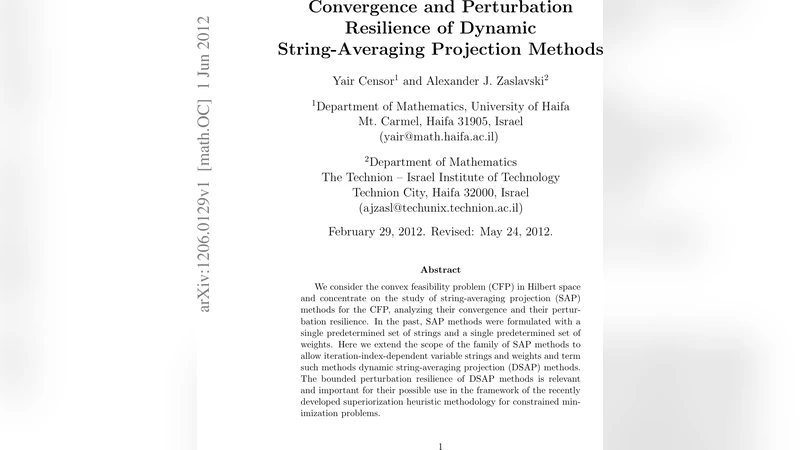
We consider the convex feasibility problem (CFP) in Hilbert space and concentrate on the study of string-averaging projection (SAP) methods for the CFP, analyzing their convergence and their perturbation resilience. In the past, SAP methods were formulated with a single predetermined set of strings and a single predetermined set of weights. Here we extend the scope of the family of SAP methods to allow iteration-index-dependent variable strings and weights and term such methods dynamic string-averaging projection (DSAP) methods. The bounded perturbation resilience of DSAP methods is relevant and important for their possible use in the framework of the recently developed superiorization heuristic methodology for constrained minimization problems.
💡 Research Summary
The paper addresses the convex feasibility problem (CFP) in a Hilbert space and develops a flexible extension of the string‑averaging projection (SAP) methodology, called dynamic string‑averaging projection (DSAP). Traditional SAP algorithms rely on a single, fixed collection of strings (ordered sequences of projection operators) and a fixed set of positive weights that sum to one. While this static framework simplifies analysis, it limits adaptability in large‑scale or time‑varying applications where the set of constraints, computational resources, or external perturbations may change from iteration to iteration.
DSAP removes this rigidity by allowing both the strings and their associated weights to depend on the iteration index. At iteration (n) a possibly different family of strings (S^{(n)}={I^{(n)}1,\dots ,I^{(n)}{m_n}}) and a weight vector (\omega^{(n)}=(\omega^{(n)}1,\dots ,\omega^{(n)}{m_n})) with (\omega^{(n)}_k>0) and (\sum_k\omega^{(n)}_k=1) are chosen. Each string (I^{(n)}k) specifies a finite ordered list of projection operators onto the individual constraint sets, and the composite operator (P{I^{(n)}_k}) is the successive application of those projections. The next iterate is then a weighted average of the results of all strings: \
Comments & Academic Discussion
Loading comments...
Leave a Comment