Turing degrees of multidimensional SFTs
In this paper we are interested in computability aspects of subshifts and in particular Turing degrees of 2-dimensional SFTs (i.e. tilings). To be more precise, we prove that given any \pizu subset $P$ of ${0,1}^\NN$ there is a SFT $X$ such that $P\times\ZZ^2$ is recursively homeomorphic to $X\setminus U$ where $U$ is a computable set of points. As a consequence, if $P$ contains a recursive member, $P$ and $X$ have the exact same set of Turing degrees. On the other hand, we prove that if $X$ contains only non-recursive members, some of its members always have different but comparable degrees. This gives a fairly complete study of Turing degrees of SFTs.
💡 Research Summary
The paper investigates the computational complexity of configurations in two‑dimensional subshifts of finite type (SFTs), also known as tilings, by analysing their Turing degrees. The authors bridge the gap between Π⁰₁ classes—effectively closed subsets of {0,1}^ℕ—and SFTs, showing that the degree structure of an SFT can be made to mirror that of any given Π⁰₁ class, under natural conditions.
The first major result is a constructive reduction from an arbitrary Π⁰₁ class P to an origin‑constrained SFT X. Using a standard encoding of Turing machines as Wang tiles, the authors force a specific tile at the origin; any tiling that respects this constraint encodes a computation of the machine that decides membership in P. Consequently, the set of tilings with the prescribed origin tile is recursively homeomorphic to P. This extends earlier work by Hanf and Simpson, which only guaranteed a Medvedev‑degree correspondence.
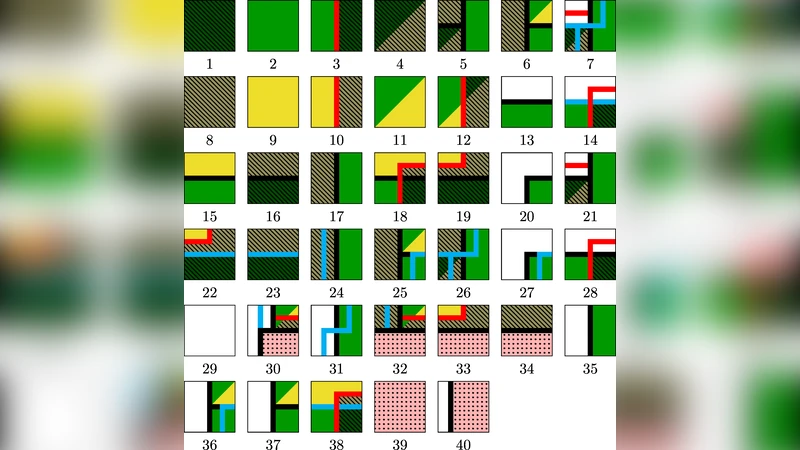
The second, more technical contribution is the design of a “sparse grid” tileset T. This tileset produces a planar pattern consisting of increasingly large squares arranged in a grid, but with the crucial property that the overall SFT is countable and has Cantor‑Bendixson rank 1 (apart from a single non‑isolated configuration). Outside the grid, any configuration contains at most one intersection of black lines, which prevents the emergence of unintended computations. Inside the grid, the authors embed the space‑time diagram of a chosen Turing machine along a diagonal, using the grid’s rows and columns as time and tape axes. The construction guarantees that only configurations that contain the full grid can host a non‑trivial computation; all other configurations are essentially static and computable.
With this machinery, the authors prove two complementary theorems about Turing degrees:
-
Presence of a computable point. If the Π⁰₁ class P contains at least one computable element, then the associated SFT X (obtained by combining the sparse‑grid tileset with the origin‑constrained encoding) has exactly the same set of Turing degrees as P, plus the degree of the computable points that arise from the trivial tilings. In other words, every degree realized in P is realized in X, and no new non‑computable degrees appear.
-
Absence of computable points. If P (and hence any SFT constructed from it) contains no computable members, then X must contain points of distinct Turing degrees that are nevertheless comparable under ≤ₜ. This phenomenon does not occur for arbitrary Π⁰₁ classes—there exist Π⁰₁ classes where no two members have comparable degrees. The paper shows that any non‑computable SFT inevitably exhibits this “degree comparability” property.
An immediate corollary is that every countable Π⁰₁ class (which always contains a computable element) yields a countable SFT with exactly the same degree spectrum. Thus the degree structure of countable tiling sets is completely characterized by the degree structures of countable Π⁰₁ classes.
Overall, the work provides a comprehensive picture of how Turing degrees manifest in two‑dimensional SFTs. It refines earlier Medvedev‑degree results to the finer notion of Turing degrees, introduces a novel sparse‑grid construction to control unwanted computations, and distinguishes between SFTs that admit computable configurations and those that do not. The findings deepen the connection between symbolic dynamics and recursion theory, showing that tilings can faithfully represent any effectively closed set’s degree spectrum while also exhibiting intrinsic degree‑comparability constraints when computable points are absent.
Comments & Academic Discussion
Loading comments...
Leave a Comment