Isomorphisms between groups of equivariant homeomorphisms of $G$-manifolds with one orbit type
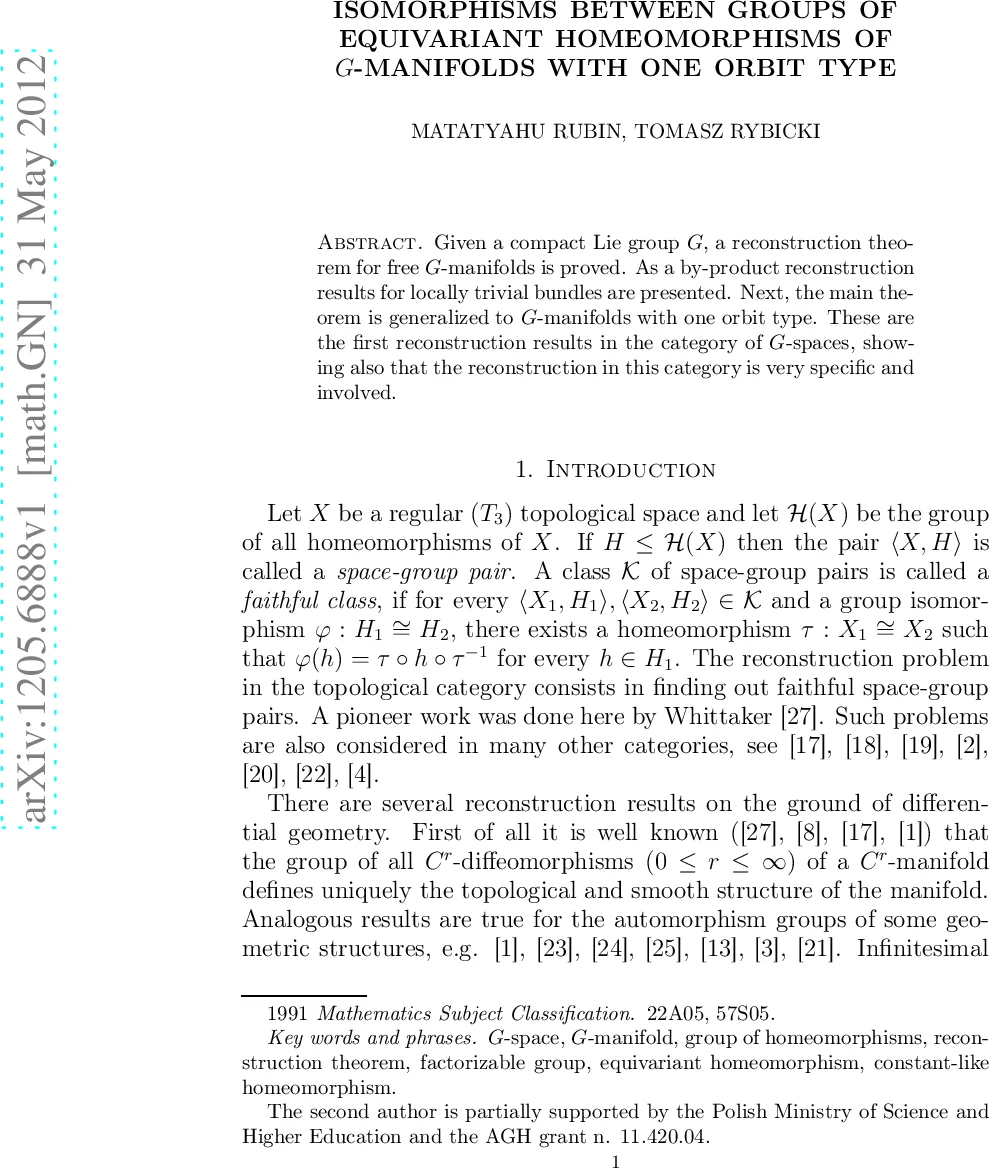
Given a compact Lie group $G$, a reconstruction theorem for free $G$-manifolds is proved. As a by-product reconstruction results for locally trivial bundles are presented. Next, the main theorem is generalized to $G$-manifolds with one orbit type. These are the first reconstruction results in the category of $G$-spaces, showing also that the reconstruction in this category is very specific and involved.
💡 Research Summary
The paper establishes reconstruction theorems for groups of equivariant homeomorphisms on G‑manifolds, first in the free‑action case and then for manifolds with a single orbit type. Let G be a compact Lie group acting on a topological (or smooth) manifold M. The group H_G(M)_0 consists of all G‑equivariant homeomorphisms that are isotopic to the identity through compactly supported, G‑equivariant isotopies. The central question is whether an abstract group isomorphism Φ : H_G(M)_0 → H_G(N)_0 determines a homeomorphism between the underlying G‑spaces M and N.
The authors build on Rubin’s reconstruction theory for “local movement systems”. A group H ≤ Homeo(X) is called factorizable if, for any open cover, the subgroup of elements supported in each open set generates H; it is non‑fixing if no point is fixed by the whole group; and it is transversally locally moving if, after projecting to the base of a bundle, the induced group on the base satisfies the same properties. They show that if two locally trivial bundles π_i : X_i → B_i (with the same fibre) have projectable homeomorphism groups H(X_i) that are factorizable, non‑fixing and transversally locally moving, then any group isomorphism between H(X_1) and H(X_2) induces a unique Boolean‑algebra isomorphism between the regular open algebras Ro(B_1) and Ro(B_2). Under additional hypotheses (e.g., the projected groups are also factorizable and non‑fixing, or are transversally LDC), this Boolean isomorphism lifts to a genuine homeomorphism τ : B_1 → B_2 satisfying Φ(f) = τ ∘ ˜f ∘ τ⁻¹ for all f ∈ H(X_1), where ˜f denotes the induced homeomorphism on the base.
Applying this framework to free G‑manifolds, the authors first verify that H_G(M)_0 satisfies the three transversal conditions. A crucial ingredient is the perfectness of H_G(M)_0 (proved in earlier work by the second author), which guarantees the fragmentation property needed for transversally locally moving groups. Consequently, Theorem 1.2 states that an abstract isomorphism Φ : H_G(M)_0 → H_G(N)_0 yields:
- A homeomorphism τ : B_M → B_N such that Φ(f) = τ ∘ ˜f ∘ τ⁻¹ for all f.
- A continuous map (\barΦ : B_M → Aut(G)) describing how the fibre‑wise G‑action is twisted.
- For each open set U ⊂ B_M, explicit isomorphisms between the section group Sect(π⁻¹(U)) and the gauge group Gau(π⁻¹(U)), together with a fibre‑wise homeomorphism σ_U induced by (\barΦ), so that Φ acts on gauge transformations via conjugation by σ_U.
When the bundles are globally trivial (M = B_M × G, N = B_N × G), Corollary 1.3 simplifies the picture: the isomorphism Φ is realized by a base homeomorphism τ and a fibre homeomorphism σ that is fibrewise over τ.
The final part of the paper extends the result to G‑manifolds with a single orbit type. Here every isotropy subgroup is conjugate to a fixed closed subgroup H ≤ G, so the orbit space B_M is again a manifold and the bundle has fibre G/H. The same three transversal properties hold for H_G(M)_0, again thanks to its perfectness. Theorem 5.1 shows that any group isomorphism between the corresponding equivariant homeomorphism groups still determines a base homeomorphism τ and a continuous twisting map (\barΦ : B_M → Aut(G)), together with the same local description on sections and gauge transformations.
The authors note that the method does not directly extend to C^r diffeomorphism groups because a key lemma (Lemma 3.8(2)) fails in the smooth category; new techniques would be required. They also remark that reconstruction from the gauge group alone is unlikely, emphasizing the essential role of the full equivariant homeomorphism group.
In summary, the paper provides the first reconstruction theorems in the category of G‑spaces, showing that the abstract algebraic structure of equivariant homeomorphism groups completely encodes both the base manifold and the fibre action, provided the groups satisfy factorizability, non‑fixing, and transversal local movement. This bridges group‑theoretic data with geometric structure in equivariant topology and opens avenues for further work in smoother categories and in understanding the minimal data needed for reconstruction.
Comments & Academic Discussion
Loading comments...
Leave a Comment