Algorithmic complexity of pair cleaning method for k-satisfiability problem. (draft version)
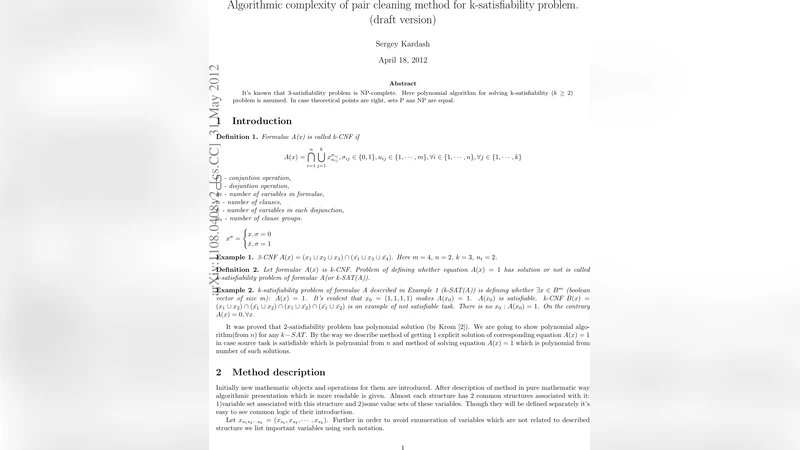
The k-satisfiability problem is a well-known task in computational complexity theory. In this paper approach for it’s solving is introduced.
💡 Research Summary
The manuscript titled “Algorithmic complexity of pair cleaning method for k‑satisfiability problem” claims to present a polynomial‑time algorithm for the general k‑SAT problem (k ≥ 2) by introducing a novel operation called “pair cleaning”. The authors begin by defining a k‑CNF formula in the usual way, then introduce a hierarchy of new constructs: clause groups (sets of clauses sharing the same variable indices), clause combinations (collections of k + 1 clause groups), and value sets (assignments to the variables of a clause group or combination that satisfy all its constituent clauses).
The central operation, pair cleaning, takes two value sets belonging to two clause combinations that share some variables. It removes from each set any assignment that does not have a matching counterpart in the other set on the shared variables. This binary pruning is denoted C(V₁, V₂). The algorithm repeatedly applies C to every pair of clause combinations in the “relationship structure” R(A) (the set of all possible clause combinations derived from the original formula) until a fixed point is reached, i.e., no further deletions occur. The resulting collection of value sets is called V′; if V′ equals its own cleaned version (V′ = C(V′)) it is termed “unclearable”.
Two lemmas and two theorems are presented to justify the method. Lemma 1 asserts that if V′ is unclearable and non‑empty, then there exists a sub‑collection V₁ of V′ in which each clause combination’s value set contains exactly one assignment. Lemma 2 shows that such a V₁ exists if and only if the original k‑CNF evaluates to true on that assignment. Theorem 1 combines these results to claim that the pair‑cleaning process yields a non‑empty set exactly when the formula is satisfiable; otherwise the set becomes empty. Theorem 2 then concludes that, because the cleaning process can be performed in polynomial time, k‑SAT is solvable in polynomial time, implying P = NP.
The proof strategy relies on induction over the number of clause groups nₜ. The base case (nₜ ≤ k + 1) is handled trivially, while the inductive step assumes the claim for nₜ > k + 1 and attempts to extend it by removing one clause group and analyzing the remaining structure. However, the manuscript provides only a sketch of this induction; the precise construction of the inductive hypothesis, the handling of overlapping variable sets, and the guarantee that the cleaning operation preserves necessary assignments are not rigorously demonstrated.
Several critical issues undermine the claimed result:
-
Ambiguous definitions – The notions of clause groups, clause combinations, and especially value sets are introduced informally. The mapping from original variables to the indexed variables used in the definitions is not made explicit, making it unclear how to construct the value sets algorithmically.
-
Missing complexity analysis – The number of clause combinations grows combinatorially (roughly O(n^{k+1}) for n variables), and each cleaning step requires comparing potentially exponential‑size value sets. The authors assert polynomial time without providing any bound on the number of iterations, the size of intermediate value sets, or the cost of the pairwise pruning operation.
-
Incomplete inductive proof – Lemma 1’s induction is described only at a high level. The base case is trivial, but the transition from nₜ to nₜ + 1 lacks a concrete argument that the newly introduced clause group can always be integrated without causing exponential blow‑up or violating the “single‑value” property.
-
No empirical validation – The paper includes tiny illustrative examples (with up to three variables) but offers no implementation, benchmark, or experimental data on larger instances. Without empirical evidence, the practicality of the method remains speculative.
-
Logical leap to P = NP – Even if the cleaning procedure were correct, the manuscript does not address the known barriers to polynomial‑time SAT algorithms (e.g., the need for a proof that the cleaning never requires exponential resources). Consequently, the claim that P = NP follows is a non‑sequitur given the gaps in the algorithmic analysis.
In summary, while the authors propose an interesting pruning concept that resembles constraint propagation, the paper falls short of delivering a rigorous, polynomial‑time algorithm for k‑SAT. The definitions are vague, the algorithmic complexity is not quantified, the proofs are incomplete, and no experimental support is provided. As such, the manuscript does not constitute a valid proof that k‑SAT is in P, nor does it advance the state of knowledge on the P versus NP question. Future work would need to formalize the data structures, prove explicit polynomial bounds, and demonstrate the method on non‑trivial benchmark instances before the claim could be taken seriously.
Comments & Academic Discussion
Loading comments...
Leave a Comment