A model for stable interfacial crack growth
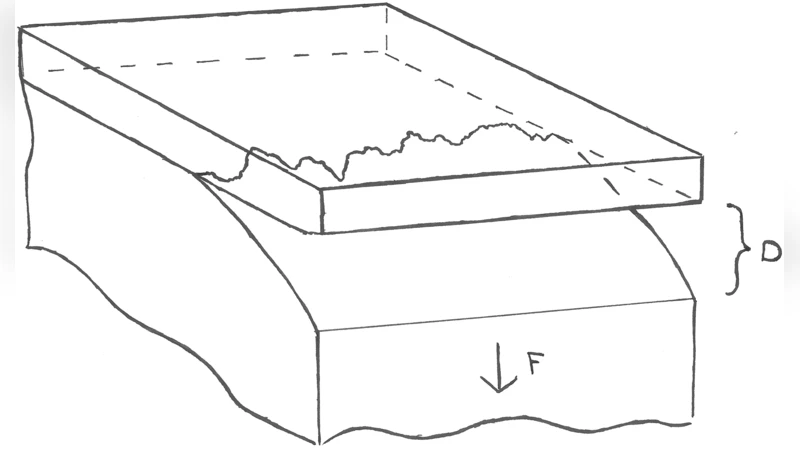
We present a model for stable crack growth in a constrained geometry. The morphology of such cracks show scaling properties consistent with self affinity. Recent experiments show that there are two distinct self-affine regimes, one on small scales whereas the other at large scales. It is believed that two different physical mechanisms are responsible for this. The model we introduce aims to investigate the two mechanisms in a single system. We do find two distinct scaling regimes in the model.
💡 Research Summary
The paper introduces a computational model that captures the stable growth of interfacial cracks in a confined geometry, a situation commonly encountered in thin films, layered composites, and other constrained structures. Experimental observations over the past decade have revealed that the morphology of such cracks is self‑affine but exhibits two distinct scaling regimes: at small length scales the roughness exponent ζ is close to the value predicted by the Kardar‑Parisi‑Zhang (KPZ) universality class (≈0.63), while at larger scales the exponent rises to ≈0.8–0.85. The prevailing interpretation is that two different physical mechanisms dominate in the respective regimes—local disorder (micro‑defects) at short scales and long‑range elastic interactions at long scales. Existing theoretical work typically treats these mechanisms separately, requiring two distinct models to explain the crossover.
To address this gap, the authors construct a lattice‑based model on a two‑dimensional square grid. Each lattice site is assigned a random fracture threshold drawn from a distribution with standard deviation σ, representing the spatial heterogeneity of material strength. An external load is increased quasistatically; whenever the stress on a site at the crack front exceeds its threshold, the site fails and the crack advances. The novelty lies in the stress redistribution rule: instead of the usual nearest‑neighbour Laplacian kernel, the model employs a power‑law kernel that decays as r^(-α) with distance r. This non‑local kernel mimics the long‑range elastic coupling that is known to be present in thin‑film geometries, where the deformation of the substrate can affect distant points along the crack front.
The authors systematically explore the parameter space defined by σ (disorder strength) and α (range of elastic interaction). They compute the height‑height correlation function S(l)=⟨