Thermal Evolution of Neutron Stars in 2 Dimensions
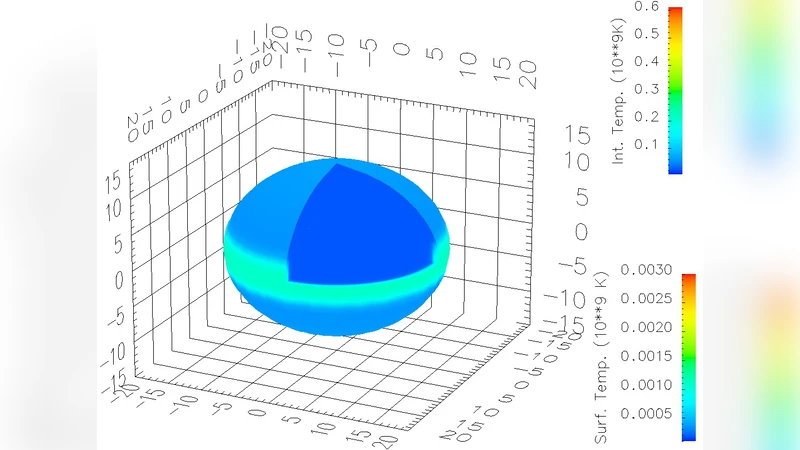
There are many factors that contribute to the breaking of the spherical symmetry of a neutron star. Most notably is rotation, magnetic fields, and/or accretion of matter from companion stars. All these phenomena influence the macroscopic structures of neutron stars, but also impact their microscopic compositions. The purpose of this paper is to investigate the cooling of rotationally deformed, two-dimensional (2D) neutron stars in the framework of general relativity theory, with the ultimate goal of better understand the impact of 2D effects on the thermal evolution of such objects. The equations that govern the thermal evolution of rotating neutron stars are presented in this paper. The cooling of neutron stars with different frequencies is computed self-consistently by combining a fully general relativistic 2D rotation code with a general relativistic 2D cooling code. We show that rotation can significantly influence the thermal evolution of rotating neutron stars. Among the major new aspects are the appearances of hot spots on the poles, and an increase of the thermal coupling times between the core and the crust of rotating neutron stars. We show that this increase is independent of the microscopic properties of the stellar core, but depends only on the frequency of the star.
💡 Research Summary
This paper presents a comprehensive study of the thermal evolution of rotating, deformed neutron stars within a fully general‑relativistic two‑dimensional (2D) framework. The authors begin by emphasizing that rotation, strong magnetic fields, and accretion can break the spherical symmetry of a neutron star, thereby altering both its macroscopic structure and microscopic composition. To capture these effects, they couple a state‑of‑the‑art GR 2D rotation code (which solves the Einstein equations for a rotating fluid configuration) with a GR 2D cooling code that solves the energy‑conservation and heat‑transport equations on the same distorted spacetime grid.
A series of simulations is performed for stars rotating at frequencies ranging from non‑rotating up to ~900 Hz, while keeping the microphysical inputs—equation of state, superfluid/superconducting gaps, neutrino emissivities, specific heats, and thermal conductivities—identical across models. This design isolates the influence of rotation alone. The results reveal two major, previously unquantified, rotation‑induced phenomena.
First, the thermal coupling time between the core and the crust grows systematically with spin frequency. In a non‑rotating star the core‑crust thermal equilibration occurs on a timescale of ~10⁴ yr; at 900 Hz this timescale is lengthened by a factor of three to four. The authors attribute the delay to centrifugal flattening, which expands the core‑crust interface and lengthens the heat‑diffusion path, as well as to the anisotropic gravitational potential that modifies the local heat‑flux direction. Importantly, this increase is independent of the detailed microphysics of the core (e.g., superfluid transition temperature), indicating that rotation alone governs the coupling delay.
Second, hot spots develop at the rotational poles. The non‑spherical metric reduces the effective gravity at the poles, lowering the local pressure and consequently the thermal conductivity. Heat therefore accumulates near the poles, producing surface temperatures that can exceed equatorial values by several million kelvin in fast rotators. For a 600 Hz star the polar temperature excess is ≈2 × 10⁶ K, and it becomes even larger at 900 Hz. These polar hot spots imprint a distinct anisotropy on the emergent X‑ray emission, potentially altering pulse profiles and producing multi‑temperature spectral components.
The paper discusses observational implications. The elongated core‑crust coupling time implies that high‑frequency pulsars will appear hotter at a given age than predicted by one‑dimensional cooling models, requiring a revision of age‑temperature diagnostics. Polar hot spots offer a novel diagnostic for spin axis orientation and may explain asymmetric pulse shapes observed with NICER and other X‑ray telescopes. Moreover, because the coupling delay is insensitive to core microphysics, it provides a clean probe of the star’s rotation rate independent of uncertainties in superfluid gap models.
In conclusion, the authors demonstrate that rotation introduces significant 2D effects—longer thermal coupling and polar hot spots—that must be incorporated into realistic neutron‑star cooling models. They suggest future extensions to include magnetic fields, accretion flows, and possible precession, as well as direct comparisons with high‑precision X‑ray timing and spectroscopy data to validate the predicted rotation‑temperature relationship.