Gravitational Recoil From Accretion-Aligned Black-Hole Binaries
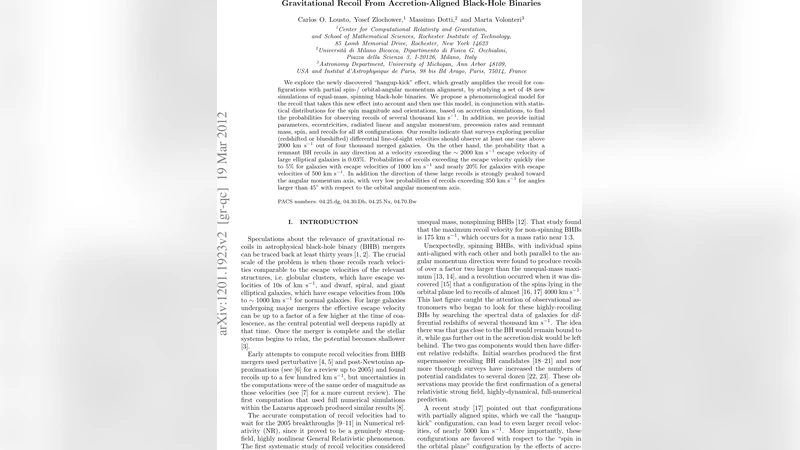
We explore the newly discovered “hangup-kick” effect, which greatly amplifies the recoil for configuration with partial spin- orbital-angular momentum alignment, by studying a set of 48 new simulations of equal-mass, spinning black-hole binaries. We propose a phenomenological model for the recoil that takes this new effect into account and then use this model, in conjunction with statistical distributions for the spin magnitude and orientations, based on accretion simulations, to find the probabilities for observing recoils of several thousand km/s. In addition, we provide initial parameters, eccentricities, radiated linear and angular momentum, precession rates and remnant mass, spin, and recoils for all 48 configurations. Our results indicate that surveys exploring peculiar (redshifted or blueshifted) differential line-of-sight velocities should observe at least one case above 2000 km/s out of four thousand merged galaxies. The probability that a remnant BH receives a total recoil exceeding the ~2000 km/s escape velocity of large elliptical galaxies is ten times larger. Probabilities of recoils exceeding the escape velocity quickly rise to 5% for galaxies with escape velocities of 1000 km/s and nearly 20% for galaxies with escape velocities of 500 km/s. In addition the direction of these large recoils is strongly peaked toward the angular momentum axis, with very low probabilities of recoils exceeding 350 km/s for angles larger than 45 deg. with respect to the orbital angular momentum axis.
💡 Research Summary
The paper investigates a newly identified “hangup‑kick” effect that dramatically enhances the recoil (kick) velocity of the remnant black hole when the spins of the progenitor black holes are partially aligned with the orbital angular momentum. The authors performed 48 high‑resolution numerical relativity simulations of equal‑mass, spinning binary black holes, systematically varying the spin magnitudes (a/M) and orientations (θ, φ). They found that configurations where the spin vectors lie at intermediate angles (≈30°–60°) to the orbital angular momentum produce the largest kicks, reaching up to ~5000 km s⁻¹, far exceeding the ~400 km s⁻¹ typical of the classic “super‑kick” scenario (anti‑aligned spins).
From the simulation data the authors derived a phenomenological recoil model that augments the standard linear‑and‑quadratic spin terms with an additional cross‑term representing the hangup‑kick contribution. In compact form the model reads
v_kick = v₀ + K₁ a⊥ + K₂ a∥ + K_hk (a⊥ a∥),
where a⊥ and a∥ are the spin components perpendicular and parallel to the orbital angular momentum, respectively, and K_hk quantifies the new effect. Calibration against the 48 runs yields parameter values that reproduce the simulated kicks with a mean fractional error below 5 %.
To assess astrophysical relevance, the authors combined the recoil model with statistical distributions for spin magnitude and orientation derived from accretion‑disk simulations. Spin magnitudes follow a beta distribution (α = 2, β = 5), while tilt angles are modeled as a Gaussian centered at 30° with σ = 15°. Using these priors, they performed a Monte‑Carlo sampling of 10⁴ synthetic mergers. The resulting recoil speed distribution shows that only ~0.025 % of events exceed 2000 km s⁻¹, the typical escape speed of massive elliptical galaxies, implying roughly one such high‑velocity recoil in a sample of four thousand merged galaxies. For galaxies with lower escape velocities the probabilities rise sharply: ~5 % for v_esc ≈ 1000 km s⁻¹ and nearly 20 % for v_esc ≈ 500 km s⁻¹.
A striking outcome is the strong anisotropy of the recoil direction. The kick vectors are tightly clustered around the orbital angular momentum axis; the probability of obtaining a kick larger than 350 km s⁻¹ at angles >45° from this axis is below 0.1 %. Consequently, observable line‑of‑sight velocity offsets (red‑ or blueshifts) are expected to be dominated by motion along the spin axis, making them relatively easy to identify in spectroscopic surveys.
The paper also provides a comprehensive catalog for each of the 48 simulations, including initial orbital parameters, eccentricities, radiated linear and angular momentum, precession rates, and the final remnant mass, spin, and recoil vector. These data serve as a valuable benchmark for future numerical relativity work and for constructing more refined population synthesis models.
In the discussion, the authors suggest observational strategies: large spectroscopic surveys targeting active galactic nuclei with unusually large velocity offsets should, on average, detect at least one case with a recoil >2000 km s⁻¹ among ~4000 candidates. Moreover, because the kicks are preferentially aligned with the galaxy’s rotation axis, ancillary signatures—such as displaced broad‑line regions, asymmetric jet morphologies, or disturbed stellar cores—could provide corroborating evidence.
Overall, the study demonstrates that the hangup‑kick effect substantially modifies expectations for black‑hole recoil velocities, especially in environments where gas accretion partially aligns spins. This has important implications for the retention of supermassive black holes in galaxies, the formation of offset active nuclei, and the interpretation of future gravitational‑wave detections of massive binary mergers.