Cover-Decomposition and Polychromatic Numbers
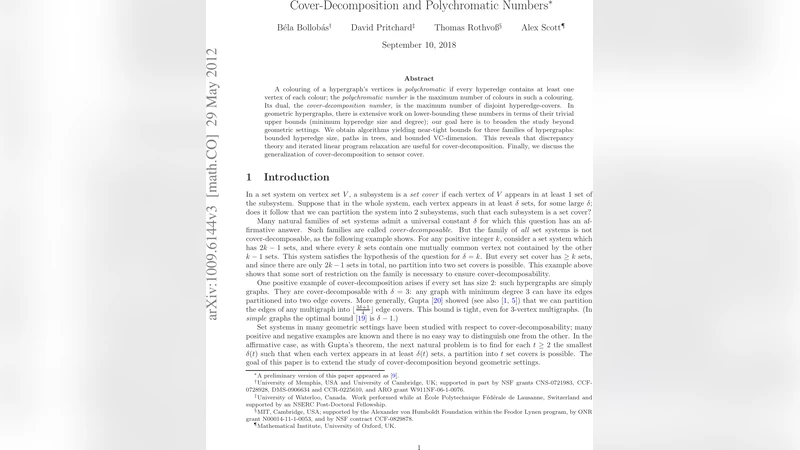
A colouring of a hypergraph’s vertices is polychromatic if every hyperedge contains at least one vertex of each colour; the polychromatic number is the maximum number of colours in such a colouring. Its dual, the cover-decomposition number, is the maximum number of disjoint hyperedge-covers. In geometric hypergraphs, there is extensive work on lower-bounding these numbers in terms of their trivial upper bounds (minimum hyperedge size and degree); our goal here is to broaden the study beyond geometric settings. We obtain algorithms yielding near-tight bounds for three families of hypergraphs: bounded hyperedge size, paths in trees, and bounded VC-dimension. This reveals that discrepancy theory and iterated linear program relaxation are useful for cover-decomposition. Finally, we discuss the generalization of cover-decomposition to sensor cover.
💡 Research Summary
The paper investigates two dual notions in hypergraph theory: polychromatic colourings and cover‑decompositions. A polychromatic colouring assigns colours to the vertices of a hypergraph (G=(V,E)) such that every hyperedge (e\in E) contains at least one vertex of each colour. The maximum number of colours that can be achieved is the polychromatic number (p(G)). The dual concept, the cover‑decomposition number, asks for the largest integer (k) for which the edge set (E) can be partitioned into (k) pairwise disjoint sub‑families, each of which covers all vertices. It is well‑known that these two quantities coincide, providing two complementary perspectives on the same combinatorial object.
Historically, most work on lower‑bounding (p(G)) (or equivalently the cover‑decomposition number) has been confined to geometric hypergraphs, where hyperedges arise from geometric ranges (e.g., disks, half‑spaces). In that setting, trivial upper bounds are given by the minimum hyperedge size (\delta) and the maximum vertex degree (\Delta). Researchers have shown that, for many geometric families, one can guarantee a polychromatic colouring with roughly (\Theta(\delta)) or (\Theta(\Delta)) colours, up to logarithmic factors. However, these results heavily exploit geometric properties such as convexity, planarity, or VC‑dimension of the underlying range space, and they do not readily extend to arbitrary combinatorial hypergraphs.
The authors therefore broaden the scope by focusing on three natural, non‑geometric families:
- Bounded hyperedge size – every hyperedge contains at most a constant (k) vertices.
- Paths in trees – the hypergraph consists of all simple paths of a tree (T).
- Bounded VC‑dimension – the hypergraph’s incidence system has VC‑dimension at most (d).
For each family they develop algorithmic constructions that achieve near‑tight lower bounds, i.e., bounds that match the trivial upper limits up to a logarithmic factor. The technical heart of the paper lies in the combination of iterated linear‑program (LP) relaxation and discrepancy theory.
Bounded hyperedge size
The authors start from the natural LP that maximises the number of colours while allowing fractional colour assignments to vertices. Solving the LP yields a fractional solution where each vertex receives a vector of colour weights summing to one. A naïve rounding would destroy the guarantee that every hyperedge sees all colours. To overcome this, the authors apply a discrepancy‑based rounding step: they treat each colour as a separate “balancing” problem and use the Beck–Fiala theorem (or more modern Spencer‑type bounds) to keep the deviation in each hyperedge bounded by (O(\sqrt{k\log n})). By iterating the LP (re‑optimising after each rounding phase) they gradually convert the fractional solution into an integral one while preserving the property that each hyperedge still contains every colour. The final guarantee is
\
Comments & Academic Discussion
Loading comments...
Leave a Comment