Revisiting Waiting Times in DNA evolution
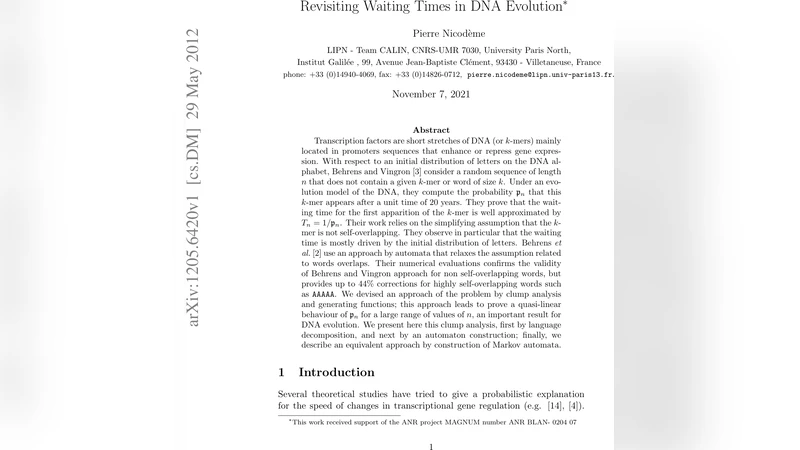
Transcription factors are short stretches of DNA (or $k$-mers) mainly located in promoters sequences that enhance or repress gene expression. With respect to an initial distribution of letters on the DNA alphabet, Behrens and Vingron consider a random sequence of length $n$ that does not contain a given $k$-mer or word of size $k$. Under an evolution model of the DNA, they compute the probability $\mathfrak{p}_n$ that this $k$-mer appears after a unit time of 20 years. They prove that the waiting time for the first apparition of the $k$-mer is well approximated by $T_n=1/\mathfrak{p}_n$. Their work relies on the simplifying assumption that the $k$-mer is not self-overlapping. They observe in particular that the waiting time is mostly driven by the initial distribution of letters. Behrens et al. use an approach by automata that relaxes the assumption related to words overlaps. Their numerical evaluations confirms the validity of Behrens and Vingron approach for non self-overlapping words, but provides up to 44% corrections for highly self-overlapping words such as $\mathtt{AAAAA}$. We devised an approach of the problem by clump analysis and generating functions; this approach leads to prove a quasi-linear behaviour of $\mathfrak{p}_n$ for a large range of values of $n$, an important result for DNA evolution. We present here this clump analysis, first by language decomposition, and next by an automaton construction; finally, we describe an equivalent approach by construction of Markov automata.
💡 Research Summary
The paper revisits the problem of estimating the waiting time until a given k‑mer first appears in a DNA sequence undergoing evolution. The original work by Behrens and Vingron considered a random DNA string of length n that initially does not contain the target word. Under a simple substitution model (e.g., Jukes‑Cantor or Kimura), they derived the probability 𝔭ₙ that the k‑mer will be present after a unit time interval (20 years) and showed that the expected waiting time can be approximated by Tₙ ≈ 1/𝔭ₙ. Their analysis, however, assumed that the word is non‑self‑overlapping, which excludes many biologically relevant motifs such as homopolymeric runs.
The present study removes this restrictive assumption by combining two complementary mathematical frameworks: clump analysis (also known as “cluster” analysis) and automata‑theoretic methods. A clump is defined as a maximal segment in which occurrences of the word overlap. By decomposing the language of DNA strings into clump‑free and clumped components, the authors construct ordinary generating functions that encode the distribution of clump lengths and the number of clumps as a function of n. This generating‑function approach yields a quasi‑linear asymptotic form for the appearance probability: \
Comments & Academic Discussion
Loading comments...
Leave a Comment