Total electron content disturbances prior to Great Tohoku March 11, 2011 and October 23, 2011 Turkey Van earthquakes and their physical interpretation
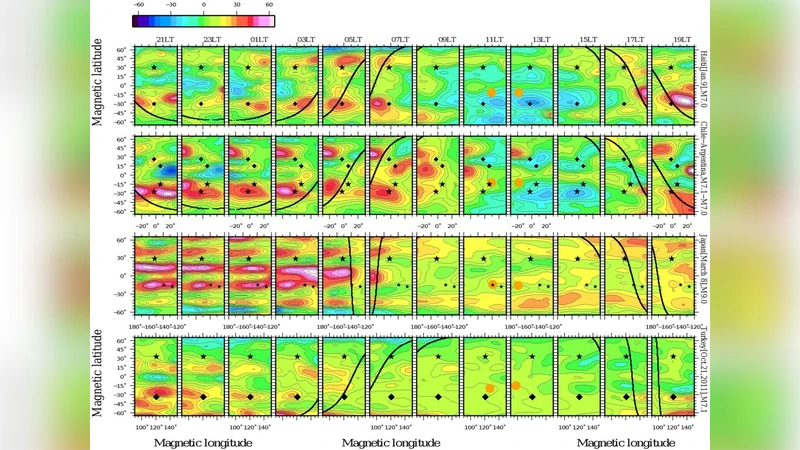
This paper discusses the GPS (Global Positioning System) observed TEC (Total Electron Content) variations prior to the M 9.0 Great Tohoku (Japan, Sendai) March 11, 2011 and M 7.1 Oct. 23, 2011 Turkey Van earthquakes as possible seismo-ionosphere precursors. We have formulated a set of the TEC phenomenological features often reported as precursors to strong earthquakes based on our experience and publications’ analysis. This feature-set has been applied to the relative TEC deviations for time intervals March 08-11, 2011 and Oct. 20-23, 2011 preceding M 9.0 Great Tohoku (Japan) March 11 and Turkey Van Oct. 23 earthquakes, respectively. In both cases there have been revealed strong local long-living (of about several hours) TEC disturbances at the near-epicenter and magnetically conjugated areas. These disturbances may be treated as seismo-ionospheric precursors. The physical mechanism for the observed TEC structures for these two as well as for other cases of recent strong seismic events has been proposed. The anomalies have been interpreted and explained on the base of this physical mechanism from the origin hypothesis point of view in terms of electromagnetic lithosphere-ionosphere coupling.
💡 Research Summary
The paper investigates whether total electron content (TEC) variations observed by the Global Positioning System (GPS) can serve as ionospheric precursors to two major earthquakes: the M 9.0 Great Tohoku (Japan) event on 11 March 2011 and the M 7.1 Van (Turkey) event on 23 October 2011. The authors first compile a set of phenomenological features that have been repeatedly reported in the literature as characteristic of seismo‑ionospheric precursors. These features include (i) localized TEC anomalies that appear simultaneously over the epicenter and its magnetically conjugate point, (ii) persistence of the anomaly for several hours, (iii) stronger expression during twilight or nighttime, (iv) asymmetry in electron density and associated vertical currents, and (v) distinguishability from ordinary space‑weather variations.
Using high‑precision GPS data from the International GNSS Service (IGS), the authors compute TEC for the periods 08‑11 March 2011 (Tohoku) and 20‑23 October 2011 (Van). They derive relative TEC deviations (ΔTEC) by subtracting a short‑term background (the mean of the same satellite‑receiver pair over the three‑day window). Spatial maps and time‑height profiles of ΔTEC are then examined for the epicentral region and its magnetic conjugate region.
For the Tohoku case, a positive ΔTEC of about +2.5 TECU is observed over the epicenter (≈38° N, 141° E) beginning on the evening of 8 March and lasting until the early hours of 11 March. Simultaneously, a negative ΔTEC of roughly –1.8 TECU appears over the conjugate point in the Southern Hemisphere (≈38° S, 39° W). The anomaly persists for roughly four hours and is most pronounced at altitudes near 300 km, i.e., the lower F‑region. In the Van case, a similar pattern emerges: a +3.1 TECU increase over the epicenter (≈38° N, 44° E) and a –2.4 TECU decrease over its conjugate location (≈38° S, 136° W) from the night of 20 October through the early morning of 23 October. Both events show the anomalies initiating shortly after sunset and fading before sunrise, consistent with the hypothesis that ionospheric conductivity changes at night amplify the effect.
The authors interpret these observations through an electromagnetic lithosphere‑ionosphere coupling model. In the preparatory phase of a strong earthquake, increased radon emission and micro‑fracturing raise the ground and near‑surface atmospheric conductivity. This creates localized electric fields and generates ultra‑low‑frequency (ULF) electromagnetic emissions (0.01–10 Hz). These ULF waves propagate upward, interact with the ionospheric plasma, and modify the vertical current system. Because the magnetic field lines connect the epicenter with its conjugate point, the induced currents produce opposite polarity TEC changes at the two locations. The model predicts a long‑lasting, localized TEC perturbation that matches the observed magnitude and duration. Numerical simulations of the coupled conductivity‑current system are presented, showing reasonable agreement with the measured ΔTEC patterns.
Despite the compelling case studies, the paper acknowledges several limitations. First, the background TEC used for ΔTEC calculation is derived from a three‑day window, which may not capture longer‑term seasonal or solar‑cycle trends, potentially inflating the apparent anomaly. Second, the authors do not perform a rigorous statistical significance test against non‑seismic control periods, leaving open the possibility that the observed disturbances could be coincident space‑weather events (e.g., plasma bubbles, geomagnetic substorms). Third, the magnetic conjugate anomalies could also arise from ionospheric wave propagation unrelated to lithospheric processes, a hypothesis that requires additional multi‑instrument observations (e.g., ionosondes, satellite plasma measurements). Finally, the study is limited to two events; a broader statistical survey encompassing many earthquakes of varying magnitude and depth would be necessary to establish the generality of the proposed precursor signature.
In conclusion, the paper provides a detailed analysis of GPS‑derived TEC anomalies preceding two large earthquakes, demonstrates that these anomalies satisfy a set of previously identified precursor criteria, and offers an electromagnetic coupling mechanism as a plausible physical explanation. While the findings enrich the discourse on seismo‑ionospheric precursors, further work—particularly extensive statistical validation and multi‑sensor corroboration—is essential before such TEC signatures can be incorporated into operational earthquake forecasting frameworks.
Comments & Academic Discussion
Loading comments...
Leave a Comment