Approximate Equalities on Rough Intuitionistic Fuzzy Sets and an Analysis of Approximate Equalities
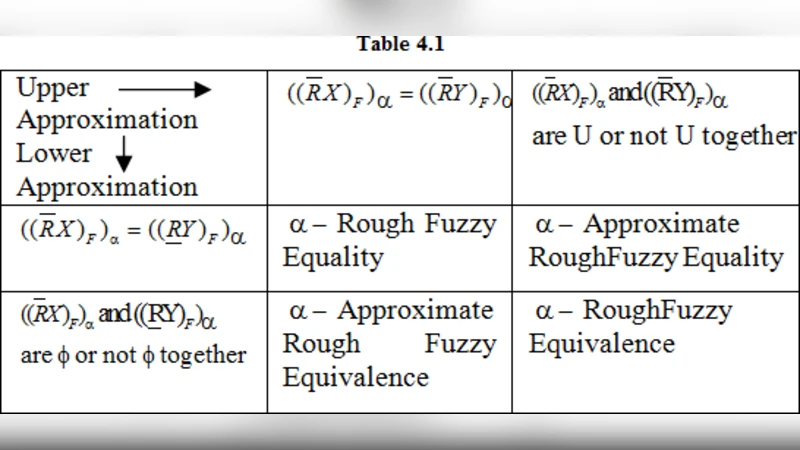
In order to involve user knowledge in determining equality of sets, which may not be equal in the mathematical sense, three types of approximate (rough) equalities were introduced by Novotny and Pawlak ([8, 9, 10]). These notions were generalized by Tripathy, Mitra and Ojha ([13]), who introduced the concepts of approximate (rough) equivalences of sets. Rough equivalences capture equality of sets at a higher level than rough equalities. More properties of these concepts were established in [14]. Combining the conditions for the two types of approximate equalities, two more approximate equalities were introduced by Tripathy [12] and a comparative analysis of their relative efficiency was provided. In [15], the four types of approximate equalities were extended by considering rough fuzzy sets instead of only rough sets. In fact the concepts of leveled approximate equalities were introduced and properties were studied. In this paper we proceed further by introducing and studying the approximate equalities based on rough intuitionistic fuzzy sets instead of rough fuzzy sets. That is we introduce the concepts of approximate (rough)equalities of intuitionistic fuzzy sets and study their properties. We provide some real life examples to show the applications of rough equalities of fuzzy sets and rough equalities of intuitionistic fuzzy sets.
💡 Research Summary
The paper extends the line of research on approximate (rough) equalities, which were originally introduced by Novotny and Pawlak to incorporate user‑defined notions of set similarity that do not require strict mathematical equality. Those early works defined three types of approximate equalities—upper, lower, and a combined upper‑lower version—by using rough set approximations. Tripathy, Mitra and Ojha later generalized these concepts to “approximate rough equivalences,” which satisfy the reflexive, symmetric, and transitive properties of an equivalence relation, thereby providing a higher‑level notion of set similarity. Subsequent studies added two composite approximate equalities by combining the basic conditions, and a comparative analysis showed that the composite versions can be more efficient in certain contexts. In 2015 the framework was further broadened to rough fuzzy sets through the introduction of leveled approximate equalities, where fuzzy membership values are discretized at several thresholds (levels) and rough set operations are applied at each level, allowing multi‑granular analysis.
Building on this trajectory, the present work moves from rough fuzzy sets to rough intuitionistic fuzzy sets (RIFS). An intuitionistic fuzzy set (IFS) is characterized by a membership degree μ, a non‑membership degree ν, and an associated uncertainty π = 1 − μ − ν. This three‑tuple representation captures not only the degree of belonging but also the degree of refusal and the residual hesitation, offering a richer description of vagueness than ordinary fuzzy sets.
The authors first define upper and lower rough approximations for IFSs by applying the classical rough set operators separately to the μ‑ and ν‑components and then recombining the results into a new IFS. Using these approximations they introduce four families of approximate equalities:
- Upper Approximation Equality (U‑Equality) – Two IFSs A and B are U‑equal if their upper approximations coincide. This reflects similarity in the “possible” membership region.
- Lower Approximation Equality (L‑Equality) – A and B are L‑equal when their lower approximations are identical, indicating agreement on the “certain” membership region.
- Upper‑Lower Approximation Equality (UL‑Equality) – A and B satisfy UL‑equality if both upper and lower approximations match, or if at least one of them coincides with the whole universe. This is a flexible hybrid that subsumes the first two.
- Combined Approximation Equality (C‑Equality) – This is the most stringent relation: it requires simultaneous satisfaction of the upper and lower conditions, or a specific inclusion relationship (e.g., the upper approximation of A is contained in the lower approximation of B). It captures a notion of mutual replaceability at both possibility and certainty levels.
For each relation the paper proves fundamental properties: reflexivity holds for all four; symmetry holds for U‑, L‑, and UL‑equalities but may fail for C‑equality unless the inclusion direction is symmetric; transitivity is guaranteed for U‑ and L‑equalities, while C‑equality is transitive only under additional containment constraints. The analysis also highlights the role of the hesitation degree π. When π is large (high uncertainty), lower approximation equality becomes more conservative, admitting fewer elements as certainly belonging; when π is small, upper approximation equality becomes more permissive, allowing a broader set of possibly belonging elements. Thus the choice of equality type can be tuned to the level of uncertainty inherent in the data.
To illustrate practical relevance, the authors present two case studies. In a medical diagnosis scenario, patient symptoms, test results, and physician assessments are encoded as IFSs. Comparing two diagnostic systems using U‑equality reveals whether they agree on the set of potentially diseased patients, while L‑equality checks agreement on patients who are definitively diagnosed. The composite equality helps identify cases where systems differ only in the certainty dimension, guiding targeted review of ambiguous diagnoses.
The second example concerns customer satisfaction surveys. Survey responses are transformed into IFSs (e.g., “satisfied” → high μ, low ν; “neutral” → moderate μ and ν, high π). By evaluating approximate equalities between different questionnaire versions, the authors demonstrate how to assess whether alternative designs capture the same underlying satisfaction profile. The combined equality, in particular, flags situations where the overall possibility distribution is similar but the certainty distribution diverges, suggesting a need to refine question wording.
Finally, the paper outlines future research directions: integrating the proposed RIFS equalities into multi‑criteria decision‑making frameworks, developing incremental algorithms for updating upper and lower approximations in streaming data environments, and applying the concepts to interpretability of machine‑learning models (e.g., converting probabilistic outputs to IFSs and checking model equivalence via approximate equalities).
In summary, this work systematically extends the theory of approximate rough equalities to the richer setting of intuitionistic fuzzy information. By defining four well‑structured equality relations, proving their algebraic properties, and demonstrating their applicability in real‑world domains, the authors provide a robust theoretical and practical toolkit for handling uncertainty‑laden data where traditional crisp or even fuzzy set comparisons are insufficient.