Two models of protoplasm microstructure of the living cell in resting state
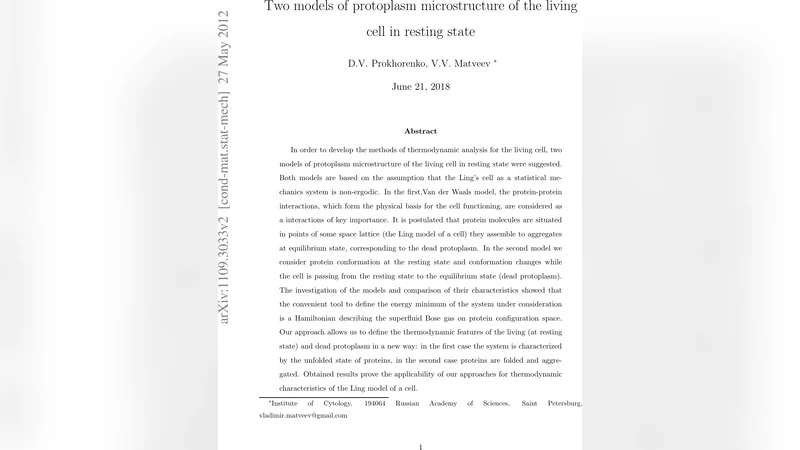
In order to develop the methods of thermodynamic analysis for the living cell, two models of protoplasm microstructure of the living cell in resting state were suggested. Both models are based on the assumption that the Ling’s cell as a statistical mechanics system is non-ergodic. In the first, Van der Waals model, the protein-protein interactions, which form the physical basis for the cell functioning, are considered as a interactions of key importance. It is postulated that protein molecules are situated in points of some space lattice (the Ling model of a cell) they assemble to aggregates at equilibrium state, corresponding to the dead protoplasm. In the second model we consider protein conformation at the resting state and conformation changes while the cell is passing from the resting state to the equilibrium state (dead protoplasm). The investigation of the models and comparison of their characteristics showed that the convenient tool to define the energy minimum of the system under consideration is a Hamiltonian describing the superfluid Bose gas on protein configuration space. Our approach allows us to define the thermodynamic features of the living (at resting state) and dead protoplasm in a new way: in the first case the system is characterized by the unfolded state of proteins, in the second case proteins are folded and aggregated. Obtained results prove the applicability of our approaches for thermodynamic characteristics of the Ling model of a cell.
💡 Research Summary
The paper presents two theoretical models for the micro‑structure of a living cell in its resting (non‑excited) state, building on Gilbert Ling’s “physiological atom” concept and on the authors’ earlier work on generalized thermodynamics. The central premise is that the cell, regarded as a statistical‑mechanical system, is non‑ergodic: it possesses a set of conserved quantities (first integrals) that prevent its phase‑space trajectory from exploring the whole accessible region. This non‑ergodicity is linked to the quasi‑crystalline organization of intracellular water and to the fixed lattice positions of proteins.
Model 1 – Van der Waals (lattice‑protein) model
Proteins are assumed to occupy specific sites of a three‑dimensional lattice (the “Ling lattice”). In the resting cell the inter‑protein distances are large, so protein‑protein interactions can be neglected and the system behaves essentially as an ideal gas of lattice‑bound particles. When the cell dies, proteins become linked by non‑covalent (secondary‑structure) bonds and form large aggregates. The authors treat this transition by adding a Van der Waals‑type correction to the free energy. Using this correction they estimate: (i) the heat released during erythrocyte death, (ii) the number of protein aggregates formed, and (iii) the fraction of cell volume occupied by these aggregates. The numerical values obtained are in qualitative agreement with experimental observations (e.g., heat release of order 10⁻¹¹ J, aggregate volume of a few percent of the cell).
Model 2 – Superfluid Bose‑gas on protein‑configuration space
The second model focuses on the internal conformational degrees of freedom of the proteins themselves. At zero temperature the authors map the protein configuration space onto a Bose‑Einstein condensate (a superfluid Bose gas). The effective Hamiltonian includes a kinetic term for the collective coordinate and a nonlinear interaction term representing protein‑protein coupling. In the living (resting) state the proteins are predominantly unfolded; this corresponds to a highly degenerate Bose‑gas ground state with maximal entropy. In the dead state the proteins are folded and aggregated, which corresponds to a lower‑entropy, lower‑energy Bose‑gas configuration. ATP concentration enters the Hamiltonian as a chemical‑potential‑like parameter that controls the sorption properties of proteins for water and physiologically important ions (K⁺, Na⁺). The authors show that changing this parameter drives the system from the unfolded to the folded configuration, reproducing the experimentally observed ion fluxes and volume changes during cell activation and death.
Non‑ergodicity and crystallization
A substantial part of the paper is devoted to a heuristic argument that non‑ergodicity arises from the solid‑like nature of the cell at low temperatures. By treating the cell as a rigid body with six macroscopic degrees of freedom (three translational, three rotational) and their conjugate momenta, the authors demonstrate that the free energy becomes independent of the rotational angles, indicating conserved integrals that break ergodicity. They further argue that the same reasoning explains why a crystal lattice remains stable at non‑zero temperatures, and by analogy why the Ling cell can maintain its ordered state at physiological temperatures.
Key insights and implications
- Physical basis of Ling’s hypothesis – The two models provide a quantitative framework for Ling’s claim that the unfolded (linear) protein state, together with bound water and K⁺, defines the resting cell.
- Complementarity of the models – The Van der Waals model captures macroscopic thermodynamic observables (heat, volume, aggregate number), while the Bose‑gas model captures microscopic conformational dynamics and the role of ATP as a control parameter.
- Non‑ergodic thermodynamics – By explicitly constructing first integrals (e.g., angular momentum) the authors justify the use of a generalized Gibbs distribution for a steady non‑equilibrium steady state, rather than the conventional equilibrium ensemble.
- Predictive potential – The derived expressions allow, in principle, the calculation of numerical values for heat release, aggregate size, and ion fluxes, opening the way for experimental validation.
- Broader relevance – The methodology of mapping protein conformations to a Bose‑gas may be applicable to other biological macromolecular assemblies where collective quantum‑like behavior (e.g., cooperativity, allostery) plays a role.
In conclusion, the paper advances a novel theoretical description of the resting cell by integrating non‑ergodic statistical mechanics, classical Van der Waals interactions, and quantum‑mechanical Bose‑gas formalism. It demonstrates that the transition from a living to a dead protoplasm can be understood as a shift from an unfolded, high‑entropy protein ensemble to a folded, low‑entropy aggregated state, controlled by ATP‑mediated sorption processes. This work lays groundwork for future quantitative comparisons with experimental data and for extending non‑ergodic thermodynamic concepts to other complex biological systems.
Comments & Academic Discussion
Loading comments...
Leave a Comment