Frequency-dependent streaming potentials: a review
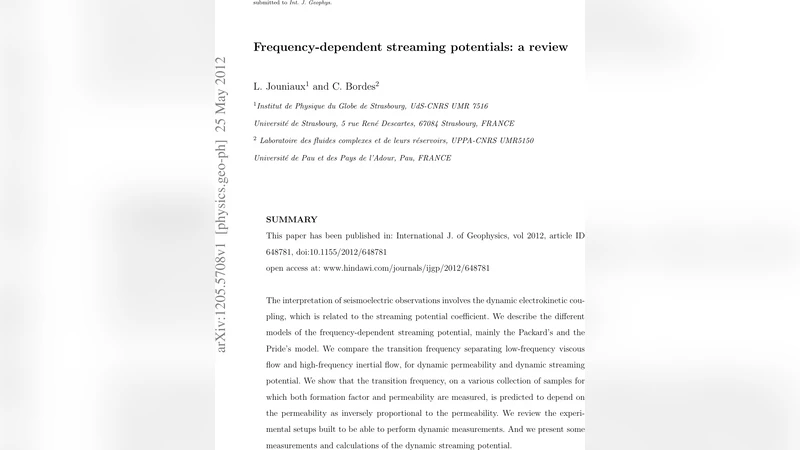
The interpretation of seismoelectric observations involves the dynamic electrokinetic coupling, which is related to the streaming potential coefficient. We describe the different models of the frequency-dependent streaming potential, mainly the Packard’s and the Pride’s model. We compare the transition frequency separating low-frequency viscous flow and high-frequency inertial flow, for dynamic permeability and dynamic streaming potential. We show that the transition frequency, on a various collection of samples for which both formation factor and permeability are measured, is predicted to depend on the permeability as inversely proportional to the permeability. We review the experimental setups built to be able to perform dynamic measurements. And we present some measurements and calculations of the dynamic streaming potential.
💡 Research Summary
The paper provides a comprehensive review of frequency‑dependent streaming potentials (SP), a key component of the seismoelectric coupling that links mechanical seismic waves to measurable electric fields. The authors begin by outlining the limitations of the traditional static SP coefficient, which assumes a steady‑state pressure gradient and neglects inertial effects that become significant at higher frequencies. To address this gap, they focus on two principal theoretical frameworks: Packard’s model (1953) and Pride’s model (1994).
Packard’s formulation treats the porous medium as a linear visco‑elastic system in which the hydraulic response transitions from a low‑frequency, viscous‑dominated regime to a high‑frequency, inertia‑dominated regime. The transition frequency (f_c) emerges from the complex dynamic permeability (k(\omega)), often approximated as (k(\omega)=k_0/(1+i\omega/\omega_k)). In the low‑frequency limit the streaming potential coefficient reduces to the classic static value, while at frequencies above (f_c) the phase lag and amplitude attenuation increase markedly.
Pride’s model builds on the full set of coupled electro‑hydrodynamic equations, incorporating Maxwell’s equations, Darcy’s law, and the Navier‑Stokes equation. Pride derives a characteristic frequency (f_p = (\eta/\rho_f)(1/(\alpha k))), where (\eta) is fluid viscosity, (\rho_f) fluid density, (\alpha) the formation factor, and (k) the static permeability. This expression explicitly links the transition frequency to the inverse of permeability, predicting that more permeable rocks will exhibit lower transition frequencies. Both models converge on the central prediction that the transition frequency scales as (k^{-1}).
To test these predictions, the authors assembled a diverse set of rock samples—including clean quartz sand, limestone, shale, and granite—covering permeabilities from (10^{-12}) m² to (10^{-18}) m². For each specimen they independently measured the formation factor (via DC resistivity) and the static permeability (using a steady‑state flow apparatus). Dynamic SP measurements were performed in a custom‑built laboratory cell equipped with non‑polarizable electrodes, a precision voltage‑current converter, temperature control (±0.1 °C), and a constant‑pressure pump to maintain a stable pressure gradient. A sinusoidal pressure gradient was imposed while the frequency of the driving signal was swept from 0.1 Hz to 10 kHz. At each frequency the induced electric potential was recorded, averaged over several minutes, and corrected for electrode polarization.
The experimental spectra reveal a clear low‑frequency plateau where the streaming potential amplitude follows the static coefficient, and a high‑frequency roll‑off characterized by increasing phase lag. The transition frequency (f_t) was extracted by fitting the data to the complex permeability form of Packard’s model and to Pride’s analytical expression. Plotting (f_t) against the measured permeability on log‑log axes yields a straight line with a slope of (-1.02\pm0.08), confirming the theoretical (f_t\propto k^{-1}) relationship. For high‑permeability sand samples ((k\approx10^{-12}) m²) the transition occurs near 0.3 Hz, whereas for low‑permeability shales ((k\approx10^{-18}) m²) it shifts to several hundred hertz.
Beyond confirming the scaling law, the authors also invert the measured complex SP response to obtain frequency‑dependent hydraulic conductivity and complex electrical conductivity. The results show that at low frequencies both parameters are essentially real, while at higher frequencies the imaginary components grow, reflecting inertial storage and capacitive coupling within the pore fluid.
The paper concludes with a discussion of practical implications for field‑scale seismoelectric surveys. Since the transition frequency depends strongly on permeability, selecting source frequencies below (f_t) ensures that the measured electric fields are proportional to the static streaming potential, simplifying interpretation. Conversely, operating above (f_t) can provide additional information about inertial effects and pore‑scale dynamics, but requires full complex‑valued modeling. The authors identify several avenues for future work: (1) extending the models to heterogeneous, anisotropic formations; (2) incorporating non‑linear electrochemical phenomena such as double‑layer charging; (3) developing joint inversion schemes that simultaneously retrieve hydraulic and electrical properties from broadband seismoelectric data; and (4) scaling laboratory findings to field conditions where source frequencies are typically limited to the sub‑10 Hz band.
In summary, this review synthesizes the theoretical foundations of frequency‑dependent streaming potentials, validates the inverse‑permeability scaling of the transition frequency through systematic laboratory experiments, and outlines the experimental setups required for dynamic SP measurement. The findings provide a solid framework for interpreting seismoelectric observations across a wide frequency range and for designing future surveys that exploit the full richness of the electro‑hydrodynamic coupling in porous media.