Mechanical properties of polycrystalline graphene based on a realistic atomistic model
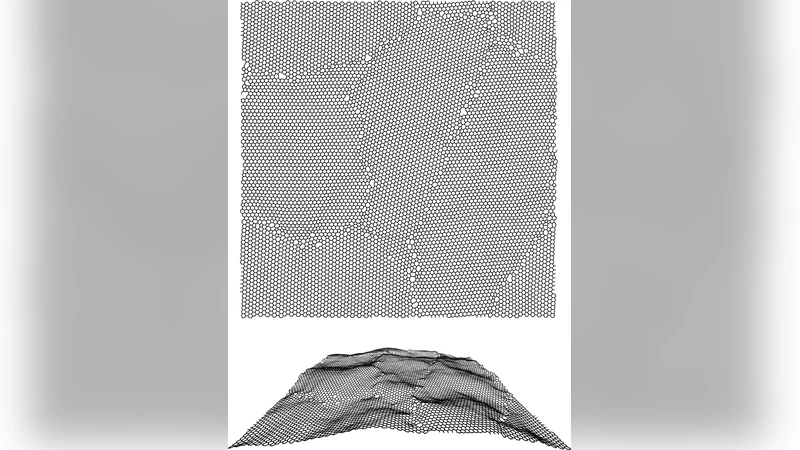
Graphene can at present be grown at large quantities only by the chemical vapor deposition method, which produces polycrystalline samples. Here, we describe a method for constructing realistic polycrystalline graphene samples for atomistic simulations, and apply it for studying their mechanical properties. We show that cracks initiate at points where grain boundaries meet and then propagate through grains predominantly in zigzag or armchair directions, in agreement with recent experimental work. Contrary to earlier theoretical predictions, we observe normally distributed intrinsic strength (~ 50% of that of the mono-crystalline graphene) and failure strain which do not depend on the misorientation angles between the grains. Extrapolating for grain sizes above 15 nm results in a failure strain of ~ 0.09 and a Young’s modulus of ~ 600 GPa. The decreased strength can be adequately explained with a conventional continuum model when the grain boundary meeting points are identified as Griffith cracks.
💡 Research Summary
The paper presents a comprehensive atomistic study of polycrystalline graphene produced by chemical vapor deposition (CVD), focusing on realistic structural modeling and mechanical characterization. The authors first develop a method to generate large‑scale atomistic models that faithfully reproduce the irregular grain boundaries and junction points observed in experimental CVD samples. By randomly rotating and translating individual graphene grains, they create polycrystalline sheets with controllable grain sizes ranging from 5 nm to 30 nm and misorientation angles between 0° and 30°. The resulting structures exhibit the characteristic “meeting points” where three or more grain boundaries intersect, which are known to host high concentrations of atomic defects.
Molecular dynamics simulations are then performed using the second‑generation REBO potential at 300 K. Uniaxial tensile loading is applied at a strain rate of 0.5 % ps⁻¹, and stress–strain curves are recorded for each configuration. The analysis yields several key mechanical parameters: (i) a Young’s modulus of approximately 600 GPa for grain sizes larger than 15 nm, which is about 40 % lower than that of pristine monocrystalline graphene (~1 TPa); (ii) an intrinsic tensile strength that follows a normal distribution centered around 50 GPa, roughly half the strength of single‑crystal graphene; and (iii) a failure strain that converges to ~0.09 for grain sizes above 15 nm, while smaller grains display slightly higher strain at failure.
A striking observation is that crack nucleation consistently occurs at the grain‑boundary junctions rather than along the boundaries themselves. These junctions act as stress concentrators because of the dense network of dangling bonds and non‑hexagonal rings. Once a crack initiates, it propagates preferentially along the crystallographic zigzag or armchair directions of the graphene lattice, mirroring recent transmission electron microscopy (TEM) experiments. Importantly, the statistical analysis shows that neither the misorientation angle nor the specific boundary type significantly influences the measured strength or failure strain; the dominant factor is the presence of the junction points.
To rationalize the strength reduction, the authors invoke classical Griffith fracture theory. By treating each grain‑boundary meeting point as an effective microcrack with an estimated length of about 2 nm, the calculated critical stress matches the simulated tensile strength. This demonstrates that, despite the complex atomic topology of polycrystalline graphene, its macroscopic mechanical response can be captured by a simple continuum model that incorporates the size and density of these microcracks.
Overall, the study makes four major contributions: (1) a scalable, realistic atomistic construction protocol for CVD‑grown polycrystalline graphene; (2) quantitative mechanical data (Young’s modulus, strength, failure strain) as functions of grain size and misorientation; (3) atom‑level insight into crack nucleation at grain‑boundary junctions and subsequent propagation along zigzag/armchair directions; and (4) validation that conventional fracture mechanics can predict the observed strength degradation when the junctions are modeled as Griffith cracks. These findings provide essential design guidelines for graphene‑based composites and flexible electronics, where the mechanical reliability of large‑area CVD graphene is a critical concern.