Tidal Disruptions of White Dwarfs from Ultra-Close Encounters with Intermediate Mass Spinning Black Holes
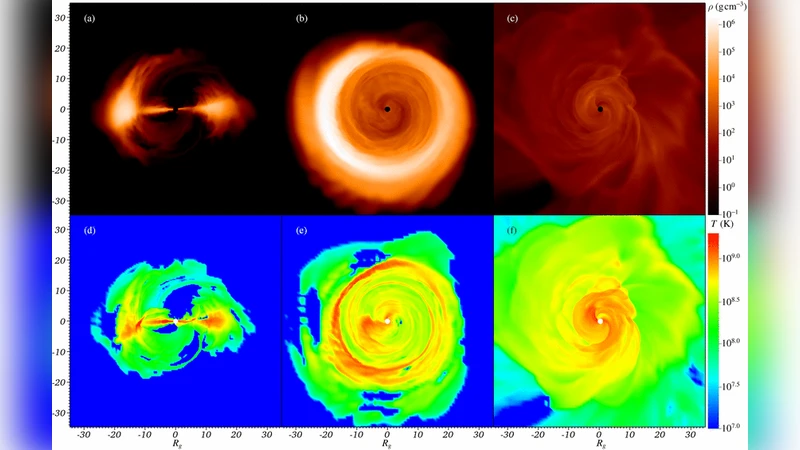
We present numerical relativity results of tidal disruptions of white dwarfs from ultra-close encounters with a spinning, intermediate mass black hole. These encounters require a full general relativistic treatment of gravity. We show that the disruption process and prompt accretion of the debris strongly depend on the magnitude and orientation of the black hole spin. However, the late-time accretion onto the black hole follows the same decay, $\dot{M}$ ~ t^{-5/3}, estimated from Newtonian gravity disruption studies. We compute the spectrum of the disk formed from the fallback material using a slim disk model. The disk spectrum peaks in the soft X-rays and sustains Eddington luminosity for 1-3 yrs after the disruption. For arbitrary black hole spin orientations, the disrupted material is scattered away from the orbital plane by relativistic frame dragging, which often leads to obscuration of the inner fallback disk by the outflowing debris. The disruption events also yield bursts of gravitational radiation with characteristic frequencies of ~3.2 Hz and strain amplitudes of ~10^{-18} for galactic intermediate mass black holes. The optimistic rate of considered ultra-close disruptions is consistent with no sources found in ROSAT all-sky survey. The future missions like Wide-Field X-ray Telescope (WFXT) could observe dozens of events.
💡 Research Summary
This paper presents the first fully general‑relativistic simulations of tidal disruption events (TDEs) involving a white dwarf (WD) on an ultra‑close encounter with a spinning intermediate‑mass black hole (IMBH) of mass 10³–10⁴ M⊙. The authors employ a three‑dimensional numerical relativity code that solves the Einstein field equations coupled to relativistic hydrodynamics. They explore nine configurations, varying the dimensionless spin parameter a∗ (0, 0.5, 0.9) and the orientation of the spin vector relative to the orbital angular momentum (aligned, anti‑aligned, and perpendicular). Initial pericenter distances are set to 0.3–0.7 times the relativistic tidal radius, ensuring that the encounter is deep enough to require a full GR treatment.
The simulations reveal that the magnitude and orientation of the black‑hole spin dramatically reshape the disruption process. High spin (a∗ ≈ 0.9) produces strong Lense‑Thirring frame dragging, which lifts debris out of the original orbital plane and creates a highly asymmetric, spiral‑like stream. When the spin is aligned or anti‑aligned with the orbit, the debris remains more planar, and a larger fraction of the WD mass is promptly swallowed by the horizon. In the perpendicular‑spin case, the out‑of‑plane motion is maximal, often leading to substantial obscuration of the nascent accretion flow.
Despite these early‑time differences, the long‑term fallback rate follows the classic t⁻⁵ᐟ³ power law predicted by Newtonian TDE theory. After an initial peak occurring within ∼0.1 s of disruption, the mass accretion rate settles into a quasi‑steady phase lasting ∼10⁴ s before decaying. This finding demonstrates that, even in the strong‑field regime, the global scaling of fallback is governed by the underlying Keplerian potential rather than spin‑induced relativistic corrections.
To translate the fallback into observable signatures, the authors feed the time‑dependent accretion rate into a slim‑disk model that accounts for radiation pressure, advection, and relativistic corrections to the emitted spectrum. The resulting disk is hot (central temperatures ≈10⁶ K) and radiates primarily in soft X‑rays, with a spectral peak between 0.2 and 2 keV. The luminosity reaches the Eddington limit (∼10⁴⁴–10⁴⁵ erg s⁻¹) and remains roughly constant for 1–3 years before the t⁻⁵ᐟ³ decline reduces the output. Because the debris can be lifted above the disk plane by frame dragging, the inner X‑ray source may be partially or fully hidden from certain lines of sight, producing variability and spectral softening that depend on the observer’s inclination.
Gravitational‑wave emission is also computed. The disruption generates a short burst with a characteristic frequency near 3.2 Hz and a strain amplitude of order 10⁻¹⁸ for a source located at the Galactic centre. While this signal lies below the sensitivity of current ground‑based detectors, it falls within the target band of proposed space‑based low‑frequency observatories such as DECIGO or BBO, suggesting that future missions could capture the GW counterpart of such events.
The authors estimate the volumetric rate of ultra‑close WD‑IMBH encounters by combining the density of IMBHs in dwarf galaxies with the cross‑section for deep encounters. They obtain a rate of 10⁻⁴–10⁻³ Mpc⁻³ yr⁻¹, consistent with the non‑detection of similar transients in the ROSAT all‑sky survey. However, upcoming wide‑field, high‑sensitivity X‑ray missions like the Wide‑Field X‑ray Telescope (WFXT) or eROSITA are expected to detect dozens of these events per year, providing a new probe of IMBH demographics and relativistic accretion physics.
In summary, the paper demonstrates that black‑hole spin and its orientation critically influence the early dynamics, debris geometry, and electromagnetic visibility of ultra‑close white‑dwarf tidal disruptions, while the late‑time fallback follows the familiar t⁻⁵ᐟ³ law. By coupling full numerical relativity with slim‑disk spectral modeling, the authors deliver a comprehensive, predictive framework that bridges gravitational‑wave and X‑ray observations of a previously unexplored class of relativistic transients.