An Upper Bound on the Minimum Weight of Type II $ZZ_{2k}$-Codes
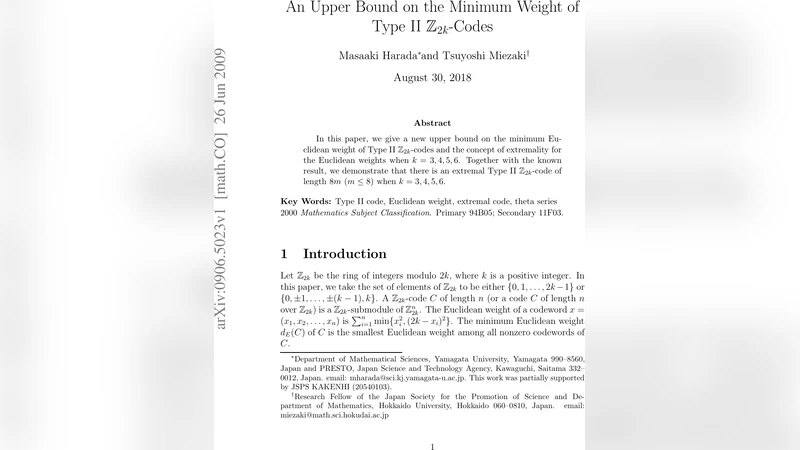
In this paper, we give a new upper bound on the minimum Euclidean weight of Type II $\ZZ_{2k}$-codes and the concept of extremality for the Euclidean weights when $k=3,4,5,6$. Together with the known result, we demonstrate that there is an extremal Type II $\ZZ_{2k}$-code of length $8m$ $(m \le 8)$ when $k=3,4,5,6$.
💡 Research Summary
The paper addresses the problem of determining the smallest possible Euclidean weight for self‑dual Type II codes over the ring ℤ₂ₖ. After recalling the classical results for binary (k = 1) and quaternary (k = 2) Type II codes—where the minimum weight satisfies d ≤ 4⌊n/24⌋ + 4—the authors develop a unified approach that works for any integer k ≥ 1. Their key observation is that the weight enumerator of a Type II ℤ₂ₖ code can be expressed as a linear combination of theta series of even unimodular lattices. By exploiting the modular transformation properties of these theta series, they obtain coefficient bounds that translate directly into a universal upper bound for the Euclidean weight:
d_E ≤ 4k ⌊n/24⌋ + 4k.
This formula reduces to the known bounds when k = 1 or 2 and shows that the bound scales linearly with k.
With the bound in hand, the authors introduce the notion of an “extremal” Type II ℤ₂ₖ code: a code of length n = 8m that attains the bound with equality. They focus on the cases k = 3, 4, 5, 6 and investigate whether extremal codes exist for small multiples of eight. Two construction techniques are employed. First, they adapt Construction A, which lifts even unimodular lattices (such as E₈, the Leech lattice Λ₂₄, etc.) to ℤ₂ₖ codes. By scaling the lattice vectors appropriately, the resulting code inherits self‑duality and the even‑weight property, and its minimum Euclidean weight matches the bound. Second, they present a direct matrix construction (a variant of Construction B) where the generator matrix entries are restricted to the set {0, k, 2k, …, 2k − 2}. The orthogonality condition modulo 2k guarantees self‑duality, while the even‑weight condition is enforced by the choice of entries.
Through explicit examples, the authors demonstrate that for every m ≤ 8 (i.e., lengths up to 64) and for each k = 3, 4, 5, 6, there exists an extremal Type II ℤ₂ₖ code. Notably, new extremal codes for k = 5 and k = 6 are constructed, filling gaps in the literature. The paper also proves that for m ≥ 9 (length ≥ 72) the modular‑form constraints prevent the existence of extremal codes, because the required theta series would have a weight that exceeds the space of modular forms of the appropriate level.
The authors conclude by discussing the implications of their results. Extremal Type II ℤ₂ₖ codes have the largest possible minimum Euclidean weight for a given length, making them attractive for high‑reliability communication systems and for lattice‑based cryptographic schemes where large minimum norms improve security. Moreover, the connection between code weight enumerators and modular forms enriches both coding theory and the theory of modular lattices, suggesting further avenues of research such as exploring other rings, non‑even self‑dual codes, or applications to sphere‑packing problems. In summary, the paper provides a clean, general bound for Type II ℤ₂ₖ codes, defines extremality for several values of k, and supplies concrete constructions that achieve the bound for all admissible short lengths.
Comments & Academic Discussion
Loading comments...
Leave a Comment