Enriched weakness
The basic notions of category theory, such as limit, adjunction, and orthogonality, all involve assertions of the existence and uniqueness of certain arrows. Weak notions arise when one drops the uniq
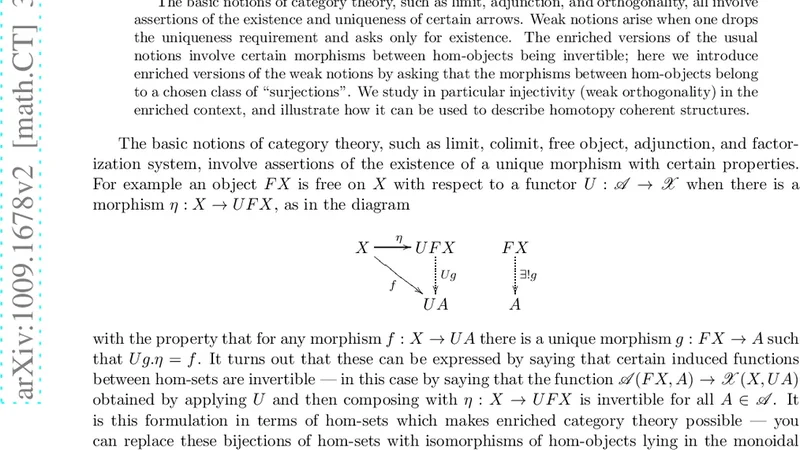
The basic notions of category theory, such as limit, adjunction, and orthogonality, all involve assertions of the existence and uniqueness of certain arrows. Weak notions arise when one drops the uniqueness requirement and asks only for existence. The enriched versions of the usual notions involve certain morphisms between hom-objects being invertible; here we introduce enriched versions of the weak notions by asking that the morphisms between hom-objects belong to a chosen class of “surjections”. We study in particular injectivity (weak orthogonality) in the enriched context, and illustrate how it can be used to describe homotopy coherent structures.
💡 Research Summary
The paper “Enriched weakness” revisits the foundational categorical notions of limits, adjunctions, and orthogonality, which traditionally require both existence and uniqueness of certain morphisms. By dropping the uniqueness requirement one obtains the familiar “weak” notions, but the authors go further: they embed these weak notions into the enriched setting, where hom‑objects live in a monoidal base category V. In the enriched world, the usual definitions demand that particular morphisms between hom‑objects be isomorphisms in V. The authors propose to replace the isomorphism condition by membership in a chosen class S of “surjections” (or more generally, a class of morphisms satisfying suitable closure properties). A morphism between hom‑objects is then considered sufficiently strong if it belongs to S, and this gives rise to “enriched weak orthogonality”.
The central technical development is the definition of enriched weak injectivity (weak orthogonality with respect to S‑surjections). An object I in a V‑enriched category C is S‑injective if for every S‑surjection f : X → Y and every map g : X → I there exists a filler h : Y → I with h ∘ f = g; uniqueness of h is not required, nor is h required to be in S. Under mild assumptions on S (containment of identities, closure under composition, and inclusion of all V‑isomorphisms) the authors prove that S‑injective objects enjoy many of the familiar closure properties: they are stable under V‑enriched limits and colimits formed along S‑maps, and a small set of generators yields a reflective subcategory of S‑injectives.
To illustrate the power of the framework the paper presents two detailed examples. First, taking V = SSet and S to be the class of Kan fibrations, S‑injectivity coincides with fibrancy in the classical model structure on simplicial sets. Thus enriched weak injectivity recovers the familiar fibrant replacement machinery while allowing a uniform treatment of other homotopical structures. Second, with V = 2‑Cat and S the class of pseudo‑epimorphisms (1‑cell epimorphisms together with suitable 2‑cell data), S‑injective objects capture biequivalence‑level coherence for 2‑categorical structures. In both cases the authors show how S‑injectivity can be used to encode homotopy‑coherent algebraic structures such as A∞‑ or E∞‑operations without imposing strict equalities.
The paper further discusses how the enriched weak framework can be lifted to ∞‑categories and ∞‑operads. By selecting appropriate surjection classes (e.g., inner fibrations in the Joyal model), one obtains a notion of ∞‑injectivity that aligns with the fibrant objects of the corresponding ∞‑categorical model structures. This suggests a systematic method for describing homotopy‑coherent structures across a wide range of higher‑categorical contexts, unifying them under a single “surjection‑based” enrichment.
In the concluding section the authors outline future research directions: (i) a systematic study of how different choices of S affect the existence of model structures on enriched categories, (ii) connections between enriched weak orthogonality and higher‑dimensional homology theories, and (iii) implementation of the theory in proof assistants to aid in the formal verification of homotopy‑coherent constructions. Overall, the paper provides a robust and flexible categorical toolkit that replaces strict isomorphism conditions with a controllable surjectivity condition, thereby extending weak categorical notions to the enriched and higher‑dimensional realms.
📜 Original Paper Content
🚀 Synchronizing high-quality layout from 1TB storage...