Martin-L"of Complexes
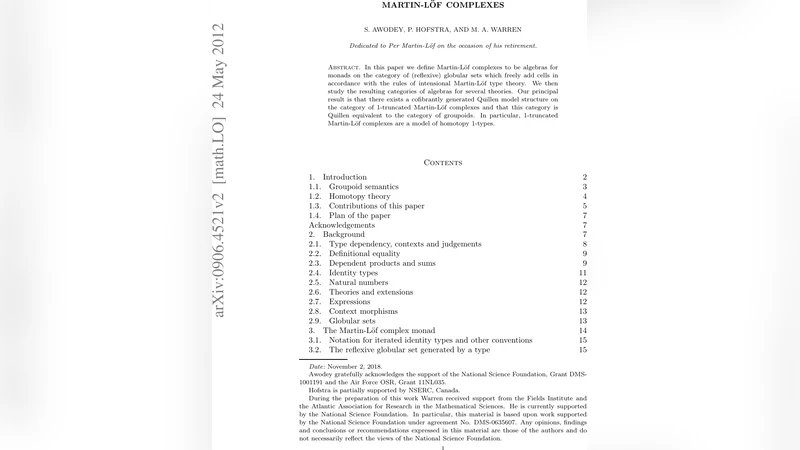
In this paper we define Martin-L"{o}f complexes to be algebras for monads on the category of (reflexive) globular sets which freely add cells in accordance with the rules of intensional Martin-L"{o}f type theory. We then study the resulting categories of algebras for several theories. Our principal result is that there exists a cofibrantly generated Quillen model structure on the category of 1-truncated Martin-L"{o}f complexes and that this category is Quillen equivalent to the category of groupoids. In particular, 1-truncated Martin-L"{o}f complexes are a model of homotopy 1-types.
💡 Research Summary
The paper introduces a new algebraic framework called Martin‑Löf complexes, designed to internalise the inference rules of intensional Martin‑Löf type theory (MLTT) within the category of (reflexive) globular sets. The construction proceeds in several stages.
First, the authors recall that reflexive globular sets provide a combinatorial model for higher‑dimensional categorical structures: they consist of a hierarchy of 0‑cells, 1‑cells, …, n‑cells together with source, target, and identity maps satisfying the usual globular identities. On this base they define a monad M whose algebras freely adjoin new cells exactly according to the formation, introduction, elimination, and computation rules of MLTT (Π‑types, Σ‑types, identity types, etc.). In other words, applying M to a globular set yields the “free ML‑type‑theoretic completion” of that set, and an M‑algebra (a Martin‑Löf complex) is a globular set equipped with coherent operations interpreting the type‑theoretic constructors. This viewpoint makes the type‑theoretic syntax a genuine algebraic structure rather than an external meta‑language.
Second, the authors restrict attention to 1‑truncated complexes, i.e. those in which all higher‑dimensional equalities (2‑cells and above) are identified. In this setting the only non‑trivial data are 0‑cells (objects) and 1‑cells (arrows), together with the identity‑type equalities that become ordinary isomorphisms. The resulting category, denoted C₁, is therefore reminiscent of the category of groupoids, but its morphisms are defined syntactically via the monad M rather than set‑theoretically.
Third, the paper establishes a cofibrantly generated Quillen model structure on C₁. Cofibrations are generated by the free inclusions of new 0‑cells and 1‑cells; fibrations are the “isofibrations” familiar from the classical model structure on groupoids (maps that lift isomorphisms); and weak equivalences are the essential equivalences—functors that are fully faithful and essentially surjective up to the ML‑type identity. The authors verify the model‑category axioms: the two‑out‑of‑three property for weak equivalences, the lifting properties, and the factorisation axioms, all using the explicit combinatorial description of M‑algebras.
Fourth, a Quillen adjunction between C₁ and the standard category Gpd of (small) groupoids is constructed. The left adjoint sends a groupoid to its underlying reflexive globular set and then freely applies the monad M, producing a Martin‑Löf complex; the right adjoint extracts from a complex its 0‑cells and 1‑cells together with the induced isomorphism structure, yielding a groupoid. The authors prove that this adjunction is a Quillen equivalence: the unit and counit are weak equivalences for cofibrant and fibrant objects respectively, and every object of C₁ is cofibrant while every groupoid is fibrant. Consequently, the homotopy category of 1‑truncated Martin‑Löf complexes is equivalent to the homotopy category of groupoids, i.e. the category of homotopy 1‑types.
The main theorem therefore shows that 1‑truncated Martin‑Löf complexes provide a new, type‑theoretic model of homotopy 1‑types, parallel to the classical groupoid model of the homotopy hypothesis. This result bridges intensional type theory with homotopical algebra in a concrete categorical setting, offering a fresh perspective on how type‑theoretic syntax can generate homotopical structures.
Finally, the authors discuss prospects for higher‑dimensional generalisation. Extending the monad to freely add 2‑cells, 3‑cells, etc., while respecting the higher identity‑type rules of MLTT would yield n‑truncated or even ∞‑Martin‑Löf complexes. If suitable model structures can be established, these would potentially give algebraic models for ∞‑groupoids and for the full homotopy‑type theory landscape, thereby deepening the connection between dependent type theory, higher category theory, and homotopy theory.
Comments & Academic Discussion
Loading comments...
Leave a Comment