A characterization of representable intervals
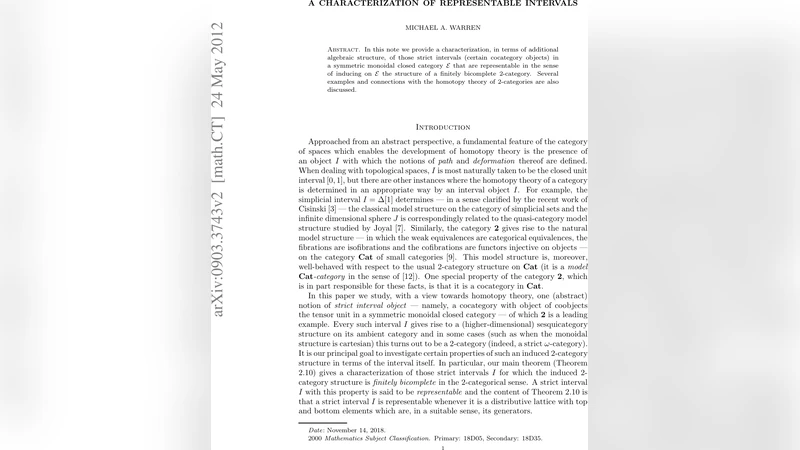
In this note we provide a characterization, in terms of additional algebraic structure, of those intervals (certain cocategory objects) in a symmetric monoidal closed category E that are representable in the sense of inducing on E the structure of a finitely bicomplete 2-category. Several examples and connections with the homotopy theory of 2-categories are also discussed.
💡 Research Summary
The paper investigates “intervals” – special cocategory objects – inside a symmetric monoidal closed category (\mathcal{E}). An interval (I) comes equipped with two distinguished points (d_0,d_1:1\to I) (the “endpoints”) and a composition map (c:I\otimes I\to I). The central question is: when does such an interval induce on (\mathcal{E}) the structure of a finitely bicomplete 2‑category? In other words, for every object (X) the hom‑set (\mathcal{E}(X,I)) should carry a natural notion of 2‑cell (a homotopy between two arrows) and these 2‑cells must satisfy the usual vertical and horizontal composition laws, identities, and interchange. When this happens the interval is called representable.
The authors show that representability cannot be captured by the cocategory data alone; one must endow the interval with additional algebraic structure that makes it a bimonoid equipped with an involution. Concretely, four pieces of structure are required:
-
A binary operation (\mu:I\otimes I\to I) satisfying associativity and having a unit (e:1\to I). This operation is distinct from the cocategory composition (c); it provides a way to “multiply” two intervals in a way that will later model the vertical composition of 2‑cells.
-
An involution (\tau:I\to I) with (\tau^2=\mathrm{id}) and which swaps the endpoints: (\tau\circ d_0 = d_1) and (\tau\circ d_1 = d_0). This gives a canonical notion of reversing a 2‑cell.
-
A comultiplication (\nabla:I\to I\otimes I) (the “connection” or “diagonal”) satisfying co‑unit and co‑associativity conditions compatible with the endpoints. It allows one to split an interval into two sub‑intervals, mirroring the horizontal composition of 2‑cells.
-
Compatibility (bialgebra) equations linking (\mu) and (\nabla) (the usual bimonoid axioms) together with the requirement that (\tau) be a homomorphism for both structures: ((\tau\otimes\tau)\circ\nabla = \nabla\circ\tau) and (\tau\circ\mu = \mu\circ(\tau\otimes\tau)).
The main theorem (Theorem 3.5) states that an interval (I) is representable iff it can be equipped with the above four pieces of data satisfying the listed equations. The proof proceeds in two directions.
Forward direction: Assuming the extra structure, the authors construct for any (X) a 2‑cell between two maps (f,g:X\to I) as a morphism (\alpha:X\to I) such that (\mu\circ(\alpha\otimes f)=g) (or an equivalent formulation using (\nabla)). The involution provides inverses, while the bimonoid axioms guarantee associativity of both vertical and horizontal compositions and the interchange law. Thus (\mathcal{E}(X,I)) becomes a bona‑fide hom‑2‑category, and the collection of these hom‑2‑categories assembles into a finitely bicomplete 2‑category structure on (\mathcal{E}).
Reverse direction: Starting from a 2‑category structure on (\mathcal{E}) induced by (I), the authors extract (\mu) as the vertical composition of the universal 2‑cells, (\nabla) as the horizontal composition of the universal 2‑cells, (\tau) as the operation sending a 2‑cell to its inverse, and (e) as the identity 2‑cell. The 2‑category axioms then translate precisely into the bimonoid and involution equations, showing that the extra structure is forced.
After establishing the characterization, the paper presents several illustrative examples. In Cat, the interval (\mathbf{2}) (the free category on a single arrow) carries the required operations: (\mu) concatenates composable arrows, (\nabla) splits a path into two sub‑paths, and (\tau) reverses the direction of the arrow. Similar constructions work in the bicategory of spans and in Prof, where intervals correspond to “walking arrows” or “walking adjunctions”. In each case the interval is a bimonoid with involution, confirming the theorem.
The authors then discuss the homotopical significance. A representable interval supplies both a cylinder object (via (\mu) and (\nabla)) and a path object (via (\tau)) for the ambient category (\mathcal{E}). This dual role is exactly what is needed to endow (\mathcal{E}) with a model structure in the sense of Bousfield–Friedlander or Lack’s model structures on 2‑categories. Consequently, the characterization provides a practical criterion for checking whether a given monoidal category admits a well‑behaved homotopy theory of 2‑categories.
In the concluding section the authors outline possible extensions. One direction is to relax the symmetry of the monoidal product, leading to “asymmetric intervals” relevant for directed homotopy. Another is to generalize the result to higher dimensions, seeking analogous characterizations of representable 3‑intervals that would generate tricategorical structures. Finally, they suggest investigating the interaction between the bimonoid structure on intervals and other algebraic gadgets such as Hopf monoids, which could illuminate connections between higher category theory and quantum algebra.
Overall, the paper delivers a precise algebraic criterion—bimonoid plus involution—for when an interval in a symmetric monoidal closed category can serve as a universal path object, thereby turning the ambient category into a finitely bicomplete 2‑category. This bridges abstract categorical algebra with concrete homotopical constructions and opens avenues for further research in higher‑dimensional category theory and its applications.
Comments & Academic Discussion
Loading comments...
Leave a Comment