Limit free computation of entropy
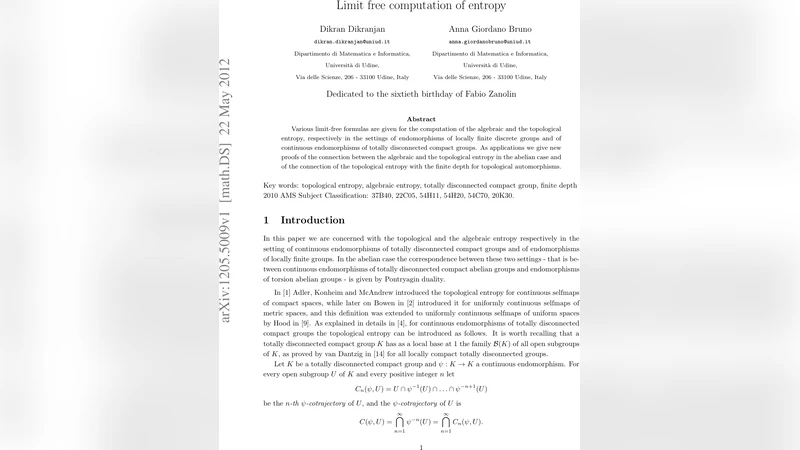
Various limit-free formulas are given for the computation of the algebraic and the topological entropy, respectively in the settings of endomorphisms of locally finite discrete groups and of continuous endomorphisms of totally disconnected compact groups. As applications we give new proofs of the connection between the algebraic and the topological entropy in the abelian case and of the connection of the topological entropy with the finite depth for topological automorphisms.
💡 Research Summary
The paper develops limit‑free formulas for both algebraic entropy (in the setting of endomorphisms of locally finite discrete groups) and topological entropy (for continuous endomorphisms of totally disconnected compact groups). Traditionally, both notions are defined via limits: algebraic entropy hₐ(φ) is the exponential growth rate of the indices |H/φⁿ(H)| as n→∞ for a finite‑index subgroup H, while topological entropy hₜ(ψ) is the growth rate of the minimal cardinality of open covers under iteration of ψ. The authors show that, under natural finiteness hypotheses, these limits can be avoided entirely.
In the algebraic case, let G be a locally finite discrete group and φ:G→G an endomorphism. If φ has finite index (i.e., φⁿ(G) has finite index for some n), one can choose a φ‑invariant finite‑index subgroup H₀ such that the index |H₀/φ(H₀)| stabilizes. The main result is the exact formula
hₐ(φ)=log |H₀/φ(H₀)|,
which holds for any such H₀ and does not involve any limit process. The proof relies on the observation that the sequence of indices |H/φⁿ(H)| eventually becomes constant once H contains a φ‑stable finite‑index core, and the constant equals |H₀/φ(H₀)|.
For the topological side, let K be a compact, totally disconnected group and ψ:K→K a continuous endomorphism. The group K possesses a basis B of open normal subgroups (the “compact open subgroups”). The authors prove that for every U∈B, the index |U/ψ⁻¹(U)| is finite and that
hₜ(ψ)=sup_{U∈B} log |U/ψ⁻¹(U)|.
Again, no limit is required: the supremum is taken over a directed family of open subgroups, and the continuity of ψ guarantees ψ⁻¹(U)∈B. When ψ is an automorphism, the formula simplifies further because ψ⁻¹(U) is again an element of B with the same index properties.
These two limit‑free expressions are then combined to give a new proof of the Bridge Theorem in the abelian case. For an abelian locally finite group G and its Pontryagin dual Ĝ, the dual endomorphism φ̂:Ĝ→Ĝ satisfies
hₐ(φ)=hₜ(φ̂).
The proof proceeds by applying the algebraic formula to φ and the topological formula to φ̂, then using Pontryagin duality to identify the relevant indices, thereby bypassing the traditional measure‑theoretic arguments.
Finally, the paper investigates topological automorphisms ψ of compact totally disconnected groups that have finite depth: there exists a smallest integer d such that ψ^{d}(K)=ψ^{d+1}(K). The authors show that in this situation
hₜ(ψ)=log |K/ψ^{d}(K)|,
establishing a precise quantitative link between depth and entropy. This result refines earlier qualitative statements that finite depth forces zero entropy, demonstrating that non‑zero entropy can coexist with finite depth, and providing an explicit formula for its value.
Overall, the work contributes a suite of practical, limit‑free tools for computing entropy in discrete and profinite settings. By eliminating the need for asymptotic limits, the authors make entropy calculations more accessible for concrete groups and endomorphisms, while preserving the deep connections between algebraic and topological dynamics that have been central to the theory.
Comments & Academic Discussion
Loading comments...
Leave a Comment