Contributions to the cross shock electric field at supercritical perpendicular shocks: Impact of the pickup ions
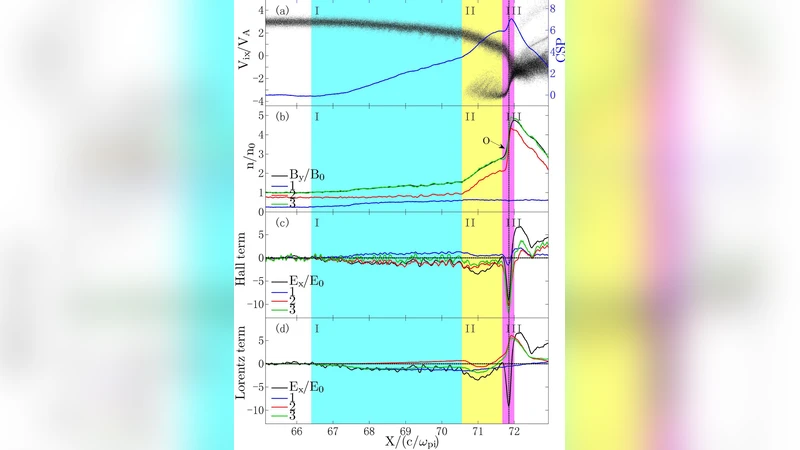
A particle-in-cell code is used to examine contributions of the pickup ions (PIs) and the solar wind ions (SWs) to the cross shock electric field at the supercritical, perpendicular shocks. The code treats the pickup ions self-consistently as a third component. Herein, two different runs with relative pickup ion density of 25% and 55% are presented in this paper. Present preliminary results show that: (1) in the low percentage (25%) pickup ion case, the shock front is nonstationary. During the evolution of this perpendicular shock, a nonstationary foot resulting from the reflected solar wind ions is formed in front of the old ramp, and its amplitude becomes larger and larger. At last, the nonstationary foot grows up into a new ramp and exceeds the old one. Such a nonstationary process can be formed periodically. hen the new ramp begins to be formed in front of the old ramp, the Hall term mainly contributed by the solar wind ions becomes more and more important. The electric field Ex is dominated by the Hall term when the new ramp exceeds the old one. Furthermore, an extended and stationary foot in pickup ion gyro-scale is located upstream of the nonstationary/self-reforming region within the shock front, and is always dominated by the Lorentz term contributed by the pickup ions; (2) in the high percentage (55%) pickup ion case, the amplitude of the stationary foot is increased as expected. One striking point is that the nonstationary region of the shock front evidenced by the self-reformation disappears. Instead, a stationary extended foot dominated by Lorentz term contributed by the pickup ions, and a tationary ramp dominated by Hall term contributed by the solar wind ions are clearly evidenced. The significance of the cross electric field on ion dynamics is also discussed.
💡 Research Summary
The authors employ a one‑dimensional particle‑in‑cell (PIC) simulation that self‑consistently treats three species – electrons, solar‑wind ions (SW) and pickup ions (PI) – to investigate how the two ion populations contribute to the cross‑shock electric field (Eₓ) at a supercritical, perpendicular shock. Two runs are presented: one with a modest PI fraction (25 % of the total ion density) and another with a high PI fraction (55 %). The electric field is decomposed into three terms: the electrostatic (potential) term, the Hall term (J × B), and the Lorentz term (v × B). By tracking the spatial and temporal evolution of each term, the study reveals how the shock structure and ion dynamics depend on the relative abundance of pickup ions.
Low‑PI case (25 %) – In the early stage the shock exhibits the classic supercritical structure: a thin foot formed by reflected SW ions ahead of a sharp ramp. The reflected SW ions generate a strong current J_y, which amplifies the Hall term (J × B)ₙ in the foot region. As time progresses the foot thickens, its electric potential grows, and eventually a new ramp forms ahead of the original one. This process repeats periodically, a phenomenon known as self‑reformation. During the re‑formation cycle the Hall term dominates Eₓ within the ramp, indicating that the dynamics of the reflected SW ions (their acceleration and deceleration) are controlled primarily by the Hall electric field. Upstream of the non‑stationary region, however, a broader, quasi‑steady foot appears on the ion‑gyro‑scale of the PIs. In this extended foot the Lorentz term (v × B) contributed by the pickup ions is the main component of Eₓ, and the Hall contribution is negligible. Thus, the low‑PI shock consists of a PI‑dominated, stationary foot and a SW‑dominated, Hall‑controlled ramp that undergoes cyclic re‑formation.
High‑PI case (55 %) – Raising the PI fraction dramatically changes the balance of terms. The PI‑generated current is larger, and the Lorentz term becomes the principal contributor to Eₓ throughout the shock front. The foot widens considerably, and its amplitude increases as expected from the higher PI density. Crucially, the self‑reformation cycle disappears: the shock settles into a stationary configuration with a single, extended foot followed by a stable ramp. In this stationary ramp the Hall term, now supplied mainly by the SW ions, still provides the dominant contribution to Eₓ, but its magnitude is reduced compared with the low‑PI case. Consequently, the shock transitions from a non‑stationary, Hall‑driven system to a stationary, Lorentz‑driven system as the PI content rises.
Implications for ion dynamics – The dominance of the Hall term in the ramp of the low‑PI shock leads to strong, rapid acceleration of reflected SW ions, enhancing ion heating and reflection efficiency. Conversely, when the Lorentz term dominates (high‑PI case), ions experience a more gradual acceleration over the extended foot, and the overall shock structure becomes smoother and steadier. The study therefore demonstrates that the cross‑shock electric field, and specifically which term (Hall vs. Lorentz) is prevailing, directly controls the energy exchange between fields and particles.
Broader significance – Pickup ions are ubiquitous in many space‑plasma environments, such as the solar‑wind interaction with planetary magnetospheres, cometary comae, and supernova‑remnant shocks. By showing that the PI fraction can suppress self‑reformation and reshape the electric‑field balance, this work provides a physical framework for interpreting the diverse shock morphologies observed in situ by spacecraft and remote sensing. It also suggests that accurate modeling of space‑weather phenomena and astrophysical shocks must include a realistic treatment of pickup‑ion populations.
In summary, the paper establishes that (1) at low PI density the shock front is non‑stationary, with a Hall‑controlled ramp that repeatedly reforms, while a PI‑driven Lorentz foot remains stationary; (2) at high PI density the shock becomes stationary, the Lorentz term supplied by the pickup ions dominates the extended foot, and the ramp is still Hall‑controlled but less dynamic. These findings highlight the pivotal role of pickup ions in determining the structure and dynamics of supercritical perpendicular shocks.