Arithmetic Self-Similarity of Infinite Sequences
We define the arithmetic self-similarity (AS) of a one-sided infinite sequence sigma to be the set of arithmetic progressions through sigma which are a vertical shift of sigma. We study the AS of seve
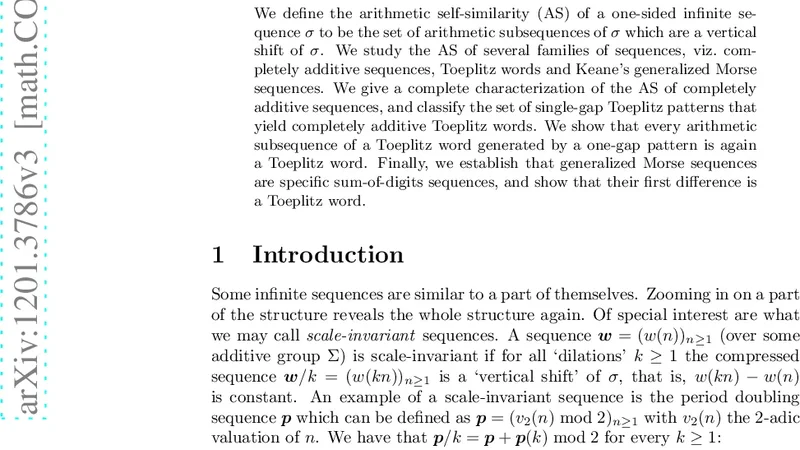
We define the arithmetic self-similarity (AS) of a one-sided infinite sequence sigma to be the set of arithmetic progressions through sigma which are a vertical shift of sigma. We study the AS of several famlies of sequences, viz. completely additive sequences, Toeplitz words and Keane’s generalized Morse sequences. We give a complete characterization of the AS of completely additive sequences, and classify the set of single-gap Toeplitz patterns that yield completely additive Toeplitz words. We show that every arithmetic subsequence of a Toeplitz word generated by a one-gap pattern is again a Toeplitz word. Finally, we establish that generalized Morse sequences are specific sum-of-digits sequences, and show that their first difference is a Toeplitz word.
💡 Research Summary
The paper introduces the notion of arithmetic self‑similarity (AS) for a one‑sided infinite sequence σ over a finite alphabet A. A pair (a, b) with a > 0 and b ≥ 0 belongs to AS(σ) if the arithmetic subsequence σ_{a·n+b} (n ∈ ℕ) coincides with σ after a uniform vertical shift, i.e., there exists a constant c such that σ_{a·n+b}=σ_n + c for all n. This definition captures repetitions that are not exact copies but are obtained by scaling the index set by an integer factor and then translating the symbol values uniformly.
The authors study AS for three families of sequences: completely additive sequences, Toeplitz words, and Keane’s generalized Morse sequences. Their contributions can be summarized as follows.
-
Completely additive sequences – A sequence σ is completely additive when σ(n)=f(n) for a function f:ℕ→G (G an abelian group) satisfying f(m+n)=f(m)+f(n) for all m,n. Because f is linear with respect to addition of indices, the authors show that for any (a,b) we have
σ_{a·n+b}=f(a·n+b)=a·f(n)+f(b)=σ_n·a+const.
Consequently every arithmetic subsequence is a vertical shift of σ, and the AS set is exactly {(a,0) | a∈ℕ_{>0}}. This gives a complete, closed‑form description of AS for the whole class of completely additive sequences. -
Toeplitz words – A Toeplitz word is generated from a finite pattern p∈(A∪{?})^ℓ by repeatedly filling each “?” with the symbol that appears at the same position in the already constructed prefix. The paper focuses on single‑gap patterns, i.e., patterns containing exactly one “?”. The authors derive necessary and sufficient algebraic conditions on the location of the gap and the surrounding letters that guarantee the resulting infinite word is completely additive. The key observation is that the gap must propagate linearly under the additive structure, leading to a system of linear congruences whose solvability characterizes admissible patterns.
Moreover, they prove that every arithmetic subsequence of a Toeplitz word generated by a one‑gap pattern is again a Toeplitz word. The proof proceeds by tracking how the index transformation (n↦a·n+b) permutes the positions of the gap; the recursive filling rule is invariant under this permutation, producing a new one‑gap pattern that generates the subsequence. Hence Toeplitz words are closed under taking arithmetic subsequences.
-
Generalized Morse sequences – Keane’s generalized Morse sequence M_k (k ≥ 2) can be written as M_k(n)=(-1)^{s_k(n)} where s_k(n) is the sum of digits of n written in base k. Since s_k is a completely additive function modulo 2, M_k belongs to the additive framework. The authors show that the first difference ΔM_k(n)=M_k(n+1)−M_k(n) is a Toeplitz word. By examining how the digit‑sum changes when n increments by one, they construct an explicit one‑gap pattern (essentially “+ – ?”) whose Toeplitz expansion reproduces ΔM_k. This links the classical Morse‑type sequences to Toeplitz dynamics and demonstrates that the first‑difference operation translates additive digit‑sum behavior into a Toeplitz structure.
Methodology – The analysis combines elementary number theory (properties of additive functions and digit sums), combinatorial dynamics (recursive definition of Toeplitz words), and modular arithmetic (to handle the shift constants). For completely additive sequences the authors use group homomorphism arguments; for Toeplitz words they formalize the filling process as a linear recurrence on indices modulo the pattern length; for generalized Morse sequences they exploit the binary nature of the digit‑sum parity and its incremental behavior.
Significance – By introducing arithmetic self‑similarity, the paper provides a new lens for studying infinite sequences that are invariant under scaling of the index set. The complete classification for completely additive sequences, the characterization of admissible single‑gap Toeplitz patterns, and the identification of generalized Morse sequences as sum‑of‑digits functions whose differences are Toeplitz words together deepen the connections between additive number theory, symbolic dynamics, and automatic sequences. The results suggest several avenues for future work, such as extending the analysis to multi‑gap Toeplitz patterns, exploring non‑additive digital functions, and investigating higher‑dimensional analogues of arithmetic self‑similarity.
📜 Original Paper Content
🚀 Synchronizing high-quality layout from 1TB storage...