DNF Sparsification and a Faster Deterministic Counting Algorithm
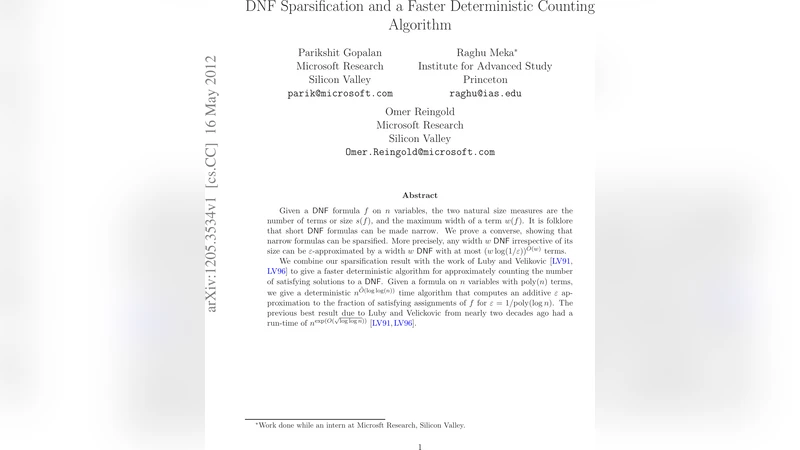
Given a DNF formula on n variables, the two natural size measures are the number of terms or size s(f), and the maximum width of a term w(f). It is folklore that short DNF formulas can be made narrow. We prove a converse, showing that narrow formulas can be sparsified. More precisely, any width w DNF irrespective of its size can be $\epsilon$-approximated by a width $w$ DNF with at most $(w\log(1/\epsilon))^{O(w)}$ terms. We combine our sparsification result with the work of Luby and Velikovic to give a faster deterministic algorithm for approximately counting the number of satisfying solutions to a DNF. Given a formula on n variables with poly(n) terms, we give a deterministic $n^{\tilde{O}(\log \log(n))}$ time algorithm that computes an additive $\epsilon$ approximation to the fraction of satisfying assignments of f for $\epsilon = 1/\poly(\log n)$. The previous best result due to Luby and Velickovic from nearly two decades ago had a run-time of $n^{\exp(O(\sqrt{\log \log n}))}$.
💡 Research Summary
The paper makes two intertwined contributions: a structural sparsification theorem for disjunctive normal form (DNF) formulas of bounded width, and a deterministic algorithm that leverages this theorem to count satisfying assignments of a DNF much faster than previously known.
1. Width‑Sparsification Theorem
For any DNF formula f on n variables whose each term (conjunction) contains at most w literals, and for any error parameter ε > 0, the authors construct another DNF g that (i) has the same width w, (ii) contains at most (w·log(1/ε))^{O(w)} terms, and (iii) ε‑approximates f in the sense that for every input x, if f(x)=1 then g(x)=1, while the probability that g(x)=1 when f(x)=0 is at most ε. The construction proceeds by repeatedly applying a strengthened Sunflower Lemma to locate large collections of terms sharing a common “core” and then replacing each such sunflower by a single representative term. Random restrictions are interleaved to keep the width bounded while shrinking the formula. The analysis shows that after O(w·log(1/ε)) iterations the number of surviving terms drops to the claimed bound. This theorem is tight up to the exponent in w and demonstrates that a narrow DNF is inherently “sparse”: its expressive power can be captured by a modest number of terms.
2. Faster Deterministic Approximate Counting
The classic deterministic counting framework of Luby and Velikovic (2003) reduces the problem of estimating the fraction of satisfying assignments of a DNF to a sequence of sub‑problems that each depend linearly on the number of terms. Their algorithm runs in time n^{exp(O(√log log n))}, which is prohibitive for large n. By first applying the width‑sparsification theorem, the authors replace the original DNF (which may have polynomially many terms) with a sparsified version whose term count is bounded by (w·log(1/ε))^{O(w)}. When the original DNF has poly(n) terms, its width w is at most O(log n) (otherwise the formula would already be too wide to be useful). Substituting this bound yields a total running time of n^{\tilde O(log log n)} for any ε = 1/poly(log n). The algorithm remains deterministic and provides an additive ε‑approximation to the true satisfaction probability.
3. Technical Highlights and Implications
- The sparsification proof blends combinatorial sunflower arguments with probabilistic random‑restriction techniques, a combination that had not been previously used to control both width and term count simultaneously.
- The deterministic counting improvement is essentially a “bootstrapping” effect: a structural reduction (width‑sparsification) feeds directly into an existing algorithmic pipeline, collapsing the previously exponential dependence on √log log n to a near‑polylogarithmic one.
- The result narrows the gap between deterministic and randomized approximate counting for DNFs. Randomized Monte‑Carlo methods can already achieve polynomial‑time additive approximations; this work shows that deterministic methods can be competitive when the formula’s width is modest.
- Beyond counting, the sparsification theorem offers a new lens on circuit complexity: any width‑w DNF can be replaced by a “core” DNF of size (w·log (1/ε))^{O(w)} without altering its behavior beyond ε. This may be useful for lower‑bound arguments, learning theory, and designing efficient SAT‑solvers that exploit width constraints.
4. Limitations and Open Directions
The sparsification bound becomes less useful when w grows super‑logarithmically, because (w·log (1/ε))^{O(w)} can still be exponential in n. Extending the technique to handle larger widths, or improving the dependence on w (e.g., achieving (log (1/ε))^{O(w)}), remains an open problem. Moreover, the current algorithm delivers an additive error; achieving a comparable deterministic multiplicative approximation with similar time bounds is another challenging direction.
In summary, the paper establishes that narrow DNFs are not only convertible to narrow formulas with few terms, but that this structural insight directly translates into a deterministic algorithm for approximate DNF counting whose running time is n^{\tilde O(log log n)}—a dramatic improvement over the previous n^{exp(O(√log log n))} bound. This bridges a longstanding gap in deterministic counting and opens new avenues for exploiting width constraints in Boolean function analysis.
Comments & Academic Discussion
Loading comments...
Leave a Comment