Estimating Small Probabilities for Langevin Dynamics
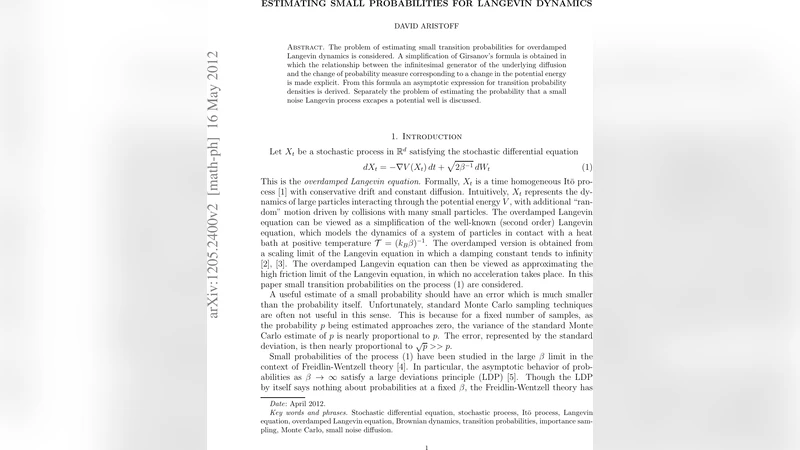
The problem of estimating small transition probabilities for overdamped Langevin dynamics is considered. A simplification of Girsanov’s formula is obtained in which the relationship between the infinitesimal generator of the underlying diffusion and the change of probability measure corresponding to a change in the potential energy is made explicit. From this formula an asymptotic expression for transition probability densities is derived. Separately the problem of estimating the probability that a small noise Langevin process excapes a potential well is discussed.
💡 Research Summary
The paper addresses the challenging problem of estimating extremely small transition probabilities in overdamped Langevin dynamics, a situation that arises when a system must cross an energy barrier under weak stochastic forcing. The authors begin by revisiting the infinitesimal generator of the diffusion, (L = -\nabla V \cdot \nabla + \beta^{-1}\Delta), where (V) is the potential energy and (\beta^{-1}) represents the temperature (or noise intensity). They then focus on a specific class of measure changes: those induced by a perturbation of the potential, (V \to V + \Delta V). By applying Girsanov’s theorem in this restricted setting, they derive a remarkably compact Radon‑Nikodym derivative
\
Comments & Academic Discussion
Loading comments...
Leave a Comment