Statistics of reflection eigenvalues in chaotic cavities with non-ideal leads
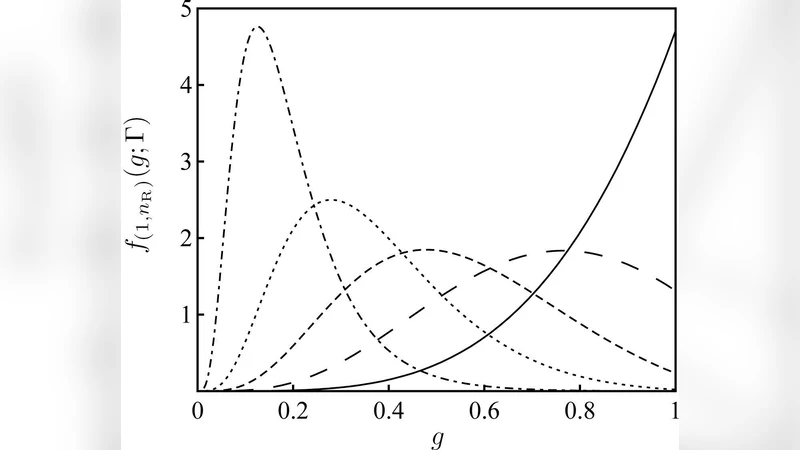
The scattering matrix approach is employed to determine a joint probability density function of reflection eigenvalues for chaotic cavities coupled to the outside world through both ballistic and tunnel point contacts. Derived under assumption of broken time-reversal symmetry, this result is further utilised to (i) calculate the density and correlation functions of reflection eigenvalues, and (ii) analyse fluctuations properties of the Landauer conductance for the illustrative example of asymmetric chaotic cavity. Further extensions of the theory are pinpointed.
💡 Research Summary
In this paper the authors develop a non‑perturbative random‑matrix‑theory (RMT) framework for quantum transport through chaotic cavities that are coupled to the external world via a mixture of ballistic (ideal) and tunnel (non‑ideal) point contacts. The analysis is restricted to systems with broken time‑reversal symmetry (Dyson index β = 2). Starting from the Heidelberg representation of the scattering matrix and the Poisson kernel for its distribution, the authors introduce a deterministic average scattering matrix (\bar S) that encodes the tunnel probabilities (\Gamma_j) of the non‑ideal lead. By performing a polar decomposition of the scattering matrix and integrating over the two unitary groups with the Haar measure, they reduce the problem to a matrix‑integral that can be evaluated using Schur‑function techniques and the theory of hypergeometric functions of matrix arguments.
The central result is the joint probability density function (JPDF) of the reflection eigenvalues (R_j=1-T_j) (with (T_j) the transmission eigenvalues) for a cavity with (n_L) channels in the left, possibly non‑ideal lead and (n_R\ge n_L) channels in the right, ideal lead. The JPDF reads \
Comments & Academic Discussion
Loading comments...
Leave a Comment