On the topology of free paratopological groups
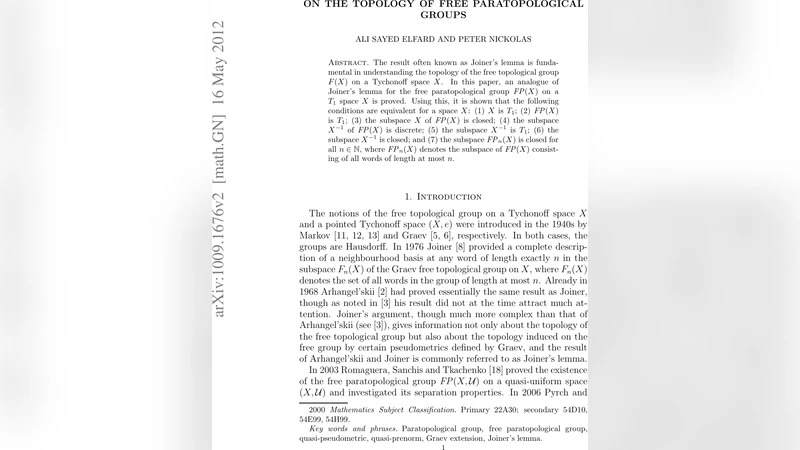
The result often known as Joiner’s lemma is fundamental in understanding the topology of the free topological group $F(X)$ on a Tychonoff space$X$. In this paper, an analogue of Joiner’s lemma for the free paratopological group $\FP(X)$ on a $T_1$ space $X$ is proved. Using this, it is shown that the following conditions are equivalent for a space $X$: (1) $X$ is $T_1$; (2) $\FP(X)$ is $T_1$; (3) the subspace $X$ of $\FP(X)$ is closed; (4) the subspace $X^{-1}$ of $\FP(X)$ is discrete; (5) the subspace $X^{-1}$ is $T_1$; (6) the subspace $X^{-1}$ is closed; and (7) the subspace $\FP_n(X)$ is closed for all $n \in \N$, where $\FP_n(X)$ denotes the subspace of $\FP(X)$ consisting of all words of length at most $n$.
💡 Research Summary
The paper extends a cornerstone result from the theory of free topological groups—Joiner’s Lemma—to the broader setting of free paratopological groups. A paratopological group is a group equipped with a topology that makes the multiplication continuous, but does not require the inversion map to be continuous. The authors focus on a $T_{1}$ space $X$ and construct its free paratopological group $\FP(X)$. By adapting the combinatorial and topological arguments underlying Joiner’s Lemma, they establish a version that works without assuming continuity of inversion. This new lemma provides an explicit description of a neighborhood basis at the identity in $\FP(X)$ in terms of finite words formed from elements of $X$ and their open neighborhoods.
Using this description, the authors prove a striking equivalence: the following seven statements are all equivalent for a space $X$:
- $X$ is $T_{1}$.
- $\FP(X)$ is $T_{1}$.
- The canonical embedding of $X$ into $\FP(X)$ yields a closed subspace.
- The set $X^{-1}={x^{-1}:x\in X}$ is discrete in $\FP(X)$.
- $X^{-1}$ is $T_{1}$ in $\FP(X)$.
- $X^{-1}$ is closed in $\FP(X)$.
- For every natural number $n$, the subspace $\FP_{n}(X)$ consisting of all reduced words of length at most $n$ is closed in $\FP(X)$.
The proof proceeds by first showing that if $X$ is $T_{1}$ then the neighborhood basis supplied by the paratopological version of Joiner’s Lemma makes $\FP(X)$ $T_{1}$ as well. Conversely, if $\FP(X)$ is $T_{1}$, the embedding of $X$ forces $X$ to inherit the $T_{1}$ property. The authors then analyze the subspace $X^{-1}$: discreteness of $X^{-1}$ forces each singleton ${x^{-1}}$ to be open, which in turn implies that $X$ is closed in $\FP(X)$, and vice‑versa. The equivalence with condition (7) is established by an induction on word length. Assuming $\FP_{n-1}(X)$ is closed, they show that any limit point of $\FP_{n}(X)$ must already belong to $\FP_{n-1}(X)$, using the continuity of multiplication and the $T_{1}$ nature of $X$.
The paper concludes by discussing the significance of these results. Despite the lack of continuity of inversion, free paratopological groups retain enough topological rigidity that many classical properties of free topological groups survive. In particular, the $T_{1}$ character of the base space $X$ completely determines the separation, closedness, and discreteness properties of several natural subspaces of $\FP(X)$. This deepens our understanding of how algebraic freedom interacts with weakened topological constraints, and opens the door to further investigations of other separation axioms (e.g., $T_{2}$, regularity) within the paratopological framework.
Comments & Academic Discussion
Loading comments...
Leave a Comment