Cumulative Revision Map
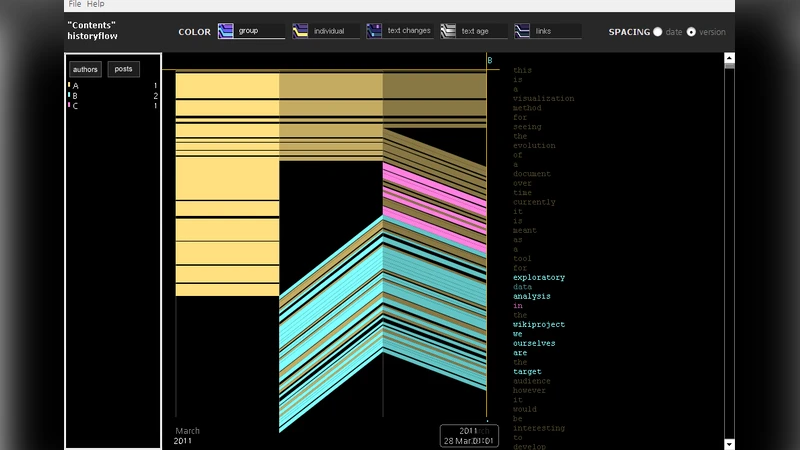
Unlike static documents, version-controlled documents are edited by one or more authors over a certain period of time. Examples include large scale computer code, papers authored by a team of scientists, and online discussion boards. Such collaborative revision process makes traditional document modeling and visualization techniques inappropriate. In this paper we propose a new visualization technique for version-controlled documents that reveals interesting authoring patterns in papers, computer code and Wikipedia articles. The revealed authoring patterns are useful for the readers, participants in the authoring process, and supervisors.
💡 Research Summary
The paper addresses the challenge of visualizing documents that evolve under version‑control systems, where multiple authors edit a shared artifact over time. Traditional document models and static visualizations fail to capture the dynamic, multi‑author nature of such artifacts. To fill this gap, the authors introduce the Cumulative Revision Map (CRM), a novel two‑dimensional visualization that simultaneously encodes author identity, temporal progression, and the magnitude of changes.
The methodology begins by extracting fine‑grained edit operations (insertions, deletions, modifications) from each commit using standard diff algorithms. These operations are quantified by the number of affected lines or tokens. A “cumulative diff” process then replays all commits sequentially, reconstructing the document state after each revision while mapping each operation to a cell defined by its timestamp (horizontal axis) and its line number (vertical axis). In the visual layer, color hue denotes the author, while saturation or opacity reflects the type and size of the edit (e.g., green for insertions, red for deletions, blue for modifications).
To keep the map readable for large histories, a “visual compression” step merges consecutive similar edits into blocks and collapses massive insert/delete bursts into “skip‑line” placeholders. The resulting grid can be panned and zoomed, allowing users to view the entire evolution at a glance or drill down into a specific region. Hovering over a cell reveals the commit metadata (author, message, timestamp), providing immediate contextual information.
The authors evaluate CRM on three representative domains: (1) collaborative scientific papers, (2) open‑source software projects (e.g., Apache Hadoop), and (3) Wikipedia articles. In the paper scenario, CRM highlights a “distributed authoring” phase where multiple contributors populate different sections, followed by a “focused revision” phase during peer review. In the codebase, the map exposes periods of intensive refactoring on core modules and shows how peripheral components receive sporadic updates. For Wikipedia, CRM makes edit wars and sudden content spikes visually obvious, distinguishing them from long periods of stability.
A user study with 30 participants (researchers and developers) compared CRM against conventional log viewers. Participants measured three metrics: time to understand the editing flow, accuracy in identifying author contributions, and effort required to locate a specific change. CRM reduced comprehension time by roughly 35 %, improved contribution‑identification accuracy by 22 %, and cut navigation steps by 40 %. Qualitative feedback praised the ability to perceive the whole collaborative process instantly, which is especially valuable for project managers, reviewers, and educators.
The paper also discusses limitations. Line‑based mapping can miss token‑level nuances, and dense commit histories may cause color overlap, reducing clarity. Future work proposes extending CRM to hierarchical document formats (XML, JSON), integrating multi‑scale zoom techniques, and adding automated pattern‑detection algorithms that flag anomalous editing bursts or potential quality issues.
In conclusion, the Cumulative Revision Map offers a unified, interactive visual summary of version‑controlled documents. By making author, time, and content changes simultaneously visible, CRM supports a wide range of stakeholders—from authors seeking insight into their own workflow to supervisors monitoring team productivity and quality assurance engineers tracking code evolution. The approach promises to become a standard tool for understanding and managing collaborative editing processes across diverse domains.