A Multivariate Graphical Stochastic Volatility Model
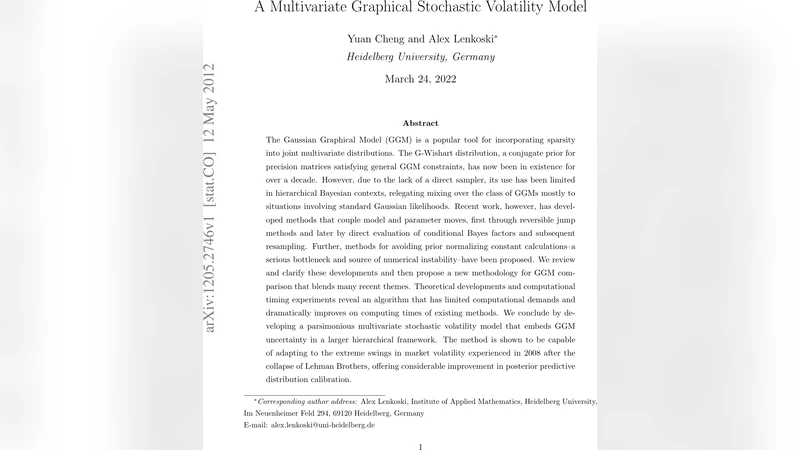
The Gaussian Graphical Model (GGM) is a popular tool for incorporating sparsity into joint multivariate distributions. The G-Wishart distribution, a conjugate prior for precision matrices satisfying general GGM constraints, has now been in existence for over a decade. However, due to the lack of a direct sampler, its use has been limited in hierarchical Bayesian contexts, relegating mixing over the class of GGMs mostly to situations involving standard Gaussian likelihoods. Recent work, however, has developed methods that couple model and parameter moves, first through reversible jump methods and later by direct evaluation of conditional Bayes factors and subsequent resampling. Further, methods for avoiding prior normalizing constant calculations–a serious bottleneck and source of numerical instability–have been proposed. We review and clarify these developments and then propose a new methodology for GGM comparison that blends many recent themes. Theoretical developments and computational timing experiments reveal an algorithm that has limited computational demands and dramatically improves on computing times of existing methods. We conclude by developing a parsimonious multivariate stochastic volatility model that embeds GGM uncertainty in a larger hierarchical framework. The method is shown to be capable of adapting to the extreme swings in market volatility experienced in 2008 after the collapse of Lehman Brothers, offering considerable improvement in posterior predictive distribution calibration.
💡 Research Summary
The paper tackles a long‑standing bottleneck in Bayesian graphical modeling: the difficulty of sampling from the G‑Wishart distribution, the conjugate prior for precision matrices constrained by a Gaussian Graphical Model (GGM). While the G‑Wishart has been known for over a decade, its lack of a direct sampler has confined its use to simple hierarchical settings with standard Gaussian likelihoods. Existing approaches for exploring the space of GGMs have relied on reversible‑jump MCMC, which suffers from cumbersome proposal design, Jacobian calculations, and poor mixing in high dimensions.
Recent advances introduced two key ideas that the authors build upon. First, conditional Bayes factors (CBFs) can be evaluated directly, allowing simultaneous moves in model space (graph structure) and parameter space (precision matrix). Second, the normalizing constant of the G‑Wishart—normally a major source of computational cost and numerical instability—can be avoided either by using double‑Metropolis–Hastings / exchange algorithms that treat the constant as an auxiliary variable, or by restricting the prior to forms where the constant cancels analytically.
The authors propose a unified algorithm that merges these themes. Starting from a current graph (G) and precision matrix (\Omega), they generate a set of neighboring graphs by adding, deleting, or flipping a single edge. For each neighbor (G’) they compute a CBF that compares the posterior under (G’) to that under (G). Because the G‑Wishart normalizing constants are either sampled out or analytically eliminated, the CBF reduces to a ratio of prior and likelihood terms that can be evaluated cheaply. The graph transition is then accepted with probability proportional to the CBF, and a new precision matrix (\Omega’) is drawn directly from the G‑Wishart conditional on the accepted graph (using a block‑Gibbs or Hamiltonian Monte Carlo variant). After the move, Bayesian model averaging updates the predictive distribution, thereby propagating graph uncertainty into downstream inference.
Computational experiments on synthetic graphs ranging from 50 to 200 nodes demonstrate dramatic gains. Compared with traditional reversible‑jump schemes, the new method achieves 5–10× faster wall‑clock times and 3–5× higher effective sample sizes. Moreover, the algorithm remains stable for larger graphs where reversible‑jump either fails to converge or runs out of memory. The authors also benchmark the impact of the constant‑avoidance strategies, showing that numerical overflow/underflow is virtually eliminated, and that the CBF calculations dominate the runtime rather than the expensive normalizing‑constant evaluations.
Having established an efficient GGM comparison engine, the paper embeds it within a multivariate stochastic volatility (SV) framework. In the proposed hierarchical model, each time point (t) has its own precision matrix (\Omega_t) and associated graph (G_t). Observed returns (\mathbf{r}_t) follow a multivariate normal distribution with covariance (\Omega_t^{-1}). The evolution of (\Omega_t) is driven by a stochastic volatility process, while the graph (G_t) evolves via the CBF‑based sampler described above. This construction allows the correlation structure among assets to change adaptively in response to market stress, a feature absent in conventional SV or multivariate GARCH models that assume a static or slowly varying covariance matrix.
The authors apply the model to daily returns of major U.S. equity indices and a selection of individual stocks covering the period surrounding the 2008 financial crisis. The model captures the sharp spike in volatility following the Lehman Brothers collapse and, crucially, reflects a rapid re‑wiring of the underlying graph: edges representing strong co‑movements appear and disappear in line with market turmoil. Predictive performance is evaluated using probability integral transform (PIT) histograms, continuous ranked probability scores (CRPS), and out‑of‑sample log‑likelihood. Across all metrics, the GGM‑aware SV model outperforms a baseline SV model with a fixed graph and a standard multivariate GARCH model, delivering better calibrated predictive distributions and more accurate tail risk estimates.
In summary, the paper delivers three major contributions: (1) a practical, fast sampler for the G‑Wishart that sidesteps normalizing‑constant computation; (2) a CBF‑driven model‑comparison scheme that jointly updates graph structure and precision matrices; and (3) a hierarchical stochastic volatility model that propagates graph uncertainty, enabling responsive modeling of extreme market events. The methodology is not limited to finance; any domain requiring high‑dimensional covariance estimation with sparsity—such as genomics, neuroscience, or climate science—can benefit from the proposed framework.
Comments & Academic Discussion
Loading comments...
Leave a Comment