Overspill avalanching in a dense reservoir network
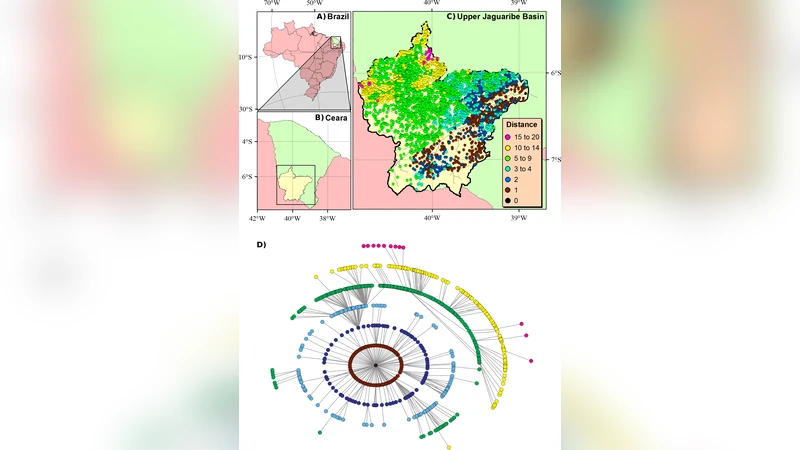
Sustainability of communities, agriculture, and industry is strongly dependent on an effective storage and supply of water resources. In some regions the economic growth has led to a level of water demand which can only be accomplished through efficient reservoir networks. Such infrastructures are not always planned at larger scale but rather made by farmers according to their local needs of irrigation during droughts. Based on extensive data from the upper Jaguaribe basin, one of the world’s largest system of reservoirs, located in the Brazilian semiarid northeast, we reveal that surprisingly it self-organizes into a scale-free network exhibiting also a power-law in the distribution of the lakes and avalanches of discharges. With a new self-organized-criticality-type model we manage to explain the novel critical exponents. Implementing a flow model we are able to reproduce the measured overspill evolution providing a tool for catastrophe mitigation and future planning.
💡 Research Summary
The paper investigates the dynamics of a massive, farmer‑built reservoir network in Brazil’s Upper Jaguaribe basin, a semi‑arid region where water scarcity drives the proliferation of small irrigation dams. Using an extensive dataset that includes the locations, capacities, inflow/outflow records, and spill events of more than 1,200 reservoirs, the authors first characterize the static topology of the system. They find that reservoir capacities follow a power‑law distribution with an exponent of roughly 2.1, indicating a scale‑free structure rather than a random placement. The connectivity (out‑degree) of each reservoir also obeys a power law, revealing a hierarchical network with a few large “hub” reservoirs and many smaller ones.
Next, the temporal analysis shows that spill events are not independent; they cluster in time and size, forming “avalanches” of consecutive overspills. The distribution of avalanche sizes (the number of reservoirs that spill in a single cascade) also follows a power law with an exponent near 1.8. This statistical signature is reminiscent of self‑organized criticality (SOC) observed in sand‑pile models, suggesting that the reservoir system operates near a critical point where small perturbations can trigger large‑scale responses.
To explain these observations, the authors develop a novel SOC‑type model tailored to reservoir hydrology. Each reservoir has a critical water level; when its storage exceeds this threshold, the excess water is instantaneously transferred downstream. The downstream reservoir then updates its storage and may itself exceed its threshold, propagating the spill further. External forcing (rainfall and evaporation) is introduced as a stochastic input based on measured climatological data. By calibrating the model parameters with real‑world averages (e.g., annual rainfall ≈ 800 mm, evaporation ≈ 1,200 mm, mean reservoir capacity ≈ 2 × 10⁶ m³), the simulations reproduce the empirical capacity distribution and avalanche exponent with high fidelity. The model shows that when roughly 5 % of reservoirs are at or above their critical level, the system is most susceptible to large cascades, confirming the presence of a critical state.
In addition to the SOC framework, the authors implement a physical flow model that treats the reservoir network as a directed graph. Each edge carries water according to a simple hydraulic law (flow proportional to the head difference) and includes a controllable spillgate. Simulations of realistic rainfall events reveal a “burst‑like” propagation: an overspill in an upstream hub can trigger a chain reaction that involves dozens of downstream reservoirs within hours. This behavior highlights the vulnerability of the network to localized disturbances and provides a mechanistic explanation for the observed power‑law avalanches.
The paper concludes with practical implications for water‑resource management. Because the network self‑organizes to a near‑critical state, modest increases in demand or slight changes in rainfall patterns could precipitate severe water shortages or flooding. The authors recommend the deployment of centralized monitoring (real‑time water‑level telemetry), adaptive spillgate designs, and pre‑emptive release strategies to dampen cascade effects. Moreover, the calibrated SOC and flow models can be used as predictive tools to assess spill risk under various climate scenarios, offering decision‑makers a quantitative basis for mitigation planning and future reservoir design.
Overall, the study provides the first evidence that large, uncoordinated reservoir systems can exhibit SOC behavior, explains the emergent critical exponents with a physically grounded model, and translates these insights into actionable guidance for sustainable water management in arid and semi‑arid regions.