An optimal local approximation algorithm for max-min linear programs
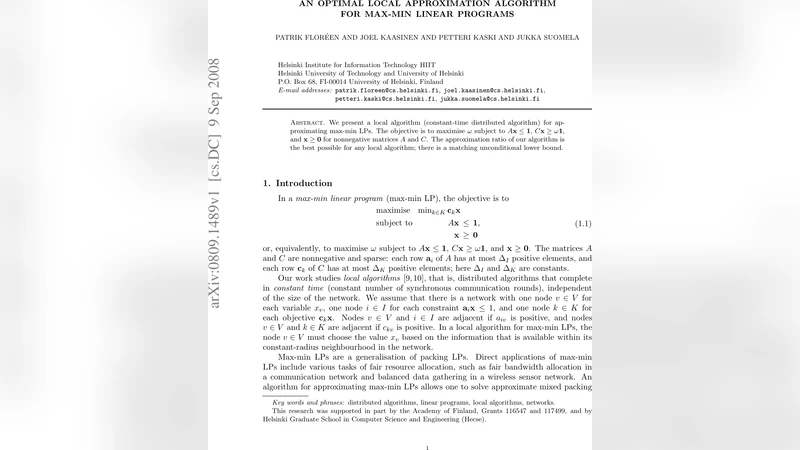
We present a local algorithm (constant-time distributed algorithm) for approximating max-min LPs. The objective is to maximise $\omega$ subject to $Ax \le 1$, $Cx \ge \omega 1$, and $x \ge 0$ for nonnegative matrices $A$ and $C$. The approximation ratio of our algorithm is the best possible for any local algorithm; there is a matching unconditional lower bound.
💡 Research Summary
The paper addresses the problem of solving a max‑min linear program (LP) in a distributed setting where each node has only local information. Formally, given non‑negative matrices (A\in\mathbb{R}^{m\times n}{\ge 0}) and (C\in\mathbb{R}^{p\times n}{\ge 0}), the goal is to choose a non‑negative vector (x) and a scalar (\omega) that maximize (\omega) subject to
(Ax\le \mathbf{1},; Cx\ge \omega\mathbf{1},; x\ge 0.)
This formulation captures many resource‑allocation scenarios: the constraints (Ax\le 1) model limited capacities, while (Cx\ge \omega\mathbf{1}) require each demand to receive at least a fraction (\omega) of its request.
Local‑algorithm model
The authors work in the standard LOCAL model of distributed computing. Each node corresponds to a variable (x_j) (or to a constraint) and can exchange messages with its neighbours in a communication graph derived from the non‑zero entries of (A) and (C). A local (or constant‑time) algorithm must decide the value of (x_j) after a constant number of synchronous rounds, i.e., using only information from a fixed‑radius neighbourhood. No global coordination or unbounded communication is allowed.
Algorithmic contribution
The paper presents a two‑phase constant‑time algorithm:
- Local activity estimation.
For each variable (x_j) the algorithm gathers, from its 1‑hop neighbourhood, the normalized coefficients of the constraints that involve (x_j).
\
Comments & Academic Discussion
Loading comments...
Leave a Comment