New method for the time calibration of an interferometric radio antenna array
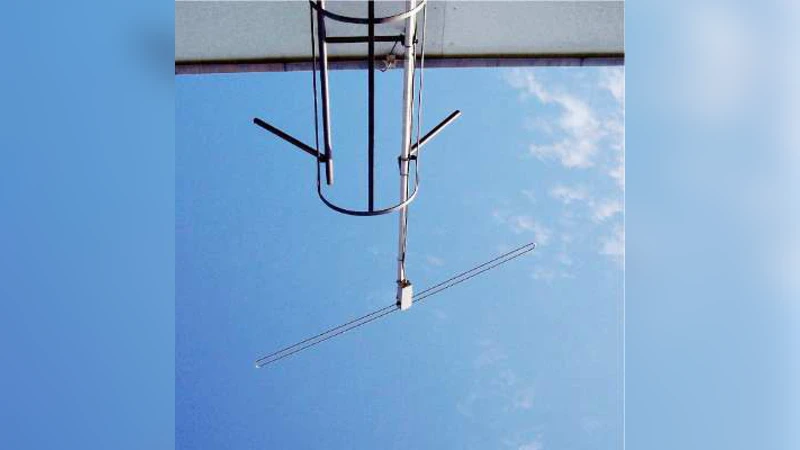
Digital radio antenna arrays, like LOPES (LOFAR PrototypE Station), detect high-energy cosmic rays via the radio emission from atmospheric extensive air showers. LOPES is an array of dipole antennas placed within and triggered by the KASCADE-Grande experiment on site of the Karlsruhe Institute of Technology, Germany. The antennas are digitally combined to build a radio interferometer by forming a beam into the air shower arrival direction which allows measurements even at low signal-to-noise ratios in individual antennas. This technique requires a precise time calibration. A combination of several calibration steps is used to achieve the necessary timing accuracy of about 1 ns. The group delays of the setup are measured, the frequency dependence of these delays (dispersion) is corrected in the subsequent data analysis, and variations of the delays with time are monitored. We use a transmitting reference antenna, a beacon, which continuously emits sine waves at known frequencies. Variations of the relative delays between the antennas can be detected and corrected for at each recorded event by measuring the phases at the beacon frequencies.
💡 Research Summary
The paper presents a comprehensive method for achieving sub‑nanosecond timing precision in the LOPES interferometric radio antenna array, which is used to detect the radio emission from extensive air showers generated by high‑energy cosmic rays. LOPES consists of dozens of broadband dipole antennas operating in the 30–80 MHz band and is co‑located with the KASCADE‑Grande particle detector at the Karlsruhe Institute of Technology. By digitally beam‑forming the signals from all antennas toward the air‑shower arrival direction, the array can extract coherent radio pulses even when the signal‑to‑noise ratio (SNR) in individual antennas is low. This interferometric technique, however, demands that the relative timing of each antenna channel be known to better than about 1 ns.
To meet this requirement the authors implement a three‑stage calibration strategy. The first stage measures the absolute group delay of each signal path (antenna, cable, front‑end electronics, and ADC trigger) using a dedicated reference transmitter that emits short pulses. By locating a consistent feature in the recorded waveforms (e.g., the rising edge or zero‑crossing) the per‑channel delay is extracted with sub‑nanosecond resolution.
The second stage addresses the frequency‑dependent component of the delay, commonly referred to as dispersion. Because the antenna‑receiver chain exhibits a non‑linear phase response across the operational bandwidth, different frequency components of a broadband pulse experience slightly different propagation times, leading to waveform distortion and timing bias. The authors characterize this dispersion by measuring S‑parameters in the laboratory and by electromagnetic simulations of the antenna and front‑end. The resulting phase‑versus‑frequency curve is then used to apply an inverse phase correction during offline data processing, effectively flattening the group delay across the band.
The third and most innovative stage introduces a continuous beacon system. A small, fixed transmitter (the “beacon”) continuously emits several narrow‑band sine waves at known frequencies (e.g., 45 MHz, 55 MHz, 65 MHz). Every LOPES antenna records these beacon tones simultaneously with the air‑shower signal. By performing a fast Fourier transform on each recorded trace, the phase of each beacon frequency is extracted for every antenna. The relative phase differences directly encode the instantaneous differential delay between antenna pairs. Because the beacon frequencies are stable and the emitted phases are known, any drift caused by temperature changes, power‑supply fluctuations, or mechanical expansion of cables can be detected on an event‑by‑event basis. The measured phase offsets are then converted into timing corrections and applied to the air‑shower data in real time.
The combined effect of the three calibration steps reduces the overall timing uncertainty to 0.5–1 ns, a factor of five improvement over previous calibration schemes that relied solely on periodic pulse tests. This level of precision enables reliable interferometric beam‑forming at low SNR, improves the reconstruction of the air‑shower arrival direction, and enhances the determination of the radio pulse’s lateral distribution and polarization. Moreover, the beacon‑based continuous monitoring provides a robust, automated solution for long‑term stability, making the approach attractive for future large‑scale radio arrays such as LOFAR‑2.0 or the planned SKA‑Cosmic‑Ray extension.
In summary, the authors demonstrate that a systematic combination of absolute group‑delay measurement, dispersion correction, and real‑time beacon phase monitoring yields the nanosecond‑level timing accuracy required for high‑precision cosmic‑ray radio detection. Their methodology is fully documented, reproducible, and scalable, representing a significant advance in the instrumentation of radio‑based astroparticle physics.
Comments & Academic Discussion
Loading comments...
Leave a Comment