On the unconstrained expansion of a spherical plasma cloud turning collisionless : case of a cloud generated by a nanometer dust grain impact on an uncharged target in space
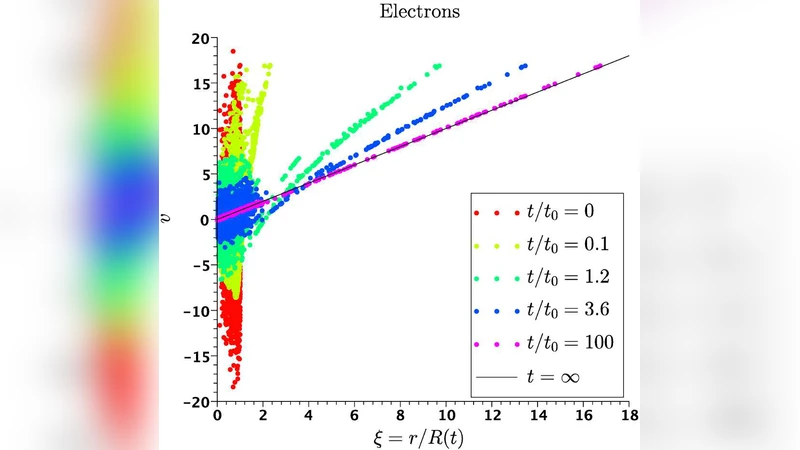
Nano and micro meter sized dust particles travelling through the heliosphere at several hundreds of km/s have been repeatedly detected by interplanetary spacecraft. When such fast moving dust particles hit a solid target in space, an expanding plasma cloud is formed through the vaporisation and ionisation of the dust particles itself and part of the target material at and near the impact point. Immediately after the impact the small and dense cloud is dominated by collisions and the expansion can be described by fluid equations. However, once the cloud has reached micro-m dimensions, the plasma may turn collisionless and a kinetic description is required to describe the subsequent expansion. In this paper we explore the late and possibly collisionless spherically symmetric unconstrained expansion of a single ionized ion-electron plasma using N-body simulations. Given the strong uncertainties concerning the early hydrodynamic expansion, we assume that at the time of the transition to the collisionless regime the cloud density and temperature are spatially uniform. We do also neglect the role of the ambient plasma. This is a reasonable assumption as long as the cloud density is substantially higher than the ambient plasma density. In the case of clouds generated by fast interplanetary dust grains hitting a solid target some 10^7 electrons and ions are liberated and the in vacuum approximation is acceptable up to meter order cloud dimensions. …
💡 Research Summary
The paper investigates the late‑time, collision‑less expansion of a spherical plasma cloud generated when a high‑velocity interplanetary dust grain impacts a solid target in space. In the immediate aftermath of the impact, the cloud is dense and collisional, and its dynamics can be described by fluid equations. However, once the cloud expands to a size of order micrometres, the mean free path of particles becomes comparable to the cloud radius, and collisions become negligible. At this transition point the authors assume spatially uniform density and temperature for both electrons and ions, and they neglect any interaction with the ambient plasma, which is justified as long as the cloud density far exceeds the background.
To study the subsequent kinetic regime the authors employ a large‑scale N‑body simulation that follows roughly 10⁷ charged particles (≈5 × 10⁶ electrons and the same number of ions). The initial cloud radius is set to a few micrometres, and the particles are given equal temperatures. The simulation solves the full electrostatic interaction among all particles, thereby providing a self‑consistent electric field at each time step.
The results reveal a clear separation of electron and ion dynamics. Because electrons are much lighter, they are rapidly accelerated by the self‑generated electric field and form a thin, positively charged sheath at the outer edge of the cloud. This sheath creates a potential barrier that confines the ions, which continue to expand more slowly and essentially undergo a quasi‑uniform acceleration from the cloud centre. Consequently, the electric field is nearly zero inside the core, rises sharply near the sheath, and then decays outside the cloud. The electron temperature drops quickly due to adiabatic expansion, while the ion temperature experiences a modest increase; the electron‑to‑ion temperature ratio therefore grows with time.
These findings differ from classic self‑similar expansion models (e.g., the Lagrangian‑type solutions) that often assume a single fluid or neglect charge separation. The presence of a distinct electron sheath and the resulting potential difference play a dominant role in limiting the overall expansion and shaping the velocity distributions of both species.
The authors discuss the implications for spacecraft dust detectors that rely on measuring the plasma flash generated by impacts. The characteristic potential pulse associated with the electron sheath could be used to infer impactor mass, velocity, and composition, provided that the detector response time is fast enough to resolve the sheath formation. The study also outlines the limits of the present model: it ignores the early hydrodynamic non‑uniformities, ambient magnetic fields, and the eventual mixing of the cloud with the surrounding plasma when the density contrast diminishes.
In summary, the paper provides the first detailed kinetic description of an unconstrained, spherical, collision‑less plasma cloud relevant to nanodust impacts. By combining realistic particle numbers with self‑consistent electrostatics, it demonstrates how charge separation, sheath formation, and differential cooling govern the expansion. These insights advance our understanding of micro‑scale plasma phenomena in space and offer practical guidance for the design and interpretation of dust impact instrumentation.