Causal graph dynamics
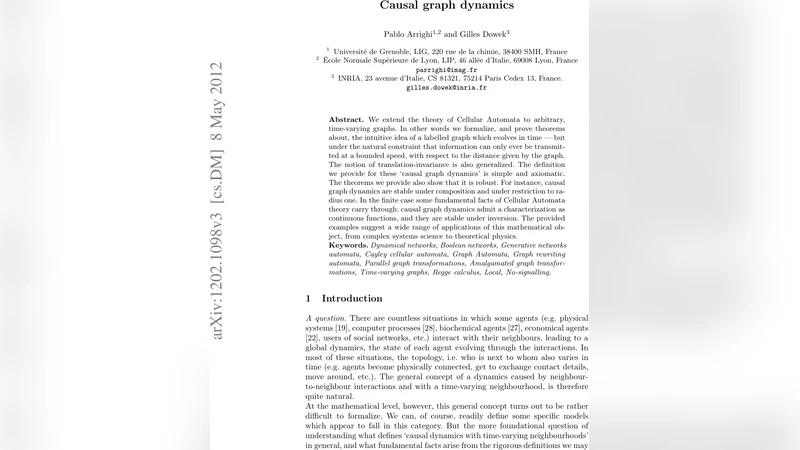
We extend the theory of Cellular Automata to arbitrary, time-varying graphs. In other words we formalize, and prove theorems about, the intuitive idea of a labelled graph which evolves in time - but under the natural constraint that information can only ever be transmitted at a bounded speed, with respect to the distance given by the graph. The notion of translation-invariance is also generalized. The definition we provide for these “causal graph dynamics” is simple and axiomatic. The theorems we provide also show that it is robust. For instance, causal graph dynamics are stable under composition and under restriction to radius one. In the finite case some fundamental facts of Cellular Automata theory carry through: causal graph dynamics admit a characterization as continuous functions, and they are stable under inversion. The provided examples suggest a wide range of applications of this mathematical object, from complex systems science to theoretical physics. KEYWORDS: Dynamical networks, Boolean networks, Generative networks automata, Cayley cellular automata, Graph Automata, Graph rewriting automata, Parallel graph transformations, Amalgamated graph transformations, Time-varying graphs, Regge calculus, Local, No-signalling.
💡 Research Summary
The paper proposes a rigorous extension of cellular automata (CA) from fixed regular lattices to arbitrary, time‑varying graphs. The authors introduce “causal graph dynamics” (CGD) as a class of graph‑based dynamical systems that respect two fundamental constraints inherited from CA: locality (information can only travel a bounded distance in one time step) and translation‑invariance (the update rule does not depend on a particular location).
Causality on graphs.
A labeled graph G = (V, E, ℓ) is considered, where each vertex v carries a state ℓ(v). The distance between two vertices is the length of the shortest path in the underlying undirected graph. A CGD of radius r is a global map F that, for every vertex v, determines the new label ℓ′(v) solely from the subgraph induced by the r‑neighbourhood of v. This directly mirrors the radius‑r neighbourhood rule of classical CA, but now the neighbourhood is defined by graph distance rather than by fixed coordinates. The bounded‑speed condition guarantees a “no‑signalling” property: changes in a distant part of the graph cannot influence a vertex faster than r steps.
Generalized translation‑invariance.
On a lattice, translation‑invariance is expressed by commuting the global update with lattice shifts. In the graph setting there is no canonical notion of shift, so the authors replace it with invariance under graph automorphisms. Formally, for any graph isomorphism φ: G → G′, a CGD F satisfies φ ∘ F = F ∘ φ. This means that the same local rule is applied uniformly regardless of how the graph is relabeled or re‑embedded, even when the graph topology itself evolves.
Mathematical properties.
The paper proves a suite of theorems that show CGD inherits the robust algebraic structure of CA:
-
Continuity. When the set of finite graphs is equipped with the natural (discrete) topology induced by finite neighbourhoods, every CGD is a continuous function, and conversely any continuous, shift‑invariant map is a CGD. This parallels the Curtis‑Hedlund‑Lyndon theorem for CA.
-
Closure under composition. If F and G are CGDs (possibly with different radii), then G ∘ F is again a CGD, with a radius bounded by the sum of the original radii.
-
Reduction to radius‑one. Any CGD can be simulated by a radius‑one CGD that works on an enriched state space (the original state together with a bounded amount of “memory”). This shows that the radius parameter does not increase expressive power.
-
Invertibility. If a CGD is bijective, its inverse is also a CGD. The proof adapts the classic argument that a reversible CA must be locally reversible, using the graph‑distance notion of locality.
These results collectively demonstrate that the axiomatic definition of CGD is both minimal and sufficient to capture a wide class of graph‑based dynamical systems.
Illustrative examples and applications.
The authors present several concrete instances:
- Boolean networks where each node updates by a Boolean function of its neighbours; the bounded‑speed condition enforces a natural notion of causal influence.
- Generative network automata that can add or delete vertices and edges while preserving locality, illustrating how CGD can model growing or shrinking topologies.
- A discrete version of Regge calculus, where the graph encodes a triangulated spacetime and the update rule corresponds to a local change of edge lengths, thereby providing a toy model for quantum gravity‑type dynamics.
These examples underline the versatility of CGD for complex‑systems science, theoretical physics, and distributed computing, where the underlying interaction network is itself dynamic.
Overall assessment.
The paper succeeds in delivering a clean, axiomatic framework that unifies cellular automata and graph rewriting under a single notion of causality and uniformity. The definitions are concise, the main theorems are proved with rigor, and the connection to existing CA theory (continuity, reversibility, composition) is made explicit. By showing that the same structural results hold on arbitrary, time‑varying graphs, the authors open a promising research avenue for studying computation, self‑organization, and physical processes on evolving networks. Future work may explore classification of CGD dynamics, universality results, and deeper links with statistical physics models on random graphs.
Comments & Academic Discussion
Loading comments...
Leave a Comment