Two-Phase Flow in Porous Media: Scaling of Steady-State Effective Permeability
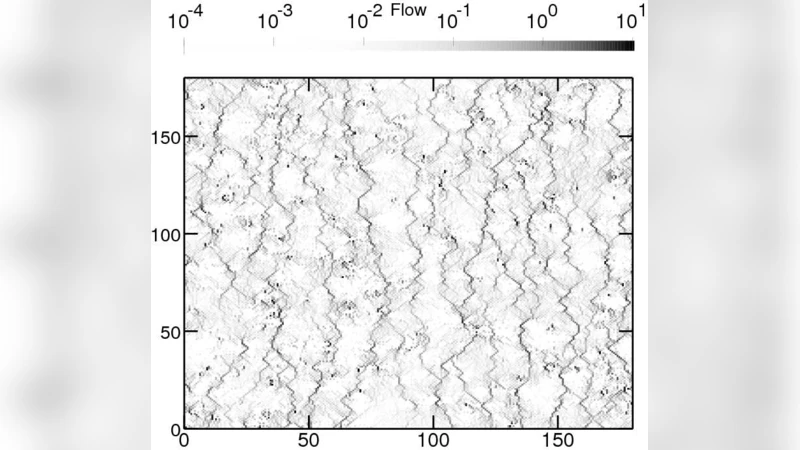
A recent experiment has considered the effective permeability of two-phase flow of air and a water-glycerol solution under steady-state conditions in a two-dimensional model porous medium, and found a power law dependence with respect to capillary number. Running simulations on a two-dimensional network model a similar power law is found, for high viscosity contrast as in the experiment and also for viscosity matched fluids. Two states are found, one with stagnant clusters and one without. For the stagnant cluster state, a power law exponent 0.50 is found for viscosity matched fluids and 0.54 for large viscosity contrast. When there are no stagnant clusters the exponent depends on saturation and varies within the range of 0.67 - 0.80.
💡 Research Summary
The paper investigates how two‑phase flow in a porous medium controls the effective permeability under steady‑state conditions. Using a two‑dimensional glass micro‑model, the authors performed experiments with air and a water‑glycerol solution, systematically varying the capillary number (Ca) by changing the flow rate. They measured the pressure drop and calculated the effective permeability (k_eff). The experimental data reveal a power‑law relationship k_eff ∝ Ca^γ. For fluids with a large viscosity contrast (air versus water‑glycerol) the exponent γ is about 0.54, while for viscosity‑matched fluids it is approximately 0.50.
To interpret these findings, the authors constructed a two‑dimensional pore‑network model that mimics the geometry of the experimental device. Each node represents a pore with a random radius and contact angle, while each bond represents a throat. Flow through a throat follows the Hagen–Poiseuille law modified by a capillary pressure term derived from the Young–Laplace equation. By solving the coupled pressure equations iteratively, they obtained steady‑state flux distributions for a wide range of Ca and saturations (S).
The simulations uncover two distinct flow regimes. In the “stagnant‑cluster” regime, which appears at low Ca, a subset of pores becomes effectively blocked, forming isolated clusters that do not contribute to the bulk flow. The presence of these clusters reduces the overall conductance and yields a scaling exponent γ that remains close to the experimental values (0.50–0.54) regardless of viscosity contrast. In the “no‑cluster” regime, attained at higher Ca, all pores participate in the flow. Here the exponent γ depends on saturation: as S approaches 0.5 the exponent rises to values between 0.67 and 0.80, indicating a stronger sensitivity of k_eff to Ca when the two phases are more evenly distributed.
The authors argue that the transition between regimes is governed primarily by the balance between capillary forces and viscous forces. At low Ca, capillary forces dominate, creating large pressure differences across throats that can trap fluid in certain pores, leading to stagnant clusters. As Ca increases, viscous forces overcome capillary barriers, homogenizing the flow and eliminating the clusters. The fact that both high‑contrast and viscosity‑matched fluids exhibit similar exponents in the stagnant‑cluster regime suggests that capillary forces, rather than viscosity contrast, control the scaling in this limit.
By comparing experimental measurements with network‑model predictions, the study validates the model’s ability to reproduce the observed scaling behavior. The work therefore provides a robust framework for predicting effective permeability in two‑phase steady‑state flow, with implications for enhanced oil recovery, groundwater remediation, and the design of microfluidic devices. The identified power‑law exponents and the characterization of the two regimes offer practical guidelines for engineers: when operating at low Ca, one should expect a relatively weak dependence of permeability on flow rate (γ≈0.5), whereas at higher Ca the dependence becomes stronger and is modulated by saturation (γ≈0.7–0.8). This insight helps in optimizing injection strategies and in interpreting field‑scale measurements where direct observation of pore‑scale dynamics is impossible.