On the axioms for adhesive and quasiadhesive categories
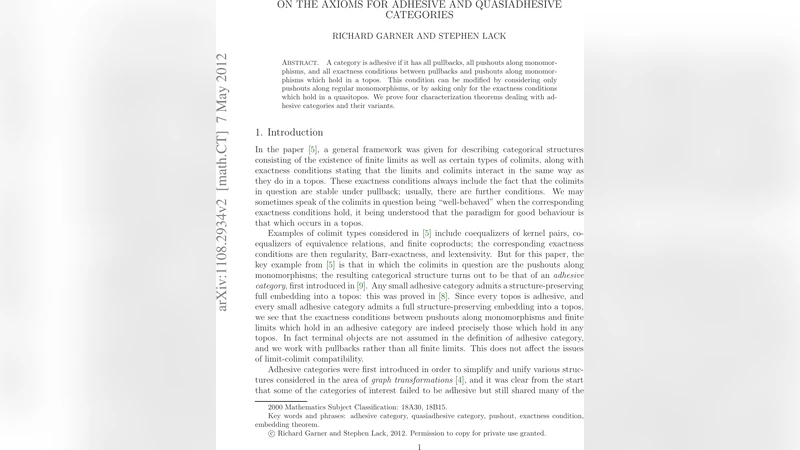
A category is adhesive if it has all pullbacks, all pushouts along monomorphisms, and all exactness conditions between pullbacks and pushouts along monomorphisms which hold in a topos. This condition can be modified by considering only pushouts along regular monomorphisms, or by asking only for the exactness conditions which hold in a quasitopos. We prove four characterization theorems dealing with adhesive categories and their variants.
💡 Research Summary
The paper revisits the notions of adhesive and quasi‑adhesive categories, providing a refined set of axioms and four main theorems that clarify their relationship to toposes and quasitoposes. Traditionally, an adhesive category is defined by the existence of all pullbacks, pushouts along monomorphisms, and a collection of exactness conditions that hold in any topos. The authors propose two orthogonal weakenings of this definition. First, they restrict the class of morphisms for which pushouts are required from all monomorphisms to regular monomorphisms. Second, they relax the exactness requirements from the full topos‑level conditions to those that hold in a quasitopos. Combining these two choices yields four variants: (i) adhesive (full monomorphisms, van Kampen condition), (ii) rm‑adhesive (regular monomorphisms, van Kampen), (iii) rm‑quasiadhesive (regular monomorphisms, pushouts that are stable under pullback and are themselves pullbacks), and (iv) a “stable‑plus‑pullback” variant where pushouts along all monomorphisms are merely stable and pullbacks.
Theorem A establishes that the “stable + pullback” condition is equivalent to the traditional van Kampen condition, so a category with pullbacks is adhesive precisely when its pushouts along monomorphisms are both stable and pullbacks. This gives a more elementary characterization that bypasses the original van Kampen definition.
Theorem B characterizes the gap between rm‑adhesive and rm‑quasiadhesive categories. Both require pushouts along regular monomorphisms that are stable and pullbacks, but rm‑adhesive additionally demands that regular subobjects be closed under binary union (i.e., effective unions exist). This closure condition is necessary and sufficient: without it, a category may be rm‑quasiadhesive but fail to be rm‑adhesive (for example, the category of sets equipped with a binary relation).
Theorem C and Theorem D are embedding theorems. For a small category C with all pullbacks and pushouts along regular monomorphisms, C is rm‑adhesive exactly when there exists a full, structure‑preserving embedding of C into a topos. Similarly, C is rm‑quasiadhesive exactly when it embeds fully into a quasitopos. The forward directions are immediate because every topos is adhesive and every quasitopos is rm‑quasiadhesive. The converse directions are proved by exploiting the exactness conditions (regularity, Barr‑exactness, lex‑extensivity) that characterize toposes and quasitoposes, together with the closure of regular subobjects under unions.
A central technical tool introduced is the notion of an “adhesive morphism”. A morphism m is pre‑adhesive if pushouts along m exist, are stable under pullback, and are pullbacks. It is adhesive if every pullback of m is pre‑adhesive. The authors show that adhesive morphisms are closed under composition, stable under pushout, and that binary unions of subobjects are effective whenever at least one of the subobjects is adhesive. This framework allows the authors to treat the class of morphisms that enjoy good pushout behaviour uniformly, rather than fixing a particular class a priori.
The paper also clarifies the relationship between regular monomorphisms and ordinary monomorphisms, and how the van Kampen property of pushouts distinguishes the topos‑level exactness from the weaker quasitopos‑level exactness. By systematically separating the requirements on morphism classes and exactness conditions, the authors provide a unified perspective that both generalizes earlier results (e.g., the embedding of small adhesive categories into toposes) and resolves ambiguities in the terminology (showing that “quasi‑adhesive” is a misnomer when the van Kampen condition is imposed).
Overall, the work deepens the categorical understanding of how pushouts and pullbacks interact, offers clean characterizations of adhesive‑type categories, and supplies practical criteria (regular subobject closure, stability of pushouts) for recognizing when a given category can be faithfully represented inside a topos or quasitopos. This has potential applications in graph transformation theory, model theory, and any domain where well‑behaved colimits are essential.
Comments & Academic Discussion
Loading comments...
Leave a Comment