Spectral analysis of communication networks using Dirichlet eigenvalues
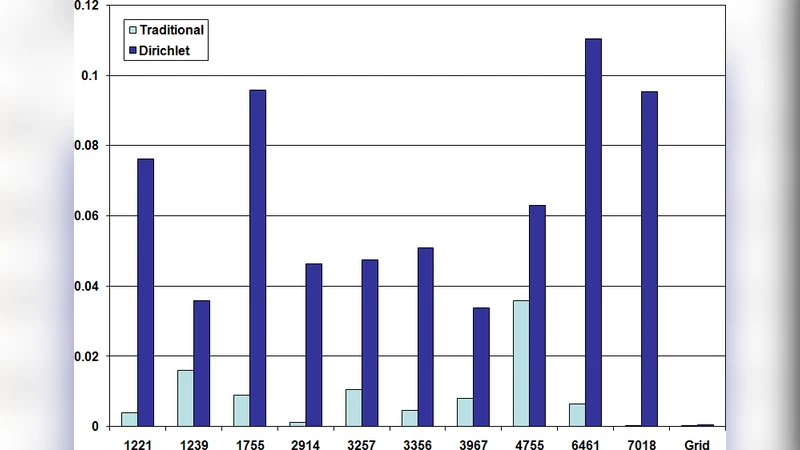
The spectral gap of the graph Laplacian with Dirichlet boundary conditions is computed for the graphs of several communication networks at the IP-layer, which are subgraphs of the much larger global IP-layer network. We show that the Dirichlet spectral gap of these networks is substantially larger than the standard spectral gap and is likely to remain non-zero in the infinite graph limit. We first prove this result for finite regular trees, and show that the Dirichlet spectral gap in the infinite tree limit converges to the spectral gap of the infinite tree. We also perform Dirichlet spectral clustering on the IP-layer networks and show that it often yields cuts near the network core that create genuine single-component clusters. This is much better than traditional spectral clustering where several disjoint fragments near the periphery are liable to be misleadingly classified as a single cluster. Spectral clustering is often used to identify bottlenecks or congestion; since congestion in these networks is known to peak at the core, our results suggest that Dirichlet spectral clustering may be better at finding bona-fide bottlenecks.
💡 Research Summary
The paper investigates the use of Dirichlet eigenvalues—eigenvalues of the graph Laplacian with Dirichlet (zero‑value) boundary conditions—to obtain a more faithful spectral characterization of large communication networks when only finite sub‑graphs are available. Traditional spectral analysis based on the normalized Laplacian’s second smallest eigenvalue (the spectral gap) suffers from a boundary effect: in finite truncations of an infinite regular tree the spectral gap shrinks to zero as the truncation grows, even though the infinite tree has a positive gap. The authors prove that, for finite (d)-regular trees of depth (L), the Dirichlet spectral gap (the smallest non‑zero eigenvalue of the truncated Laplacian (L_D) that excludes boundary nodes) converges to the true infinite‑tree gap (\lambda = 1 - 2\sqrt{d-1}/d) as (L\to\infty). The proof constructs azimuthally symmetric eigenvectors, derives a linear recurrence, solves the characteristic equation, and applies the Dirichlet boundary conditions at the leaves and the root, showing that the smallest admissible angle (\alpha) tends to zero, yielding the desired limit.
Motivated by this theoretical result, the authors compute both the traditional and Dirichlet spectral gaps for ten real‑world IP‑layer subnetworks drawn from the Rocketfuel dataset (sizes ranging from 121 to 10 152 nodes). Degree‑1 nodes, which are artifacts of the measurement process and likely connect to the larger Internet, are treated as the boundary. Across all datasets, the Dirichlet gap is dramatically larger—often an order of magnitude—than the traditional gap, and it does not decay with increasing network size, unlike the traditional gap which consistently shrinks. This suggests that Dirichlet eigenvalues capture the expansion properties of the underlying infinite network even when only a finite portion is observed.
The paper also explores the practical impact on spectral clustering. Traditional spectral clustering (using the second eigenvector of the full Laplacian) frequently isolates peripheral “whisker” subtrees, producing clusters composed of many disconnected fragments and yielding misleading interpretations of network bottlenecks. By contrast, Dirichlet spectral clustering—performed with the top two eigenvectors of (L_D)—produces cuts near the network core, resulting in far fewer disconnected components while maintaining comparable Cheeger ratios. Empirical results show a substantial reduction (30‑70 %) in the average number of components per cut, indicating that Dirichlet clustering more accurately identifies genuine bottlenecks, which are known to occur in the core of large communication networks.
In summary, the authors demonstrate that Dirichlet eigenvalues provide a robust tool for (i) estimating the true expansion (spectral gap) of large networks from limited observations, and (ii) improving the quality of spectral clustering by avoiding boundary‑induced artifacts. The work has immediate implications for network design, traffic engineering, and fault diagnosis, where identifying core bottlenecks is critical. Future directions include extending the approach to irregular, dynamic, and multilayer graphs, and developing scalable algorithms for computing Dirichlet spectra on massive networks.
Comments & Academic Discussion
Loading comments...
Leave a Comment