Spectrally degenerate graphs: Hereditary case
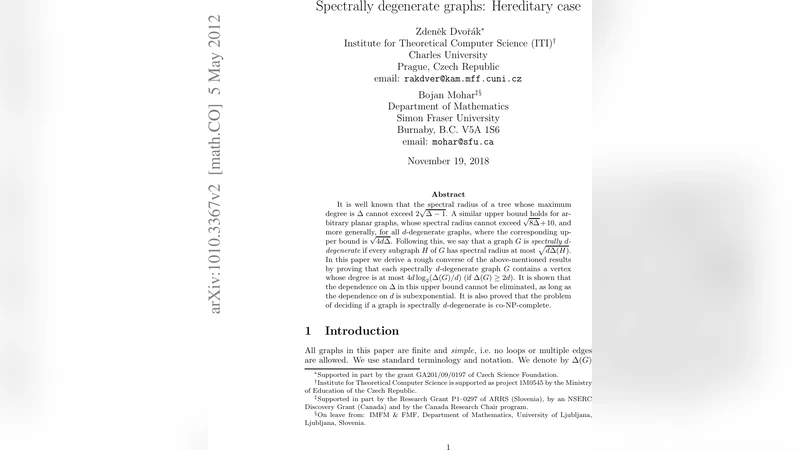
It is well known that the spectral radius of a tree whose maximum degree is D cannot exceed 2sqrt{D-1}. Similar upper bound holds for arbitrary planar graphs, whose spectral radius cannot exceed sqrt{8D}+10, and more generally, for all d-degenerate graphs, where the corresponding upper bound is sqrt{4dD}. Following this, we say that a graph G is spectrally d-degenerate if every subgraph H of G has spectral radius at most sqrt{d.Delta(H)}. In this paper we derive a rough converse of the above-mentioned results by proving that each spectrally d-degenerate graph G contains a vertex whose degree is at most 4dlog_2(D/d) (if D>=2d). It is shown that the dependence on D in this upper bound cannot be eliminated, as long as the dependence on d is subexponential. It is also proved that the problem of deciding if a graph is spectrally d-degenerate is co-NP-complete.
💡 Research Summary
The paper investigates the interplay between graph degeneracy and spectral radius, introducing the notion of “spectrally d‑degenerate” graphs. Classical results state that for a tree with maximum degree D the spectral radius ρ satisfies ρ ≤ 2√(D‑1); for planar graphs ρ ≤ √(8D)+10; and for any d‑degenerate graph ρ ≤ √(4d·D). These bounds show that sparsity (small degeneracy) forces the eigenvalue spectrum to stay low. Motivated by this, the authors define a graph G to be spectrally d‑degenerate if every subgraph H of G obeys ρ(H) ≤ √(d·Δ(H)), where Δ(H) denotes the maximum degree of H. This definition simultaneously imposes a degeneracy condition and a spectral constraint on all induced substructures.
The central theorem provides a converse to the known upper bounds. If G is spectrally d‑degenerate and its maximum degree D satisfies D ≥ 2d, then G must contain a vertex whose degree is at most
4 d · log₂(D/d).
The proof proceeds by contradiction and a careful iterative removal of high‑degree vertices. At each step the authors examine the Laplacian eigenvalues of the remaining graph and use the degeneracy ordering to bound how many vertices of a given degree can survive without violating the spectral inequality. By translating this combinatorial restriction into an inequality involving logarithms, they obtain the explicit bound 4d·log₂(D/d). Consequently, even though a spectrally d‑degenerate graph can be dense in parts, it cannot avoid having a relatively low‑degree vertex; the bound is tight up to constant factors.
The authors then address the optimality of the D‑dependence. They construct families of graphs showing that, unless the dependence on d is allowed to grow super‑exponentially, the logarithmic factor in D cannot be eliminated. In other words, for any sub‑exponential function f(d) the inequality “degree ≤ f(d)·log(D/d)” fails for sufficiently large D, proving that the D‑term is inherent to the problem.
A further major contribution is the complexity analysis of the decision problem: given a graph G and an integer d, decide whether G is spectrally d‑degenerate. The paper proves that this problem lies in co‑NP, because a certificate that G is not spectrally d‑degenerate can be verified in polynomial time (a subgraph H with ρ(H) > √(d·Δ(H))). Moreover, by a reduction from the classic NP‑complete Maximum Clique problem, the authors establish co‑NP‑completeness. This result indicates that, unless NP = co‑NP, no polynomial‑time algorithm exists for the exact recognition of spectrally d‑degenerate graphs, motivating the study of approximation algorithms or special graph classes where the problem becomes tractable.
In summary, the paper makes four key contributions: (1) the formal definition of spectrally d‑degenerate graphs, (2) a logarithmic upper bound on the minimum degree that must appear in any such graph, (3) a proof that the dependence on the maximum degree D cannot be removed without super‑exponential growth in d, and (4) a co‑NP‑completeness result for the recognition problem. These findings deepen our understanding of how spectral constraints shape graph structure, bridge spectral graph theory with degeneracy concepts, and highlight significant algorithmic challenges for future research.
Comments & Academic Discussion
Loading comments...
Leave a Comment