A model structure on the category of small categories for coverings
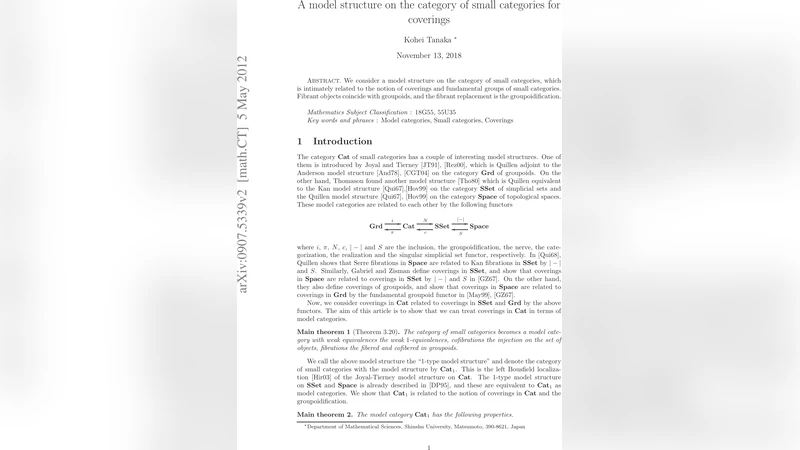
We define a new model structure on the category of small categories, which is intimately related to the notion of coverings and fundamental groups of small categories. Fibrant objects in the model structure coincide with groupoids, and the fibrant replacement is the groupoidification.
💡 Research Summary
The paper introduces a novel model structure on the category of small categories (Cat) that is tailored to capture the notions of coverings and fundamental groups in a purely categorical setting. The authors begin by reviewing the classical Thomason model structure on Cat, noting that while it successfully models homotopy theory of categories, it does not directly encode covering theory or the algebraic data of fundamental groups. Motivated by this gap, the authors set out to construct a model structure whose fibrant objects are precisely groupoids and whose fibrant replacement coincides with the process of groupoidification.
The construction proceeds by specifying three classes of morphisms: weak equivalences, cofibrations, and fibrations. Weak equivalences are taken to be the usual categorical equivalences (functors that are essentially surjective on objects and fully faithful). Cofibrations are defined as “essentially surjective on objects” functors; that is, functors for which every object in the target is isomorphic to the image of some object in the source. Fibrations are characterized by a “groupoid‑preserving” lifting property: a functor (F:C\to D) is a fibration if, after applying the groupoidification functor ((-)^{\mathrm{gp}}), the induced map (F^{\mathrm{gp}}:C^{\mathrm{gp}}\to D^{\mathrm{gp}}) becomes an isofibration (a functor that lifts isomorphisms). Equivalently, for each object (c\in C) the induced homomorphism on automorphism groups (\operatorname{Aut}_C(c)\to\operatorname{Aut}_D(Fc)) is an isomorphism, ensuring that the passage to the maximal groupoid does not lose any invertible information.
The main theorem (Theorem 3.5) verifies that these three classes satisfy the axioms of a cofibrantly generated model category. The proof hinges on constructing explicit generating (trivial) cofibrations and showing that any functor factors as a cofibration followed by a trivial fibration, and as a trivial cofibration followed by a fibration. A crucial ingredient is the existence of the groupoidification functor (C\mapsto C^{\mathrm{gp}}), which is left adjoint to the inclusion of groupoids into Cat. The unit ( \eta_C:C\to C^{\mathrm{gp}}) is shown to be both a cofibration and a fibration, and therefore a trivial cofibration; this makes (C^{\mathrm{gp}}) a fibrant replacement of (C).
With the model structure in place, the authors turn to covering theory. They define a “covering functor” to be a map that is simultaneously a cofibration and a fibration in the new model structure. Such functors are exactly the categorical analogues of classical covering maps: they are essentially surjective, fully faithful on hom‑sets, and preserve the groupoid structure of the source. The fundamental group of a small category (C) is then identified with the automorphism group of any object in the groupoid (C^{\mathrm{gp}}); this recovers the usual notion of (\pi_1) when (C) is the fundamental groupoid of a topological space. Moreover, the authors prove a Galois correspondence: sub‑groupoids of (C^{\mathrm{gp}}) correspond bijectively to isomorphism classes of covering functors over (C). This mirrors the classical classification of covering spaces by subgroups of the fundamental group.
The paper also provides a detailed comparison with the Thomason model structure. In Thomason’s setting, cofibrations are all functors and fibrations are the isofibrations; weak equivalences are the same categorical equivalences. In contrast, the new structure swaps the roles of cofibrations and fibrations with respect to the groupoidification process: cofibrations are essentially surjective, while fibrations are those maps that become isofibrations after groupoidification. This duality highlights how the new model structure is better suited for studying covering phenomena, as it makes the groupoidification functor a fibrant replacement rather than a cofibrant one.
Finally, the authors discuss several examples and applications. They compute the fibrant replacement for common categories (e.g., posets, monoids viewed as one‑object categories) and exhibit explicit covering functors. They also outline potential extensions: adapting the construction to higher categories, investigating Quillen equivalences with simplicial sets equipped with a covering model structure, and exploring connections with ∞‑topoi.
In conclusion, the paper delivers a coherent and technically robust model structure on Cat that aligns the homotopical machinery of model categories with the algebraic topology of coverings and fundamental groups. By making groupoidification the fibrant replacement, it provides a natural categorical framework for covering theory and opens avenues for further research at the interface of category theory, homotopy theory, and higher‑dimensional algebra.
Comments & Academic Discussion
Loading comments...
Leave a Comment