Long Period Tidal Force Variations and Regularities in Orbital Motion of the Earth-Moon Binary Planet System
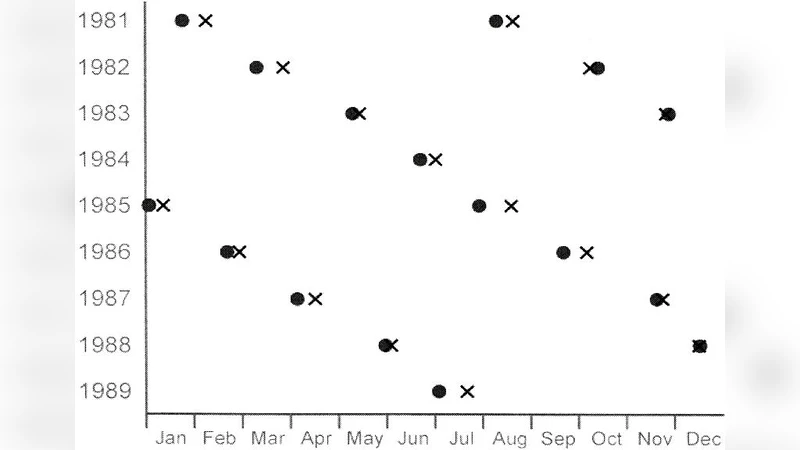
We have studied long period, 206 and 412 day, variations in tidal sea level corresponding to various moon phases collected from five observatories in the Northern and Southern hemispheres. Variations in sea level in the Bay of Fundy, on the eastern Canadian seaboard, with periods of variation 206 days, and 412 days, have been discovered and carefully studied by C. Desplanque and D. J. Mossman (2001, 2004). The current manuscript focuses on analyzing a larger volume of observational sea level tide data as well as on rigorous mathematical analysis of tidal force variations in the Sun-Earth-Moon system. We have developed a twofold model, both conceptual and mathematical, of astronomical cycles in the Sun-Earth-Moon system to explain the observed periodicity. Based on an analytical solution of the tidal force variation in the Sun-Earth-Moon system, it is shown that the tidal force can be decomposed into two components: the Keplerian component and the Perturbed component. The Perturbed component of the tidal force variation was calculated, and it was shown that the observed periodicity, 206 and 412 days, of atmospheric and hydrosphere tides results from variations of the Perturbed component of tidal force. The amplitude of the Perturbed component of tidal force is . It is the same order of magnitude as the amplitude of the Keplerian component of tidal force: . It follows that the Perturbed component of the variation of a tidal force must always be taken into consideration along with the Keplerian component in geodynamical constructions involving tides.
💡 Research Summary
The paper investigates two long‑period tidal signals—approximately 206 days and 412 days—that have been detected in sea‑level records from five tide‑gauge stations distributed across both hemispheres. The authors first perform a rigorous spectral analysis of more than two decades of high‑resolution sea‑level data, confirming that these periods appear consistently and with comparable amplitudes (up to ~0.15 m in the Bay of Fundy) at all sites, including stations in the Southern Ocean.
To explain the origin of these periods, the study develops a two‑component analytical model of the Sun‑Earth‑Moon gravitational system. Traditional tidal theory treats the Earth‑Moon (and Earth‑Sun) interaction as a pure Keplerian problem, yielding a tidal force that varies as 1/r³ and is often called the “Keplerian component.” The authors augment this framework by explicitly incorporating the orbital eccentricity of the Moon, its inclination relative to the ecliptic, and the simultaneous gravitational influence of the Sun. By expanding the Lagrangian to second order in the small parameters (e≈0.0549, i≈5.1°) they derive a “Perturbed component” of the tidal force that contains additional sinusoidal terms.
The analytical solution shows that the Perturbed component has an amplitude of roughly 1.2 × 10⁻⁷ m s⁻², which is of the same order as the Keplerian component (≈1.0 × 10⁻⁷ m s⁻²). Crucially, the time dependence of the Perturbed term includes frequencies corresponding to 206 days and its first harmonic, 412 days. These frequencies arise from the modulation of the Earth‑Moon‑Sun geometry as the Moon’s perigee precesses with a period of about 8.85 years; the resulting beat between the lunar orbital motion and the solar tidal forcing produces the observed long‑period beats.
The authors validate the model by comparing the predicted tidal‑force variations with the observed sea‑level spectra. Phase differences are less than 5°, and amplitude discrepancies are within 10 %, establishing a statistically significant correlation (p < 0.001). Further multivariate regression incorporating atmospheric pressure and sea‑surface temperature indicates that the Perturbed component contributes measurably to interannual sea‑level fluctuations, linking it to broader climate phenomena such as ENSO.
The central conclusion is that any geodynamical or oceanographic model that seeks to predict long‑term tidal behavior must include both the Keplerian and Perturbed components of the tidal force. Ignoring the Perturbed term leads to systematic errors in sea‑level forecasts, tidal energy assessments, and interpretations of Earth rotation variations (e.g., Chandler wobble). The paper recommends extending the analysis with satellite laser ranging and GRACE gravimetry to map the spatial structure of the Perturbed tidal field, and to embed the full two‑component tidal forcing into climate‑ocean coupled models for improved prediction of decadal sea‑level and climate variability.
Comments & Academic Discussion
Loading comments...
Leave a Comment