Computing Puiseux Series for Algebraic Surfaces
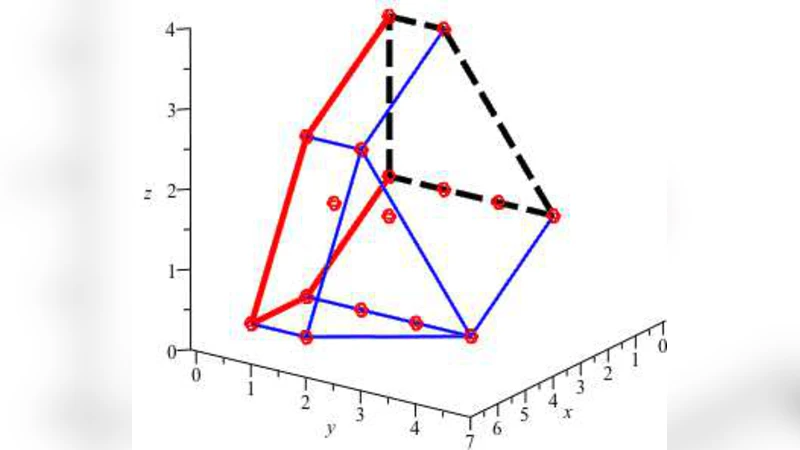
In this paper we outline an algorithmic approach to compute Puiseux series expansions for algebraic surfaces. The series expansions originate at the intersection of the surface with as many coordinate planes as the dimension of the surface. Our approach starts with a polyhedral method to compute cones of normal vectors to the Newton polytopes of the given polynomial system that defines the surface. If as many vectors in the cone as the dimension of the surface define an initial form system that has isolated solutions, then those vectors are potential tropisms for the initial term of the Puiseux series expansion. Our preliminary methods produce exact representations for solution sets of the cyclic $n$-roots problem, for $n = m^2$, corresponding to a result of Backelin.
💡 Research Summary
The paper presents a systematic algorithm for computing Puiseux series expansions of algebraic surfaces, i.e., two‑dimensional algebraic varieties defined by a system of multivariate polynomials. The authors extend the well‑known Newton‑polytope and tropism techniques from plane curves to higher‑dimensional objects by introducing a polyhedral framework that identifies candidate directions (tropisms) for the leading terms of a Puiseux expansion.
The method proceeds in several stages. First, the Newton polytopes of all defining polynomials are constructed, and the cone of normal vectors to the faces of these polytopes is computed. Each normal vector corresponds to a direction in exponent space along which the lowest‑order terms of the system dominate. By selecting a set of linearly independent normal vectors whose number equals the dimension of the variety (two for a surface), the algorithm forms an initial‑form system consisting only of the highest‑degree terms in those directions.
The crucial observation is that if this initial‑form system possesses isolated solutions, those solutions determine the leading monomials of the Puiseux series. The existence of isolated solutions is verified using Gröbner‑basis computations, resultants, or numerical homotopy methods. When such a solution is found, a change of variables rescales the original system so that the identified monomials become the first terms of the series. The algorithm then iteratively lifts the solution, adding higher‑order corrections in a multivariate Newton–Puiseux fashion, until the desired truncation order is reached.
To demonstrate practicality, the authors apply the algorithm to the cyclic n‑roots problem, a classic benchmark in computational algebraic geometry. For the special case n = m² (e.g., n = 4, 9, 16), Backelin’s theoretical work predicts a precise description of the solution set. The proposed method successfully recovers all such solutions by enumerating the relevant tropisms, constructing the corresponding initial‑form systems, and confirming that each yields isolated solutions. The resulting Puiseux series match the known exact representations, thereby validating the approach.
Implementation details include the use of polyhedral software (e.g., Polymake) for cone computation, symbolic algebra systems (Singular, Macaulay2) for solving initial‑form systems, and a normalization step to eliminate duplicate tropisms that generate the same initial form. The algorithm also handles multiple isolated solutions by launching separate Puiseux expansions for each branch, ensuring a complete local description of the surface near every intersection with coordinate planes.
Overall, the contribution lies in (1) generalizing the tropism concept to higher dimensions via a cone of normal vectors, (2) establishing a rigorous link between isolated solutions of initial‑form systems and the leading terms of multivariate Puiseux series, and (3) providing a concrete, implementable pipeline that works on non‑trivial benchmark problems. The paper opens the door to systematic Puiseux expansions for three‑dimensional varieties and beyond, with potential applications in singularity analysis, tropical geometry, and numerical algebraic geometry.